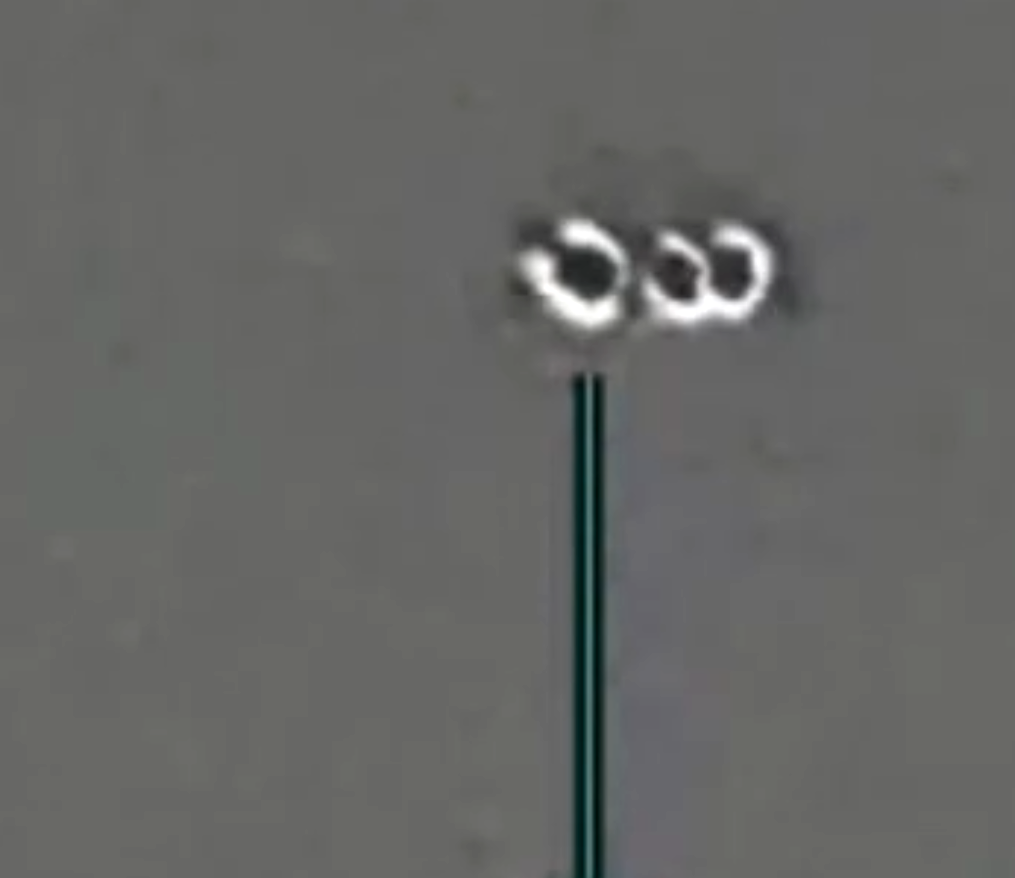
07 DOD 111689142 Multi Lobed Jump Frame Assessment
The captured frame shows a high-contrast, multi-lobed bright pattern near the top of a vertical sensor/reticle line. Three bright loop-like regions are visible, with darker interior pockets and a surrounding gray smear. The capture is visually striking, but the vertical...
UAPs.world keeps this analysis report connected to its original source path, release context, and related analysis path so readers can inspect the evidence trail directly.
Analysis report summary
This analysis page exposes the report substance directly for readers and crawlers, while the research viewer remains the place for source inspection, frame review, and follow-up work.
Observation
The captured frame shows a high-contrast, multi-lobed bright pattern near the top of a vertical sensor/reticle line. Three bright loop-like regions are visible, with darker interior pockets and a surrounding gray smear. The capture is visually striking, but the vertical reticle or overlay element intrudes through the lower part of the frame and complicates interpretation. The approved question asks whether this is the first frame before a quick jump or possible cut frames. The still image alone cannot establish a cut or jump. It does establish that this timestamp is worth adjacent-frame stepping because the shape looks like a discrete transition point rather than an ordinary single-dot contact.
Hypothesis To Test
Two hypotheses should be tested: 1. Transition-frame hypothesis The multi-lobed shape may be a frame where the object changes state, moves rapidly, or passes through a sensor-processing boundary. 2. Controlled-craft morphology hypothesis The repeated bright lobes may represent multiple reflective/thermal structures, a field envelope with several hot edges, or a controlled craft body partly obscured by bloom. Competing explanations remain strong: reticle overlap, sharpening, compression, bloom, frame interpolation, or a fast-moving conventional object can produce multi-lobed artifacts.
Why It Matters
If adjacent frames show a rapid onset, disappearance, or geometry change around 33.253s, this lead could support a motion/state-transition analysis. If the same lobes remain locked to the reticle, compression grid, or zoom behavior, then the apparent morphology should be downgraded as imaging artifact.
Working Assessment
Assessment: high-priority frame-step lead. The still frame supports a multi-lobed source signature and a possible transition point, but it does not yet establish a controlled craft or cut-frame event. Resolve by stepping frames before and after 33.253s with the same viewer state.
Classify this source for 2 points, mark useful or misleading records for 1 point, or submit observations for curator review. Public contribution points progress through Observer, Analyst I, Analyst II, Case Builder, and Archivist and can unlock field desk themes.