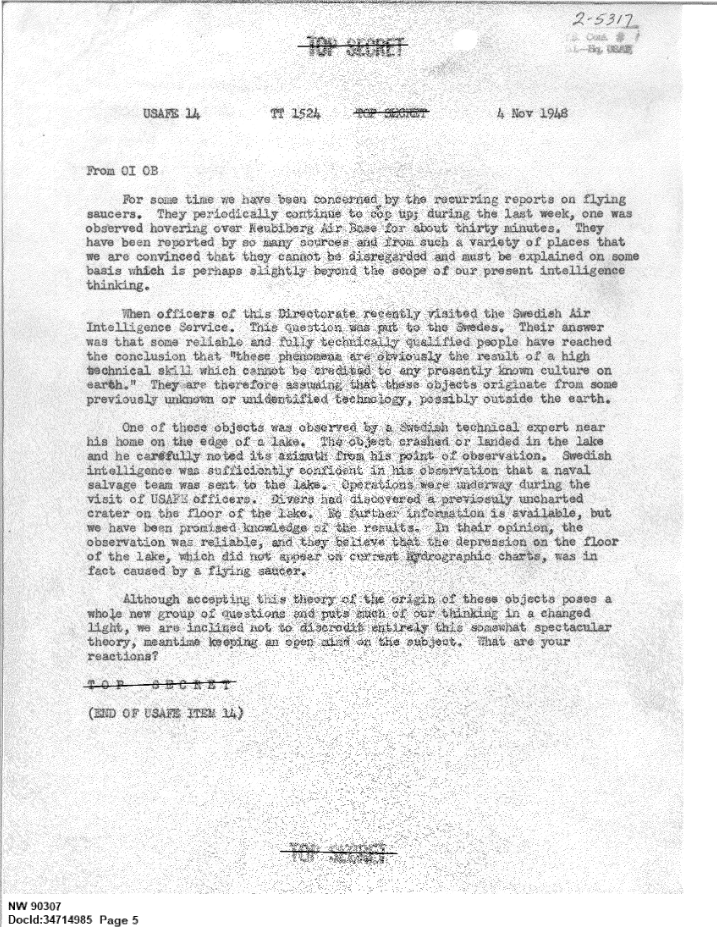
The packet is short but unusually direct. It combines a cover/filing layer, a 5 September 1948 unidentified-aircraft sighting off Holland, and a 4 November 1948 USAFE intelligence discussion of recurring "flying saucer" reports. The strongest page is page 5, where USAFE...
UAPs.world keeps this analysis report connected to its original source path, release context, and related analysis path so readers can inspect the evidence trail directly.
Analysis report summary
This analysis page exposes the report substance directly for readers and crawlers, while the research viewer remains the place for source inspection, frame review, and follow-up work.
Observation
The packet is short but unusually direct. It combines a cover/filing layer, a 5 September 1948 unidentified-aircraft sighting off Holland, and a 4 November 1948 USAFE intelligence discussion of recurring "flying saucer" reports. The strongest page is page 5, where USAFE describes the reports as too numerous and varied to disregard, relays a Swedish Air Intelligence view that some reliable technical observers considered the objects beyond known terrestrial culture, and records a reported lake impact or landing investigated by Swedish salvage divers.
Hypothesis To Test
The non-human hypothesis is source-relevant because the document itself preserves that fork as an intelligence question, not because the packet proves it. The key test is whether the Swedish-lake claim and USAFE's open-ended reaction can be corroborated by adjacent Swedish, USAFE, Air Intelligence, or Project Sign/Grudge records. Without that corroboration, the document is best treated as evidence of serious official consideration, not confirmation of origin.
Why It Matters
This report belongs beside the Sandia green-fireball packet as a historical institutional-pattern document. It does not give a clean modern sensor chain, but it preserves the moment where military intelligence appears to ask whether conventional aircraft, rocket-assisted jets, unknown foreign technology, and non-earth-origin technology all have to remain live branches. The page 4 Holland case is a conventional/advanced-aircraft fork; page 5 is the stronger non-human-hypothesis fork.
Working Assessment
Assessment: high-value historical intelligence note, not standalone proof. The important claim is not "USAFE proved saucers were extraterrestrial." The source-backed claim is narrower and more useful: by November 1948, USAFE had collected enough recurring saucer reports to say they could not be disregarded, and it preserved a Swedish Air Intelligence account in which technically qualified observers considered unknown or possibly extra-terrestrial technology as a live explanation.
Classify this source for 2 points, mark useful or misleading records for 1 point, or submit observations for curator review. Public contribution points progress through Observer, Analyst I, Analyst II, Case Builder, and Archivist and can unlock field desk themes.