C110 D098 Utah and Montana Film Analysis Case File
The 1953 Naval Photographic Interpretation Center report is a serious early attempt to turn the 1950 Montana and July 2, 1952 Utah films into measurable evidence. Its analysts used stop-frame projection, position overlays, densitometry, terrestrial controls where available,...
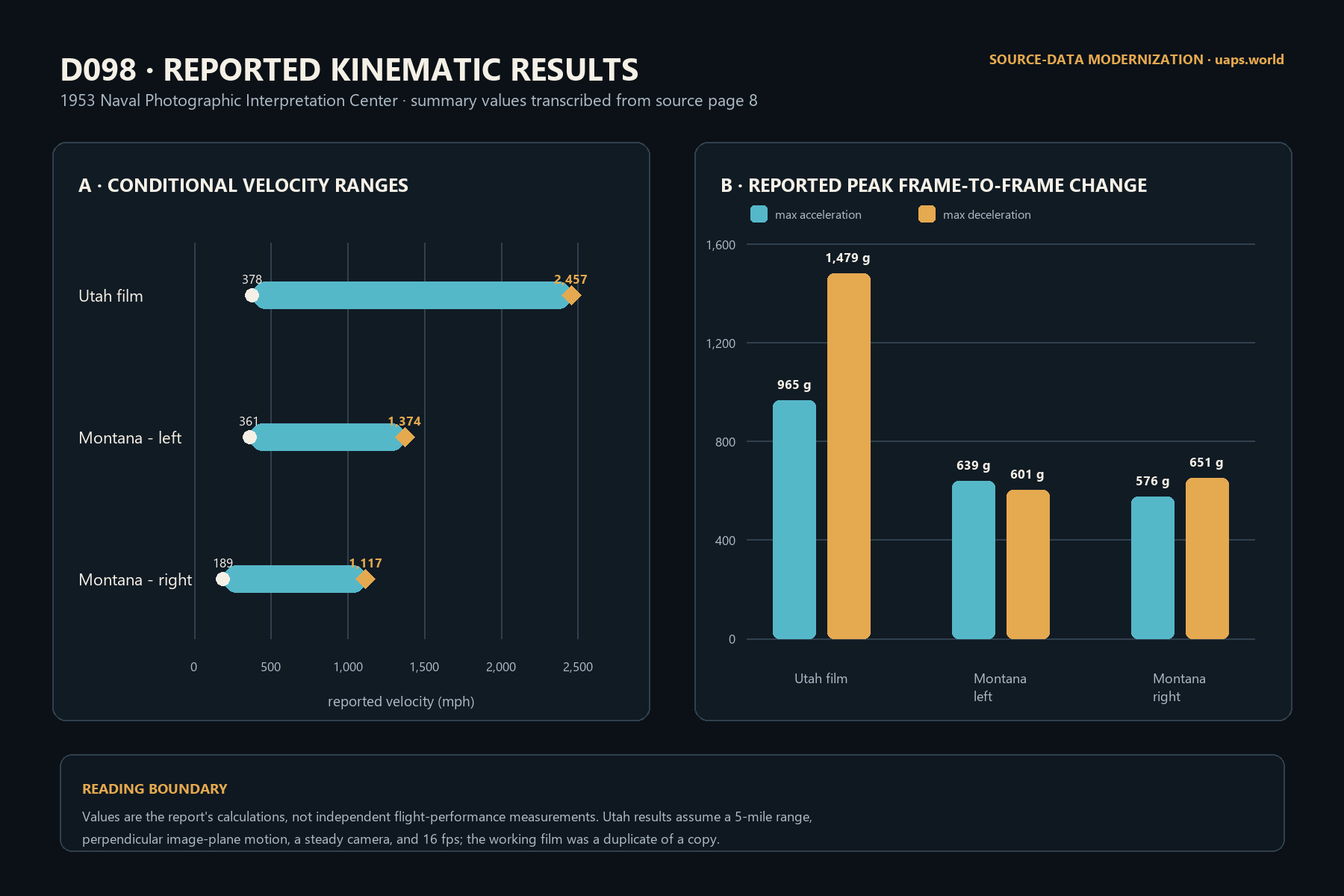
The 1953 Naval Photographic Interpretation Center report is a serious early attempt to turn the 1950 Montana and July 2, 1952 Utah films into measurable evidence. Its analysts used stop-frame projection, position overlays, densitometry, terrestrial controls where available, relative image-size comparison, and conditional velocity calculations. They explicitly removed transient colored spots and water marks from consideration and documented several limitations in their own process. The report supports a strong historical conclusion: trained government imagery analysts judged the films worthy of sustained quantitative study and reported behavior they could not identify as natural phenomena or commonly known manufactured objects. It supports a weaker physical conclusion. The most dramatic speeds and accelerations depend on an arbitrary five-mile range, assumed perpendicular motion, a steady camera, 16-frame-per-second timing, and degraded duplicate film. Those numbers are evidence of the analysts' model output, not verified vehicle performance.
UAPs.world keeps this analysis report connected to its original source path, release context, and related analysis path so readers can inspect the evidence trail directly.
Analysis report summary
This analysis page exposes the report substance directly for readers and crawlers, while the research viewer remains the place for source inspection, frame review, and follow-up work.
Source Basis
Pages 3-5 define the two film cases, preservation history, plotting method, densitometer procedure, and measurement limitations. - Pages 6-9 contain the interpretive answers, conditional size and motion estimates, expert consultation, caveats, and proposed follow-up. - Page 10 begins the chart set with parallel density and image-magnitude traces intended to show a possible relationship. - Pages 11-15 preserve Utah and Montana density plots, including multi-image traces and an averaged Utah series. - Pages 16-22 preserve hand-plotted position and formation paths. - Page 23 closes the enclosure set with another density trace. The companion transcript is a search aid only: it is marked partial and low quality,...
Observation
The report's source-visible observations are narrower than its most dramatic calculations: - Pages 4-6 describe fairly constant blue-white color, changing image size and luminosity, three persistent Utah groups, and apparent merging/splitting at roughly 25-frame intervals. - Page 7 describes the images as oblate or disc-like and gives a conditional 16-to-98-foot size range based on the five-mile assumption. - Page 9 reports abrupt apparent direction changes, objects remaining motionless while others moved, and objects disappearing within the field of view. Those statements establish persistent, structured image behavior in the analysts' working copy. They do not by themselves distinguish self-luminous craft...
Hypothesis To Test
Hypothesis: D098 contains enough internally controlled measurement to support an anomalous assessment stronger than a simple unidentified-light report. Supported: the report uses repeatable plotting and density procedures, separates transient artifacts, includes terrestrial controls in the Montana film, records hundreds of measurements, and openly documents methodological weaknesses. The analysts' majority view that the images behaved as light sources is a source-backed historical finding. Not established: the released packet does not independently establish the reported physical speeds, accelerations, object dimensions, material construction, or non-human origin. Each of those upgrades requires calibration...
Why It Matters
D098 is not compelling because it prints a four-digit g figure. It is compelling because the report shows an early government laboratory trying to separate artifacts, compare multiple objects, use controls, expose assumptions, and recommend falsifying tests. The packet captures both halves of serious anomaly work: disciplined measurement and the danger of converting an underdetermined image geometry into physical certainty.
Working Assessment
High confidence in the document-level finding; medium-to-low confidence in physical kinematics. D098 supports the conclusion that the Utah and Montana films retained structured, unresolved image behavior after a nontrivial 1953 analysis. It does not independently prove extraordinary vehicle performance. The Disclosure-Forward Neutrality Gate is passed. Conventional aircraft, classified aircraft or missile-family testing, film-processing, camera-geometry, atmospheric, optical-projection, and advanced controlled-source lanes remain explicit. The exotic lane would be upgraded by first-generation film, calibrated range, independent sensor correlation, and a reproducible trajectory solution that preserves the...
A cross-release disclosure guide connecting information control, unresolved encounters, historical assessment disputes, AAWSAP research and the evidence still needed.
D099 page 3 describes reports ranging from fireballs with tails to shiny cigar-shaped objects, with wildly varying altitude and speed estimates. It notes that most witnesses were untrained and that no recovered fragment exceeded ambiguous nonmetallic slag.
Release 6 makes Tremonton a comparison of conflicting assessments and film provenance, rather than a fresh independent confirmation of the dramatic kinematics in Release 5. The Navy analysis and later Air Force bird interpretation belong in the same case...
An official unresolved finding is a substantive disclosure of analytical uncertainty. It is not a demonstrated extraordinary capability. The most useful cases let a reader inspect both the consequential claim and the limits of the evidence behind it.
Classify this source for 2 points, mark useful or misleading records for 1 point, or submit observations for curator review. Public contribution points progress through Observer, Analyst I, Analyst II, Case Builder, and Archivist and can unlock field desk themes.