C35 Macroscopic Quantum States and Long Duration Travel Hypothesis
The Nobel-recognised system used superconductors separated by a thin insulating barrier: a Josephson junction. In that system, many Cooper pairs in the superconducting circuit behaved in unison, describable as a shared quantum state. The circuit could remain in a zero-voltage...
UAPs.world keeps this analysis report connected to its original source path, release context, and related analysis path so readers can inspect the evidence trail directly.
Analysis report summary
This analysis page exposes the report substance directly for readers and crawlers, while the research viewer remains the place for source inspection, frame review, and follow-up work.
Observation
The Nobel-recognised system used superconductors separated by a thin insulating barrier: a Josephson junction. In that system, many Cooper pairs in the superconducting circuit behaved in unison, describable as a shared quantum state. The circuit could remain in a zero-voltage state and then escape that state by macroscopic quantum tunnelling, producing a measurable voltage. The system also absorbed and emitted energy only in specific quantised amounts. For the UFO archive, the important conceptual bridge is not "a craft tunnels through a wall." It is this: An engineered macroscopic system can occupy, preserve, and switch between quantised collective states. That gives the field-envelope model a real physics...
Hypothesis To Test
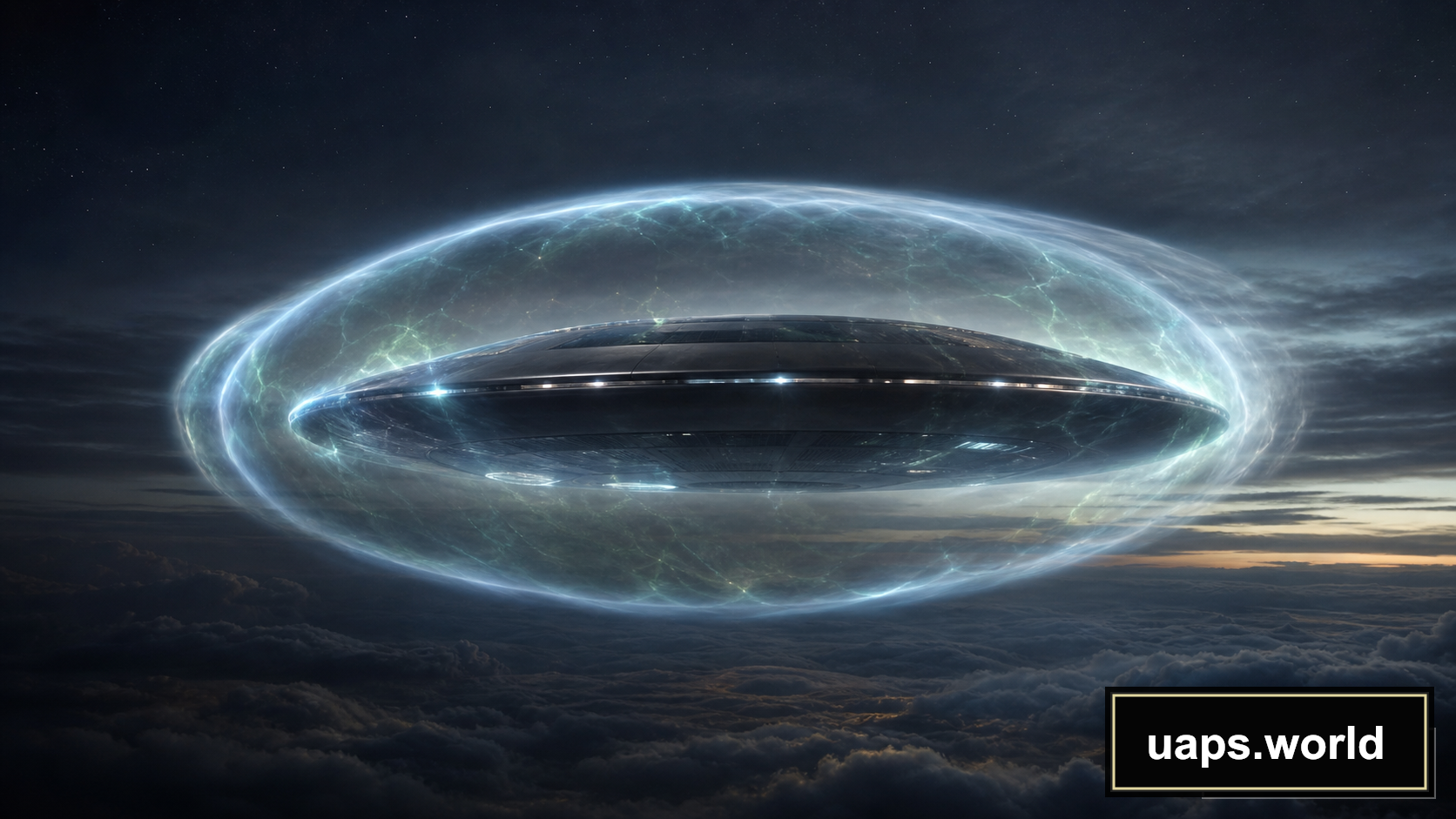
Hypothesis: if some UAP systems are advanced fieldcraft, their visible performance may depend on controlled macroscopic quantum states or quantum-adjacent coherent states in superconducting, plasma, metamaterial, or vacuum-boundary subsystems. The craft would not be "made of quantum magic." Instead, it would use a stable engineered state as the control layer between the physical vehicle and the environment. The testable archive question becomes: Do the strongest UAP cases show signs of state switching rather than ordinary mechanical motion? Useful indicators would include: - abrupt visible transitions without proportional thermal or aerodynamic cost; - envelope changes that appear quantised, pulsed, or...
Why It Matters
This Nobel breakthrough matters to UFO analysis because it gives the archive a cleaner way to imagine advanced technology without abandoning physics vocabulary. Instead of saying: - "the craft ignores inertia," - "the craft turns into light," - "the craft vanishes," - "the craft warps space," the archive can ask: - what state is the visible boundary in? - did the boundary switch states? - did the sensor see the hull, the envelope, or the leakage from the envelope? - did the medium respond to the object itself or to a field condition around it? - is there a quantised, pulsed, or mode-like pattern in the observable behavior? That is a better bridge between human science and exotic possibility. It makes the...
Working Assessment
The Nobel-recognised experiments do not prove alien propulsion, but they strengthen one philosophical premise behind the archive's physics lane: macroscopic engineered systems can exhibit quantum behavior when the system is coherent, shielded, and precisely controlled. For future travel, the likely near-term human path is not teleportation or passenger-scale tunnelling. It is quantum-enabled control: better simulation, materials, superconducting systems, sensors, navigation, communication, and field-shaping devices. Over longer horizons, macroscopic state control could become part of propulsion-adjacent technology, especially where a vehicle must manage heat, drag, plasma, radiation, or sensor visibility....
Classify this source for 2 points, mark useful or misleading records for 1 point, or submit observations for curator review. Public contribution points progress through Observer, Analyst I, Analyst II, Case Builder, and Archivist and can unlock field desk themes.


![DOW-UAP-PR056, "Spherical UAP pulsing over water [CALLSIGN]"](/?open=Release_2%2FAnalysis%2Fimages%2Fpr056-hypothesis-craft-field-envelope-realistic.png)

