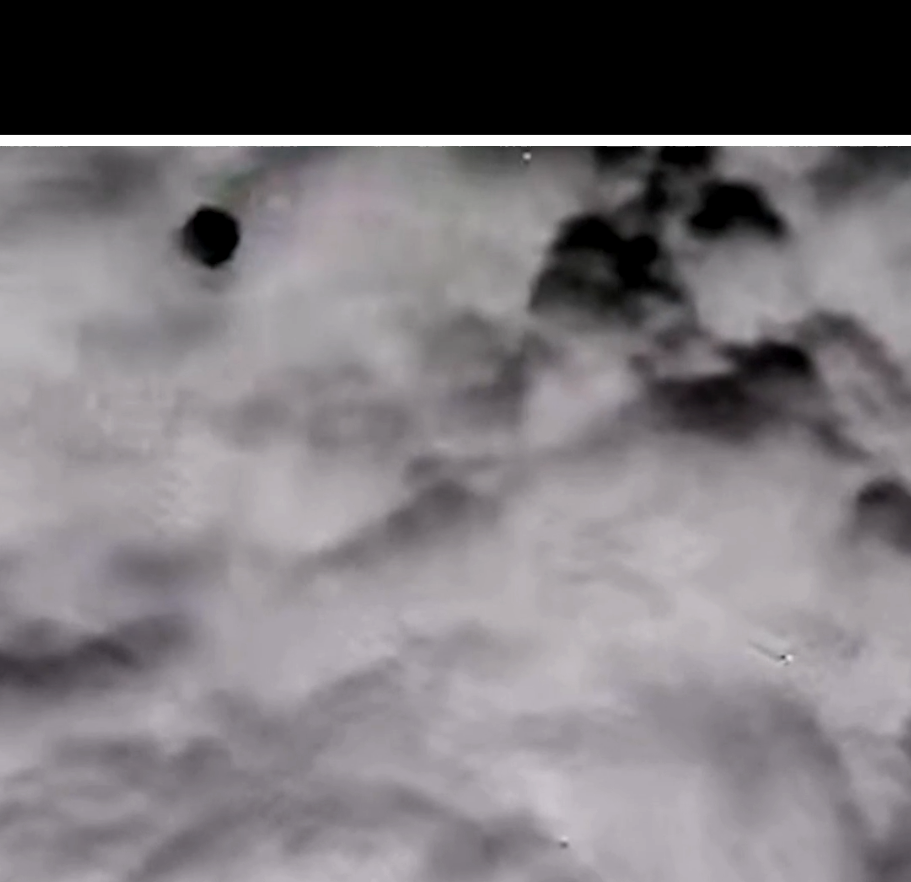
The capture shows a cloudlike or textured atmospheric field with at least two small bright/dark contact-like marks. One appears toward the lower right of the frame, with a faint streak or point-like shape. Another darker round feature appears toward the upper left against...
UAPs.world keeps this analysis report connected to its original source path, release context, and related analysis path so readers can inspect the evidence trail directly.
Analysis report summary
This analysis page exposes the report substance directly for readers and crawlers, while the research viewer remains the place for source inspection, frame review, and follow-up work.
Source Basis
This note resolves the approved cloud-interaction lead for DOD 111719732 video. The captured state is 4.160s normal, 1.78x, targeting C08 - Formation Cloud and Atmospheric Interaction. Captured image: New July 1 source-state retest: - Submitted source state: 6.049s normal, 1.00x. - Four-frame source review sheet: cloud-obscuration four-frame source sheet. - Raw/geometry review sheet: submitted full-frame region. - Enhanced inspection aid: cloud-obscuration contrast pass. - Forward burst sheet: one-second eight-frame source burst. - Forward burst enhanced aid: one-second contrast burst.
Observation
The capture shows a cloudlike or textured atmospheric field with at least two small bright/dark contact-like marks. One appears toward the lower right of the frame, with a faint streak or point-like shape. Another darker round feature appears toward the upper left against brighter cloud texture. The source state is heavily dependent on background structure: cloud shadows, compression, contrast, and sensor motion can all create small contact-like impressions. The source-backed claim is therefore modest: PR088 contains small candidate contacts embedded in cloud texture. The frame is valuable because cloud context gives the archive a medium-interaction test, but the still does not prove that the marks are...
A darker, rounder contrast patch appears in the cloud field.
This is the strongest frame for an "elemental" or cloud-embedded read, because the feature looks more like a dark object or void than a bright glint.
The enhanced pass shows thresholding can exaggerate the roundness.
The retest supports the lead as a bounded cloud-obscuration hypothesis: something contact-like remains worth tracking across the cloud field, and by 7.549s the visible state reads as darker and more cloud-embedded. It does not prove an elemental body or cloud coupling. The stronger claim should wait for centroid tracking across more adjacent frames and a control pass that tests whether the dark round state moves independently of the cloud texture. ### One-Second Forward Burst At the user's request, the submitted frame was retested as a short one-second burst forward from 6.049s, using eight sampled frames: 6.049s, 6.192s, 6.335s, 6.478s, 6.621s, 6.764s, 6.907s, and 7.049s. The denser burst strengthens the...
Hypothesis To Test
Hypothesis: if the lower-right contact persists across adjacent frames while crossing or sitting within cloud structure, its edge behavior may reveal whether it occludes, lights, heats, refracts, or ignores the cloud medium. This would strengthen C08 - Formation Cloud and Atmospheric Interaction's physics lane. Competing explanations: - cloud shadow or high-contrast texture; - compression artifact around a small bright/dark patch; - sensor pan making cloud features look like moving contacts; - ordinary aircraft or debris at unknown range; - display overlay or crop artifact.
Theoretical Scene Panels
Theoretical Scene Panels
Panel
Read
Boundary
Source frame
The 6.049s submitted view places a small contact-like mark in a mottled cloud field.
Evidence only: cloud texture and sensor processing are visible.
Geometry read
The four-frame sheet shows a bright contact-like state before the target frame, and the one-second burst shows a darker round state emerging from 6.335s through 7.049s.
Observation plus low-level inference: apparent transformation may be occlusion, thresholding, or drift through cloud shadow.
Medium model
Under the disclosure-forward field model, a contact moving through a cloud boundary might dim, sharpen, or appear "elemental" if a field envelope is interacting with the visible medium.
Speculative only: this is a model to test, not a conclusion.
Limits
The same look can arise from compression blocks, cloud shadows, sensor gain, or an ordinary object crossing a textured background.
Upgrade only if stable centroid motion and local cloud response persist across more frames.
Working Assessment
Promote PR088 as a cloud-interaction test candidate in C08 - Formation Cloud and Atmospheric Interaction. It is not yet a strong anomaly by itself. Its value is methodological: it asks whether candidate contacts interact with a visible atmospheric medium or simply ride on the sensor/background image chain.
The source still contains a high-contrast dark round point near the reticle and a broader tonal boundary in the surrounding image field. The submitted thermal-style view makes the boundary easier to perceive as a rim-like arc or edge band, but the source...
This index consolidates the prior methodology and release-map notes. It references the main documentary families: DOW mission reports such as Mission Report, Greece, January 2024, Mission Report, United Arab Emirates, October 2023, Mission Report, Iraq,...
The atmospheric cases involve multiple contacts, soft-edged contacts, cloudlike backgrounds, pulses, splitting or grouping impressions, and possible formation behavior. The visual challenge is separating sensor/background blending from genuine multi-object...
Classify this source for 2 points, mark useful or misleading records for 1 point, or submit observations for curator review. Public contribution points progress through Observer, Analyst I, Analyst II, Case Builder, and Archivist and can unlock field desk themes.