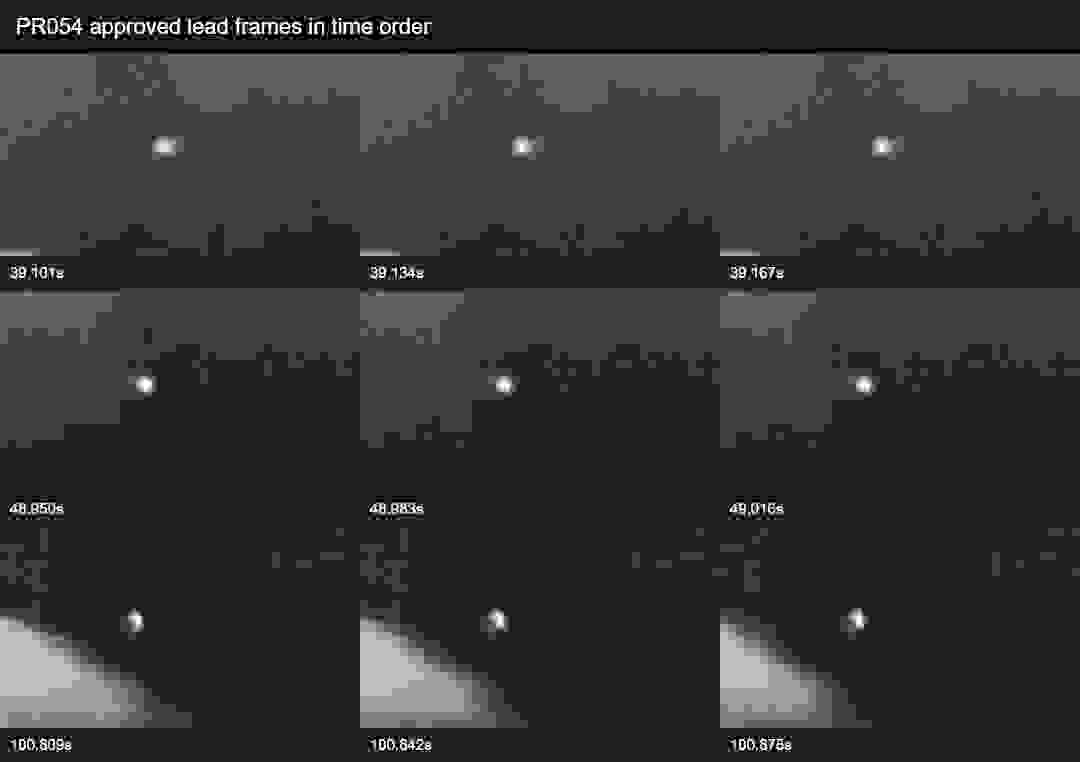
C48 PR054 Approved Frame Morphology Boundary State Check
At 39.134s, the contact persists across 39.101s, 39.134s, and 39.167s as a compact bright target with a small saturated core. It is not a one-frame flash.
UAPs.world keeps this analysis report connected to its original source path, release context, and related analysis path so readers can inspect the evidence trail directly.
Analysis report summary
This analysis page exposes the report substance directly for readers and crawlers, while the research viewer remains the place for source inspection, frame review, and follow-up work.
Source Basis
This report resolves four approved anonymous capture leads for Spherical UAP Erratic movement (CALLSIGN) (Mission) 2022. The leads are consolidated because they share the same source, target C07 - Field Propulsion and Morphology Model, C23 - Inertia and Boundary Field Interaction Model, and C39 - Favorite Material Analysis Refinement, and ask the same frame-level morphology question. Submitted frame states:
The submitted control was Frame for each lead, so the durable check sampled one adjacent frame before and after each target timestamp. The source-derived sheet below is an inspection aid; the timestamp links remain the evidence anchors. The late state was also checked with an inverted aid to match the submitted invert preset.
Observation
At 39.134s, the contact persists across 39.101s, 39.134s, and 39.167s as a compact bright target with a small saturated core. It is not a one-frame flash. At 48.983s, the contact remains compact and bright across the adjacent samples. Its boundary is soft and saturated, so apparent shape should be treated as sensor-visible brightness distribution rather than resolved hull geometry. At 100.842s, the contact persists across the submitted state and adjacent frames. The raw source-frame aid shows a small bright vertical or teardrop-like contact near a large high-contrast background edge. The inverted aid turns that contact into a dark mark against a light field, making the lower/vertical asymmetry easier to see...
Hypothesis To Test
The strongest source-backed claim is narrow: PR054 preserves repeated compact bright contact states, and the 100.842s lead is a useful morphology/boundary-state sample because the contact is not a single-frame artifact. Live explanation lanes:
Hypothesis To Test
Lane
Read
Unresolved compact object
Compatible with persistence across adjacent frames, but the source does not resolve hull edges, range, size, or surface detail.
Sensor/gain/compression behavior
Strong control lane. The target is saturated and sits near high-contrast terrain/background boundaries in the late sample.
Field/body visibility model
Useful speculative lane. The object may be recorded as a bright envelope or sensor-visible boundary rather than a clean physical body.
Inertia or propulsion inference
Not established from these frame captures. There is no measured acceleration, plume absence, or medium-response analysis in this pass.
The early and mid samples read as rounded bright cores with soft saturated edges. The late sample reads as a small vertical or teardrop-like boundary state near a large background contrast edge.
Mechanism model
Conservative model: unresolved bright target plus sensor gain/compression and background contrast. Disclosure-forward model: a field/body composite where the recorded shape is the sensor-visible boundary envelope more than a resolved hull.
Limits
No calibrated radiometry, range, size, native sensor mode, platform motion, or telemetry is available in this frame pass. Shape and field-dynamics claims should stay provisional.
Working Assessment
The approved PR054 leads are worth preserving as frame-anchored morphology checks. They support adding Spherical UAP Erratic movement (CALLSIGN) (Mission) 2022 to the C07 - Field Propulsion and Morphology Model test set with the wording "compact bright contact and unresolved boundary-state variation." They do not yet support stronger claims of propulsion, downwash, inertia modification, or resolved craft shape. The best next analysis would sample a longer window around 100.842s, track the contact centroid and bloom radius, and compare raw, normal, and invert views without changing the frame window.
Classify this source for 2 points, mark useful or misleading records for 1 point, or submit observations for curator review. Public contribution points progress through Observer, Analyst I, Analyst II, Case Builder, and Archivist and can unlock field desk themes.