C63 DOD 111689044 Reactor Cloak Field Hypothesis Review
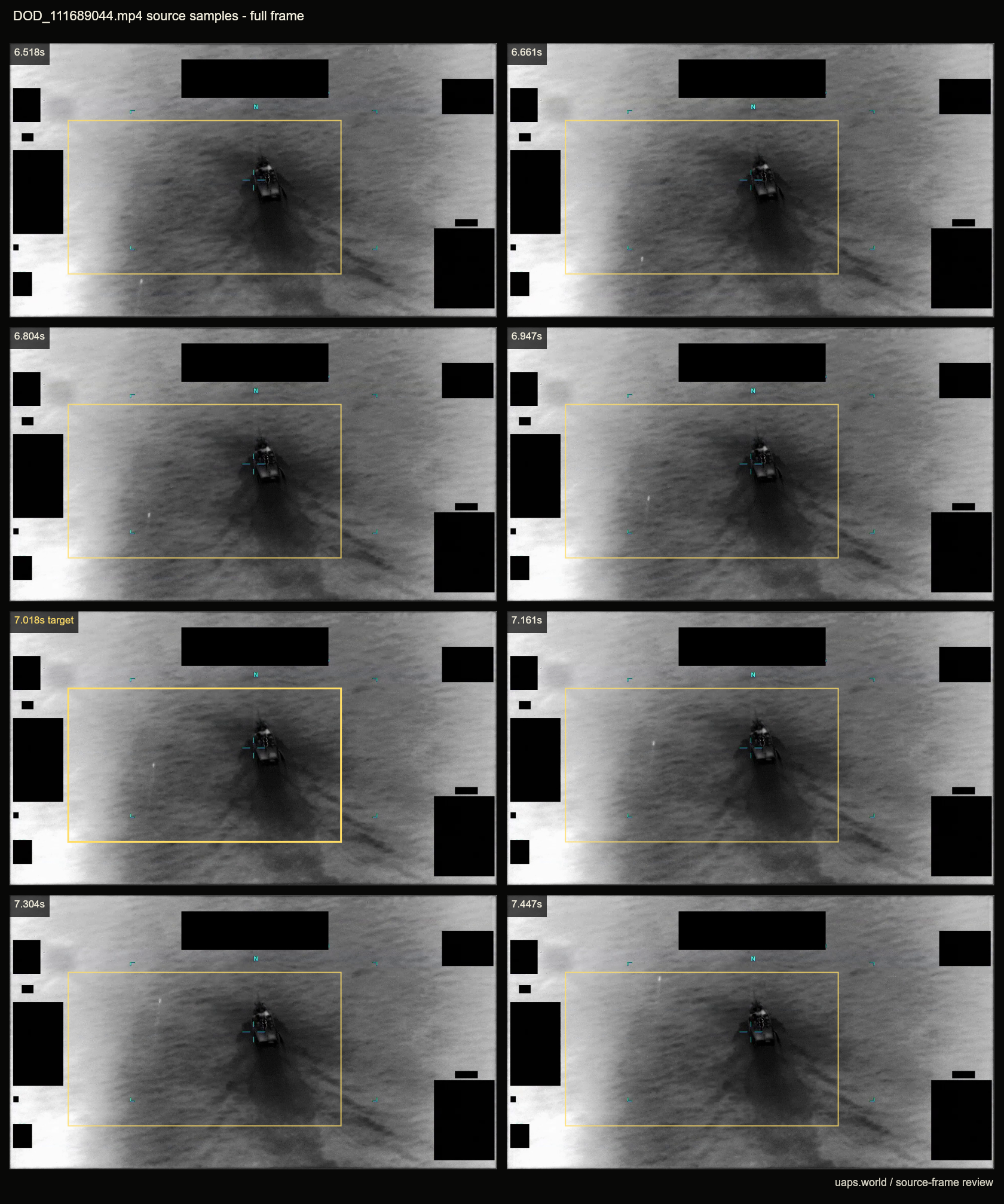
The sampled window shows a compact vehicle-like bright structure moving through a darker disturbed region. The dark region remains roughly coherent behind and around the target, while smaller bright points on the target stay locked to the target body rather than separating as...
UAPs.world keeps this analysis report connected to its original source path, release context, and related analysis path so readers can inspect the evidence trail directly.
Analysis report summary
This analysis page exposes the report substance directly for readers and crawlers, while the research viewer remains the place for source inspection, frame review, and follow-up work.
Observation
The sampled window shows a compact vehicle-like bright structure moving through a darker disturbed region. The dark region remains roughly coherent behind and around the target, while smaller bright points on the target stay locked to the target body rather than separating as independent objects. The surrounding background has moving, wave-like tonal texture, so the frame does not give a clean stationary grid that would prove optical displacement, background warping, or a masked hull edge.
Hypothesis To Test
Three explanation lanes remain useful: - Sensor/ordinary lane: the dark area may be wake, shadow, exhaust, surface disturbance, compression, exposure behavior, or a contrast response around a bright moving target. - Field-interaction lane: a compact reactor or field envelope could affect what the sensor sees by changing apparent brightness, scattering, thermal contrast, or the surrounding medium. - Cloak/reference-frame lane: if a field envelope exists, the visible bright structure could be only the leakage or sensor-coupled part of a larger system, while the darker region is a low-observable envelope or time/reference-frame mismatch. The source supports keeping the second and third lanes alive as theory...
Working Assessment
Promote this lead as a medium-low confidence field-interaction hypothesis note, not as proof of cloaking or time displacement. The strongest source-backed claim is that the one-second window contains a compact bright target coupled to a persistent dark disturbed region. The useful unresolved question is whether that region is environmental/sensor behavior or a disclosure-forward field envelope.
Classify this source for 2 points, mark useful or misleading records for 1 point, or submit observations for curator review. Public contribution points progress through Observer, Analyst I, Analyst II, Case Builder, and Archivist and can unlock field desk themes.