Observation
The captured pages preserve two related but distinct wartime report families:

The captured pages preserve two related but distinct wartime report families:
UAPs.world keeps this analysis report connected to its original source path, release context, and related analysis path so readers can inspect the evidence trail directly.
This analysis page exposes the report substance directly for readers and crawlers, while the research viewer remains the place for source inspection, frame review, and follow-up work.
The captured pages preserve two related but distinct wartime report families:
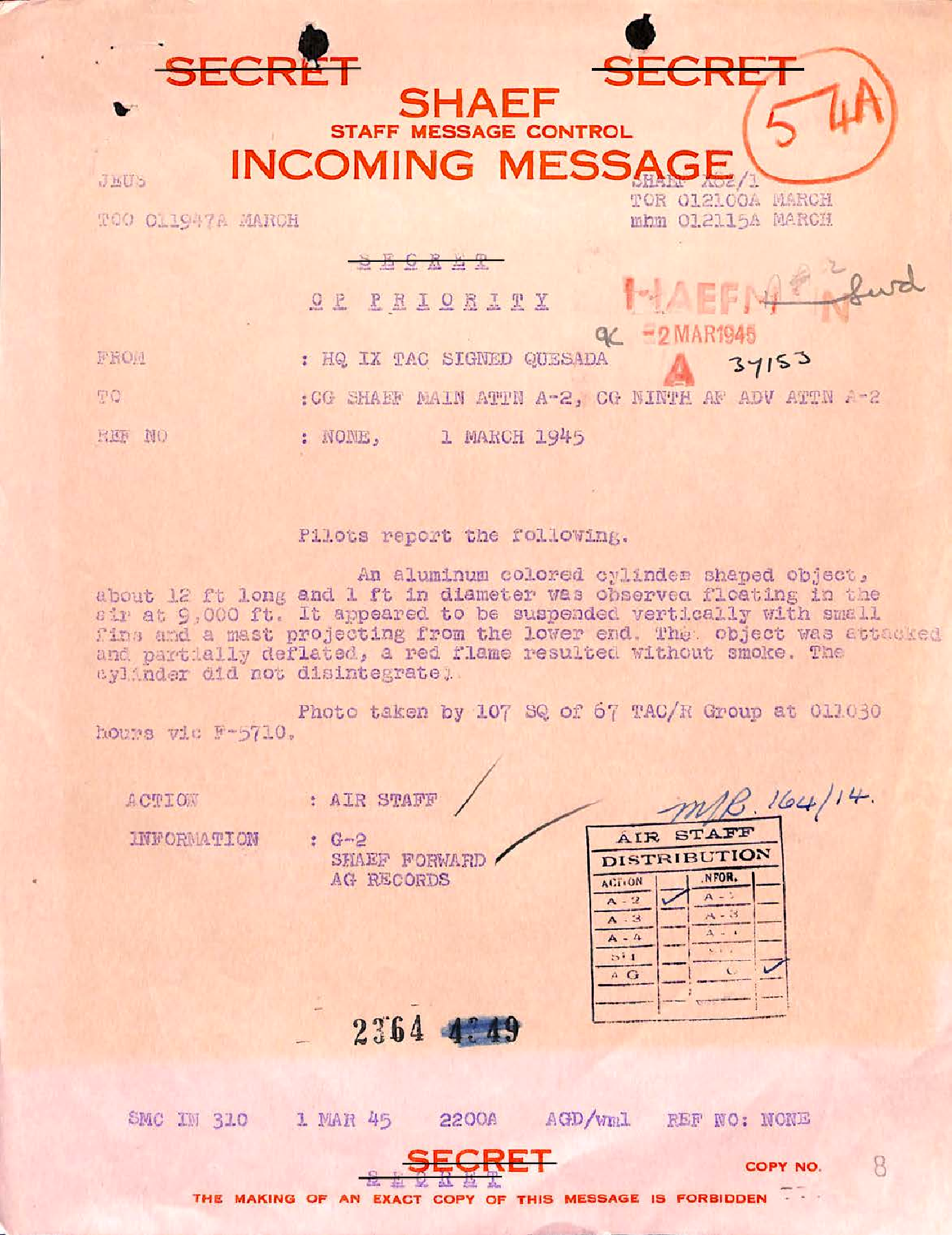
The submitted question asks whether page 9 may be a very early "tic tac" encounter. The source supports a narrower statement: page 9 records an early official-channel cylindrical aerial object report with a high length-to-width ratio, but the same page also records features that make a modern tic-tac-style craft analogy provisional at best. The stronger pattern is not the shape alone. It is the source family's combination of wartime collection channels, precise pilot-facing measurements, following behavior, formation behavior, and negative GCI/bogey checks across the January 1945 415th Night Fighter Squadron pages.
Approve the five captured pages as one source-backed historical-pattern analysis. The "very early tic tac" hypothesis is only partly supported: the March 1945 report does preserve a slim cylindrical object with a high aspect ratio, but the source text itself weakens any clean modern tic-tac analogy. The more durable finding is that this file preserves wartime official-channel reports of unexplained close-following lights and a separate cylindrical object report, with enough measurements to compare against later UAP shape and behavior families. The Disclosure-Forward Neutrality Gate passes because this note keeps outlandish continuity hypotheses open as comparison questions, while refusing to convert a shape...
These images are rendered directly for quick review, with clean image pages for crawlers and viewer links for inspection.

analysis image
Release_1/Analysis/images/331-120752-german-armament-page-09-source-render.png · Updated 2026-07-06

analysis image
Release_1/Analysis/images/331-120752-german-armament-page-14-source-render.png · Updated 2026-07-06

analysis image
Release_1/Analysis/images/331-120752-german-armament-page-17-source-render.png · Updated 2026-07-06
Classify this source for 2 points, mark useful or misleading records for 1 point, or submit observations for curator review. Public contribution points progress through Observer, Analyst I, Analyst II, Case Builder, and Archivist and can unlock field desk themes.