Evidence trail: analysis report

C87 PR116 Atlantic Detached Sphere and TAP Like Feature

Raw-frame and native Fiji/ImageJ review of the bright rounded upper-left feature visible near 25.210 seconds, testing separation against balloon/payload, sensor, and deployment-platform hypotheses.

Open this source in the research viewer Open source file
Rendered source preview Open in viewer
C87 PR116 Atlantic Detached Sphere and TAP Like Feature

Source details

Media type
analysis report
Archive path
Release_4/Analysis/C87-PR116-Atlantic-Detached-Sphere-and-TAP-Like-Feature.md
Last updated
2026-07-20
Source file
Open source file

Source Summary

UAPs.world keeps this analysis report connected to its original source path, release context, and related analysis path so readers can inspect the evidence trail directly.

Analysis report summary

This analysis page exposes the report substance directly for readers and crawlers, while the research viewer remains the place for source inspection, frame review, and follow-up work.

Current Status

Current Status
Reader questionCurrent answer
What is observed?A persistent irregular tracked silhouette contains an upper-left bright substructure across adjacent raw frames.
What is not established?The sequence does not resolve a stable sphere, clean detachment gap, independent scout motion, transfer aperture, rigid hull, biological entity, or non-human origin.
What is the strongest case-specific control?The paired D091 account describes windborne motion, no maneuver or direction change, and resemblance to a large deformed balloon; envelope folds, payload, rigging, and sensor resampling remain the leading control lane.
What would change the assessment?A calibrated longer track with growing independent separation, repeatable egress geometry, multisensor corroboration, a wind mismatch, or recovery/identification evidence.

Read Raw Observation for the source result and Working Assessment for the present conclusion. The later Amendment Record preserves how additional windows tested that conclusion without forcing readers to reconstruct the current answer from chronology.

Source Basis

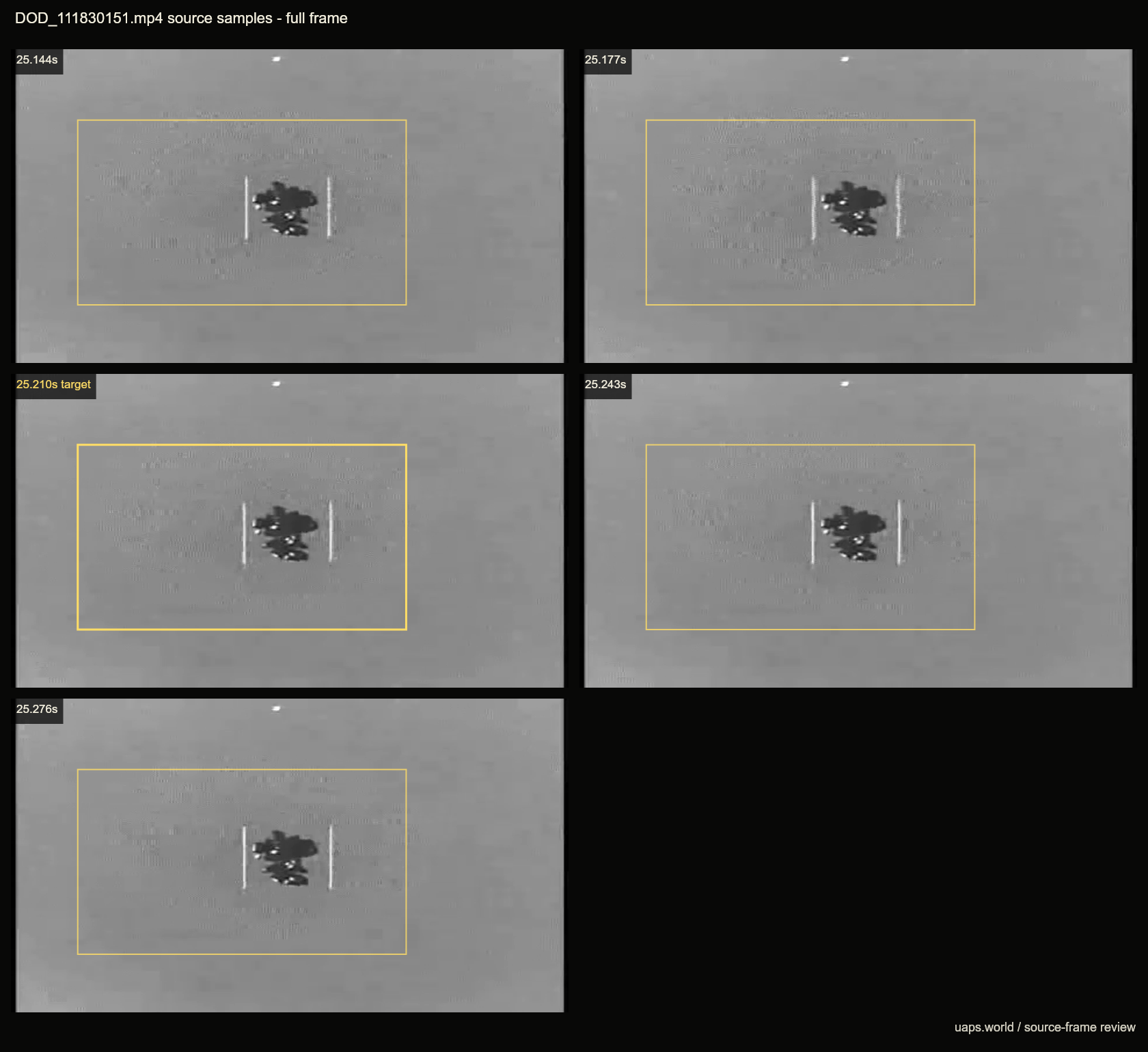
The source is DOD_111830151.mp4, paired in Release 4 with D091 Range Fouler Debrief - Atlantic Ocean 2020. The debrief's visible account describes an object moving with the wind, without maneuver or direction change, and structurally resembling a large, somewhat deformed balloon. That is the strongest conventional control lane for this feature. The exact raw review window samples 25.144s, 25.177s, 25.210s, 25.243s, and 25.276s. The tested viewer state was zoom 1.697, pan -390.4/-414.6, contrast 1.15, and brightness 1.

Raw Observation

The proposed upper-left bright feature is present in the raw source. It is not an enhancement-only invention. At 25.210s it sits just inside the left tracking bar and left of the larger dark upper mass. Other bright holes and dark lobes occur throughout the silhouette, so location and persistence matter more than brightness alone. The stronger claim does not survive the sequence: the pixels do not preserve a clean, stable, background-colored moat around a consistently circular body. Across the five samples, the bright patch changes shape and its apparent connection to the neighboring lower cluster changes with the source frame. The lower structure moves as one unresolved cluster rather than displaying an...

Raw Observation
ObservableRaw-frame resultEvidential meaning
Upper-left bright rounded patchPresent across the sampled windowA persistent contrast feature exists at the user-identified location.
Clean circular boundaryNot stableThe source does not resolve a geometrically reliable sphere.
Stable gap from upper massNot stablePhysical detachment is not demonstrated.
Independent motionNot detected in this short windowNo basis for calling it a separate flying object.
TAP-like interface geometryNot resolvedA transfer aperture, coupling, field bridge, or release port remains a proposed mechanism, not an identified structure.

Native Fiji/ImageJ Clarification

Enhanced inspection aid, not source evidence. The same native crop was processed at three adjacent times. The fixed custom smokey-ir recipe used median radius 1, disabled adaptive contrast, unsharp radius 1 / weight 0.30, and disabled edge diagnostics. This reproduces the submitted ImageJ Lab state in which median denoise and unsharp mask are active while adaptive contrast and edge diagnostics are off. The sensitivity variant changed only unsharp weight from 0.30 to 0.25 at the target.

Native Fiji/ImageJ Clarification
Fiji panelRoleReader-relevant result
25.177s · enhanced aidAdjacent beforeThe coarse upper-left contrast feature remains visible.
25.210s · enhanced aidTargetThe candidate remains visible, without a stable circular boundary or clean separation gap.
25.243s · enhanced aidAdjacent afterThe coarse feature persists while its apparent connection changes.
Target sensitivity aidUnsharp weight `0.25`The main contrast feature survives the small parameter change; fine edge detail remains non-diagnostic.

The upper-left candidate survives Fiji and the sensitivity variant, confirming the coarse contrast feature. Fiji does not create a stable circular outline or a stable separation gap. It also leaves numerous bright holes, dark lobes, vertical bars, and striped/block texture elsewhere in the frame. Those repeated structures make fine-detail readings vulnerable to resampling, compression, focus, gain, and contrast-boundary effects. The recipe-tagged board makes the comparison auditable without requiring the reader to infer which settings produced each image.

Three Competing Hypotheses

Interpretive reconstruction - not source evidence. The plate keeps the source-inspired PR116 outline but replaces a rigid hull with a dark shared envelope inhabited by luminous plasmoid beings. The cloud medium, internal light, individual bodies, hive behavior, and upper-left transition are invented to make the hypothesis legible. PR116 does not establish biology, non-human origin, or an independent orb release.

Three Competing Hypotheses
HypothesisCore proposalWhat it explainsMain difficultyObservation that would upgrade it
Military deployment platformA classified or experimental carrier transports and releases subordinate spherical scouts through a controlled TAP region.The carrier-and-orb visual impression, a candidate boundary region, and a coherent reconnaissance architecture.No rigid hull, port, propulsion system, command link, or independently tracked scout is resolved.Stable structure, repeatable egress, controlled motion, command signatures, or multisensor corroboration.
Deformed balloon or envelopeA windborne envelope, folds, payload, and rigging combine with infrared/video transfer to create the irregular silhouette and bright lobes.The wind drift, lack of maneuver, changing morphology, and the paired D091 witness description.The exact balloon, payload, and material remain unidentified; several frames retain a compelling body-like outline.Wind and trajectory agreement, recovery evidence, or a known balloon/payload configuration matching the source.
Non-human plasmoid hiveMultiple luminous plasmoid beings share a dark atmospheric or field envelope and may protrude, separate, or recombine at temporary TAP boundaries.Bright lobes embedded at different depths, unstable edges, changing morphology, and the impression of several orbs within one mass.The source does not establish life, plasma composition, collective intelligence, independent entities, or non-human origin.Repeatable separation and recombination, coordinated autonomous tracks, spectral or thermal data, or corroborating sensors.

### Military Platform The revised disclosure-forward hypothesis is operational rather than manufacturing-first: the larger PR116 silhouette is a deployment platform carrying already prepared floating scout orbs. A candidate orb reaches an edge or aperture, remains briefly coupled, separates, then performs surveillance, reconnaissance, sensing, relay, or formation duties independently. No specific nation, service, program, or operator is identified by the source. This model does not require the analysis to assume that orb lift or platform motion must follow a conventional general-relativistic or aerodynamic implementation. Propulsion, field generation, inertia control, spacetime coupling, plasma-boundary...

TAP Mechanism And Feasibility

TAP is a provisional report label for Transfer Aperture / Transition. It names the candidate boundary region without claiming the pixels resolve a hatch, nozzle, tether, docking fixture, or field interface. The military lane may implement TAP as a physical port; the plasmoid-hive lane treats it as a temporary field or phase boundary. It is not an established aerospace acronym and should not be read as the name of a known device or program. In this report it is simply a compact cross-lane label for the image region where a model predicts temporary restraint or coherence, transfer, release, and separation.

TAP Mechanism And Feasibility
StageDeployment-platform interpretationSource requirement
PrepareA scout orb is powered, synchronized, or field-coupled inside or along the carrier.Not visible in the present clip.
TransferThe orb reaches an edge or port while remaining temporarily coupled to the platform.Persistent candidate body at one stable platform-relative location.
ReleaseThe coupling ends and the gap grows.Multiple raw frames with a stable perimeter and increasing separation.
Independent operationThe orb hovers, translates, joins a formation, or performs a separate sensing path.Independent centroid track after release, ideally on a second sensor.

Interpretive reconstruction - not source evidence. Panel A marks the revised upper-left candidate region. Panels B and C picture the proposed carrier/TAP/scout-orb sequence. Panel D keeps the balloon/payload control lane beside it. The complete platform, sphere construction, port, coupling hardware, materials, scale, and motion sequence are invented to make the hypothesis legible; none is resolved in PR116. ### Conventional Engineering Feasibility Feasibility is evaluated in two deliberately separate lanes. The open-physics lane asks whether the deployment concept is internally coherent if floating UAP orbs and field-mediated motion are admitted as working premises. The conventional GR/engineering lane asks...

TAP Mechanism And Feasibility
QuestionOpen-field / UAP-operational laneConventional GR / engineering contrastPR116 evidential status
Can a carrier deploy scouts?Coherent mission architecture: carrier supplies transport, coordination, energy/data exchange, and scouts distribute sensing coverage.Air and space systems already deploy drones, decoys, sonobuoys, satellites, and submunitions; a spherical scout is mechanically plausible if lift and control are solved.Mission role is not visible.
Must the orb be manufactured in flight?No. Pre-carried orbs are the minimum-assumption model; field assembly or phase-change storage remains an optional stronger hypothesis.In-flight fabrication is far harder than carriage because it needs feedstock, tooling, energy, heat rejection, quality control, and time.No manufacturing sequence is resolved.
Can an orb float without visible lift surfaces?Yes under the working premise of a field, plasma, inertia-control, spacetime-coupling, or another non-aerodynamic envelope. The corpus's orb/field-emitter model leaves the mechanism open.GR alone does not supply a practical local antigravity device in current engineering. Conventional hovering needs buoyancy, rotor/jet thrust, aerodynamic lift, electrohydrodynamics, magnetic interaction, or another reaction path, each with environmental signatures.No lift mechanism is measurable.
Is a TAP interface coherent?A temporary field/data/energy coupling could appear as a gap, bridge, lobe, or morphology change rather than a hard mechanical arm.A physical bay needs clearance, restraint, release actuation, collision avoidance, and wake/flow management. A tether or payload line is an ordinary alternative.The upper-left lobe lacks a resolved interface.
What would release look like?Stable orb envelope, growing separation, independent centroid, possible later formation or scout behavior.The same kinematic requirements apply; wake, gravity, drag, platform motion, and stabilization must be modeled.Present three-frame pass shows no independent track.
What would corroborate command/control?Coordinated multi-orb timing, geometric formations, synchronized luminosity, return/docking, or relay-like spacing.Radio, optical, acoustic, thermal, or maneuver signatures might accompany control.No command/control observable is available.

### Engineering Analogues And Limits The TAP model has bounded real-world analogues, but none validates the PR116 interpretation. DARPA's Gremlins airborne launch and recovery program treats carriage, release, relative navigation, station keeping, and recovery as distinct engineering problems; its 2021 airborne-recovery demonstration also emphasizes aerodynamic interaction and contact dynamics around the host aircraft. NASA's SmallSat integration, launch, and deployment review describes retention, protection, command, separation hardware, and safe release as critical parts of deployment, and notes that separation systems can be among the most complex launch mechanisms. Those sources support only the...

Theoretical Scene Panels

Theoretical Scene Panels
PanelSource anchorReadBoundary
A - Target stillRaw target frameA bright rounded upper-left patch is visible just inside the left tracking bar.Evidence only: an image-plane contrast patch.
B - Adjacent-frame geometryFive-frame raw reviewThe upper-left patch persists, but its outline and apparent gap vary with the frame.Weakens a completed physical-separation claim.
C - Flexible-envelope modelD091 debriefA folded or deformed envelope with payload/rigging can project separate-looking lobes.Conventional working model, not a recovered identification.
D - Pumbaa balloon controlInterpretive reconstructionA collapsed Pumbaa upper envelope plus attached Timon, payload, and rigging can reproduce the two-tier mass and bright islands without propulsion.Conventional morphology control only; resemblance does not identify the object or confirm color.
E - Scout-orb deployment modelTAP interpretive reconstructionA carrier could prepare, transfer, release, and coordinate independent floating scouts.Model only; current frames do not preserve a release trajectory.
F - Plasmoid-hive modelHive interpretive reconstructionLuminous individuals could share a dark field envelope, then cross a temporary TAP boundary into independent coherence.Model only; the artwork clarifies the hypothesis and adds no evidence for life, plasma composition, or separation.

Working Assessment

The screenshot has been reproduced at the correct source neighborhood: the best target is 25.210s. The upper-left bright feature is genuinely present in the raw video and is stable enough to merit analysis. The most defensible source-only answer is that it is not yet resolved as a deployed scout sphere. It is a bright upper-left substructure within an unresolved tracked silhouette. The apparent gap and circularity are too frame-dependent, and there is no independently measurable release motion. The paired witness/debrief record therefore keeps the deformed balloon/envelope, attached payload or rigging, and sensor-resampled contrast structure as the strongest case-specific control lane. The intended...

Follow-Up Amendment - Assessment-Changing Tests

The assessment-changing checklist was retested against a longer fixed-coordinate window rather than the original five-frame neighborhood. Seven raw samples at 24.610s, 24.810s, 25.010s, 25.210s, 25.410s, 25.610s, and 25.810s use the same source crop derived from zoom 1.697 and pan -390.4/-414.6. This 1.2-second interval is long enough to test whether the candidate begins a visible egress while the tracker bars and primary silhouette remain in view.

Follow-Up Amendment - Assessment-Changing Tests
Assessment-changing testFollow-up resultEffect on assessment
Independent movement in a longer fixed-coordinate sequenceNot detected. The left bright lobe remains embedded in the same changing upper-left cluster; no separate centroid or growing displacement can be followed.Does not upgrade the scout-orb lane.
Stable background-colored gap in unprocessed framesNot detected. Bright interior regions open, narrow, and merge with neighboring bright structure while the outer lobe boundary changes.Weakens physical-detachment and hard-circular-perimeter readings.
Higher-generation imagery resolving seams, cords, or attachment pointsNot present in the local release packet. The available MP4 remains too resampled and soft for those distinctions.Identity stays unresolved; enhancement cannot substitute for missing source generation.
Range, wind, platform geometry, or second-sensor discriminationPartly available only as witness context: D091 page 2 says the object traveled with the wind, generally south, with no maneuver or direction change. Range/platform geometry and a second sensor remain redacted or unavailable.Raises the passive windborne lane; controlled relative motion is not demonstrated.
Recovery or identification matchNo recovery record or specific object identification is present in the local PR116/D091 packet. The witness resemblance to a large, somewhat deformed balloon is descriptive, not a recovered match.Balloon/envelope remains the strongest control, but not a closed identification.
Second PR116 egress or return/docking intervalNot found in the reviewed PR116 analysis windows from 16.637s through 31.784s. Those windows preserve a clustered upper/lower silhouette without a repeatable release sequence.No within-case repetition support.
Western U.S. mother-orb/smaller-orb matchWitness-level analogy remains in C58 - D077 Western US Event Analysis Update Companion, but PR116 lacks the required timing, luminosity, formation, and independently departing bodies.Cross-case model remains provisional and does not identify PR116.

### Advanced Enhancement Check The already published native Fiji sequence at 25.177s, 25.210s, and 25.243s, plus the target sensitivity variant, remains the controlling advanced-enhancement result: the coarse left-side contrast feature survives identical processing and a small unsharp-weight change, while the proposed circular perimeter and separation gap do not. Amended assessment: the new longer sequence clarifies rather than reverses the report. It strengthens confidence that a real coarse substructure occupies the nominated image region, but it weakens the claim that the substructure is a detached or actively deploying sphere. The current evidence favors an unresolved part of one deforming/resampled...

Amendment Record

### July 2026 Multi-Window Amendment Six additional submitted viewer states were retested with their exact Frame, Short/Lots, Balanced/Lots, or Balanced/four-observation controls. The complete evidence bundles are retained for 10.804 seconds, 19.402 seconds, 20.846 seconds, 26.738 seconds, 30.508 seconds, and 30.942 seconds. Each bundle also includes a 10.804 geometry sheet, 10.804 enhanced aid, 19.402 geometry sheet, 19.402 enhanced aid, 20.846 geometry sheet, 20.846 enhanced aid, 26.738 geometry sheet, 26.738 enhanced aid, 30.508 geometry sheet, 30.508 enhanced aid, 30.942 geometry sheet, and 30.942 enhanced aid.

Amendment Record
Submitted stateSource-backed resultDecision
10.804s - exact frameOne dark, irregular tracked silhouette with bright internal/edge lobes is visible.“Ominous globes” is an appearance description; independently bounded globes are not resolved.
19.402s - exact zoomed frameThe high-zoom crop exposes block/resampling texture and several bright islands inside one coarse silhouette.Useful morphology frame, but enhancement cannot assign physical parts.
20.346s, 20.489s, 20.632s, 20.775s, 20.846s, 21.060s, 21.203s, 21.346sThe silhouette persists through 20.846 seconds; the 21.060-second frame collapses into horizontal scan-line/display content, then the silhouette returns.Documents a feed/encoding cut, not object disappearance or interference.
25.238s, 25.667s, 26.096s, 26.525s, 26.738s, 27.382s, 27.811s, 28.238sThe upper and lower lobed regions remain one changing cluster with no detached centroid.The existing physical-hull reconstruction remains an explicitly interpretive extraterrestrial scenario, not source evidence.
30.508s - exact frameThe same clustered silhouette is centered between tracking bars.Adds a late morphology reference, not a new object class.
29.442s, 30.442s, 30.942s, 31.942sObject scale/position and tracking bars change, followed by a no-object/display state.Parallax cannot be isolated without platform, line-of-sight, zoom, and range telemetry.

Amended assessment: these windows strengthen the conclusion that PR116 contains a real, persistent, irregular tracked silhouette, but they do not resolve multiple globes, an independently moving scout, a hard extraterrestrial hull, or calibrated parallax. The paired D091 windborne/deformed-balloon account remains the strongest case-specific control. The TAP/carrier and extraterrestrial reconstructions remain useful falsifiable scene models, explicitly separated from source evidence. ### July 2026 Exact-Frame Amendment - 21.122s Sensor-State and Balloon Control A new frame lead asked whether 21.122s shows a sensor switch, and a related follow-up asked for a more explicit propulsion/balloon control, including...

Amendment Record
TestResultEffect on assessment
Sensor-state switch at the submitted frameThe 21.056s sample is dominated by horizontal scan-line/display content, while the irregular tracked silhouette is visible again at 21.089s, 21.122s, 21.155s, and 21.188s.Supports the existing feed/encoding/display-state interpretation near 21 seconds. It does not show object disappearance, interference, or a discrete propulsion event.
Propulsion signatureNo resolved exhaust, plume, jet, wake, flare, or controlled acceleration is visible in this five-frame raw neighborhood. The apparent shape change is dominated by blocky video state, tracking-bar context, and the same irregular dark silhouette returning after the display disruption.Propulsion remains unobserved in the local source. The frame cannot be promoted into evidence of an active drive system.
Balloon/envelope controlThe paired D091 debrief page 2 remains the case-specific conventional control: windborne motion, no maneuver or direction change, and resemblance to a large, somewhat deformed balloon. The 21.122s silhouette is compatible with a soft envelope, fold, payload, or rigging cluster in low-generation infrared/video transfer.Balloon/envelope remains stronger than a source-supported craft-control or scout-release reading, but it is still a control lane rather than a recovered identification.
"Maroon balloon" color/material claimThe local MP4 frame and paired debrief view are monochrome/thermal-style source evidence. They do not preserve a reliable visible-color channel for red, maroon, or material identification.The analysis can test balloon/envelope morphology, but it cannot assert maroon color from this source state.

Amended assessment: the exact 21.122s submission strengthens the report's sensor/feed-state caution and the balloon/envelope control. It does not add a resolved propulsion observable, a physical sensor-switch mechanism, or a color-specific balloon identification. The most defensible reading is a persistent irregular windborne/deformed silhouette reappearing after a brief display/feed disruption, with active propulsion and TAP/scout deployment still below the promotion gate. ### July 2026 Exact-Frame Amendment - 30.202s Smokey Carrier Model A new exact-frame lead asked to restore the disclosure-forward alien-hypothesis image for the 30.202s "smokey mass" as a possible carrier. The retest used the submitted...

Amendment Record
TestResultEffect on assessment
Smokey carrier silhouetteThe raw target frame shows a coherent dark, lobed mass between the tracking bars, with bright edge/internal lobes on the left and underside.The carrier-model visual is source-motivated enough to retain as an interpretive scene, not merely a decorative hypothesis image.
Adjacent-frame persistenceThe mass persists across the five sampled frames while its perimeter, bright lobes, and lower cluster shift subtly with video transfer and tracking-bar context.Supports one unresolved clustered silhouette; does not resolve a separate deployed scout, bay, port, or hard hull edge.
Independent carrier/scout behaviorNo separate centroid, clean egress path, or growing gap is trackable in this 30.136-30.268s window.Keeps scout deployment below the promotion gate.
Case-specific controlThe paired D091 account still describes windborne motion, no maneuver or direction change, and resemblance to a large deformed balloon.Balloon/envelope or attached-payload morphology remains the strongest conventional lane.

Enhanced inspection aid, not source evidence. The fixed smokey-ir recipe used median radius 1, disabled adaptive contrast, unsharp radius 1 / weight 0.30, and disabled edge diagnostics at 30.169s, 30.202s, and 30.235s, with 30.169 enhanced aid, 30.202 enhanced aid, and 30.235 enhanced aid. A target sensitivity variant changed only unsharp weight to 0.25 at 30.202s, saved as a 30.202 sensitivity aid. The coarse mass survives the unchanged recipe and sensitivity variant, but Fiji does not add a clean separation gap, resolved aperture, or independent subordinate object. Interpretive reconstruction - not source evidence. This plate visualizes the disclosure-forward carrier model requested by the lead: a smokey...
Cited public sources

Analysis of this record

These UAPs.world reports cite this record. Read their findings and evidence limits, or inspect the cited material in the research viewer.

Public Field Desk

Classify this source for 2 points, mark useful or misleading records for 1 point, or submit observations for curator review. Public contribution points progress through Observer, Analyst I, Analyst II, Case Builder, and Archivist and can unlock field desk themes.

Open this source in the research viewer Browse related analysis report items Open analysis desk