C88 PR108 Western US 2020 Tracked Contact and Display State
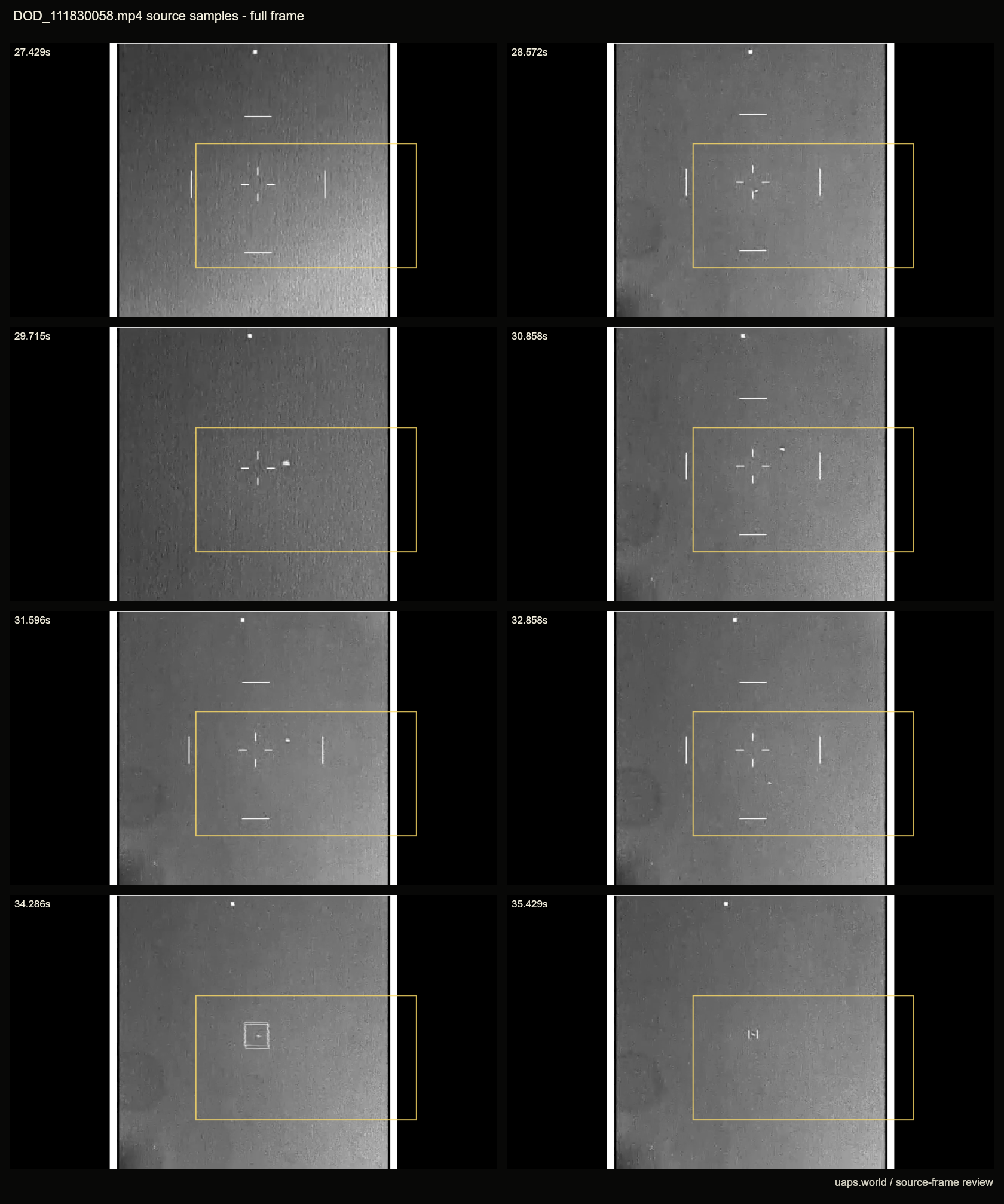
The clip preserves a compact bright contact at multiple positions around the central reticle. It is not a one-frame compression speck. The strongest source-backed result is a tracked-contact sequence accompanied by display-state changes.
UAPs.world keeps this analysis report connected to its original source path, release context, and related analysis path so readers can inspect the evidence trail directly.
Analysis report summary
This analysis page exposes the report substance directly for readers and crawlers, while the research viewer remains the place for source inspection, frame review, and follow-up work.
Source Basis
The source is Unresolved UAP Report, Western United States, 2020 (PR108). Four captured leads asked about monitor interference near 18.880s, sudden acceleration near 31.596s, a longer position review centered near 31.429s, and a tunneling interpretation near 68.136s. The submitted Long/Lots controls were executed as eight observations over the requested eight-second interval: 27.429s, 28.572s, 29.715s, 30.858s, 31.596s, 32.858s, 34.286s, and 35.429s.
Observation
The clip preserves a compact bright contact at multiple positions around the central reticle. It is not a one-frame compression speck. The strongest source-backed result is a tracked-contact sequence accompanied by display-state changes.
Cross-state pixel positions are not one continuous calibrated coordinate system.
Hypothesis To Test
The submitted hypotheses are monitor interference, sudden acceleration, and tunneling. The source supports a display/feed dropout and apparent rapid image-plane displacement, but it does not connect the dropout causally to the contact or establish physical acceleration/tunneling. A defensible kinematic claim requires stabilized angular coordinates, sensor field of view, platform attitude/slew, track-mode transitions, frame cadence, and range or a justified range bracket.
Theoretical Scene Panels
Theoretical Scene Panels
Panel
Read
Boundary
A - Source contact
A compact thermal contact persists across the requested window.
Evidence only: a contact is present.
B - Reticle-relative path
The contact changes quadrants around the reticle.
Low-level inference: apparent motion is real in the image plane.
C - Tracking-state transition
Acquisition-box and symbology changes indicate sensor/display intervention.
The intervention must be removed before target kinematics are inferred.
D - Field-control model
Under a disclosure-forward model, abrupt motion could represent low-inertia or field-mediated maneuver.
This remains speculative until calibrated target-relative motion survives platform/sensor subtraction.
Explanation Lanes
Explanation Lanes
Lane
Fit
Upgrade or falsification test
Sensor slew / track correction
Reticle-relative position and symbology change together; an acquisition box appears later.
Recover platform attitude, line-of-sight angles, and track-mode flags.
Ordinary moving target
A real compact contact can cross the image while the sensor operator reacquires it.
Establish range, target class, winds, and platform motion.
Video/display processing
Point-spread, scan conversion, resampling, and contrast can alter apparent size and centroid.
Inspect native sensor export and per-frame metadata.
Contact-induced interference
The early window contains a black-field dropout with fixed borders still present.
Correlate the event with native fault, electromagnetic, operator, and sensor logs; temporal coincidence alone is insufficient.
Unusual acceleration or tunneling
The contact's apparent path includes rapid displacement and reversals.
Show a discontinuity in stabilized angular rate and continuous target identity that cannot be explained by sensor/platform state.
Working Assessment
PR108 contains a durable tracked-contact event and deserves telemetry recovery. The source does not currently justify "contact-induced monitor interference," "sudden physical acceleration," or "tunneling." The strongest publishable claim is: the clip contains a display/feed dropout and a compact contact that changes reticle-relative position rapidly across intervals containing acquisition, framing, and symbology changes. The Disclosure-Forward Neutrality Gate passes. Sensor/platform explanations remain active, and the unusual-acceleration lane remains testable rather than dismissed. The lane upgrades only if stabilized line-of-sight motion retains the discontinuity after track-state and platform corrections.
Crosswalk and analysis triage for the Release 4 DVIDS media files, including Yellow Sea, East China Sea, South China Sea, Eastern/Western United States, Gulf, Atlantic, Apollo debrief audio media, and repeated or digitally altered clips.
Classify this source for 2 points, mark useful or misleading records for 1 point, or submit observations for curator review. Public contribution points progress through Observer, Analyst I, Analyst II, Case Builder, and Archivist and can unlock field desk themes.