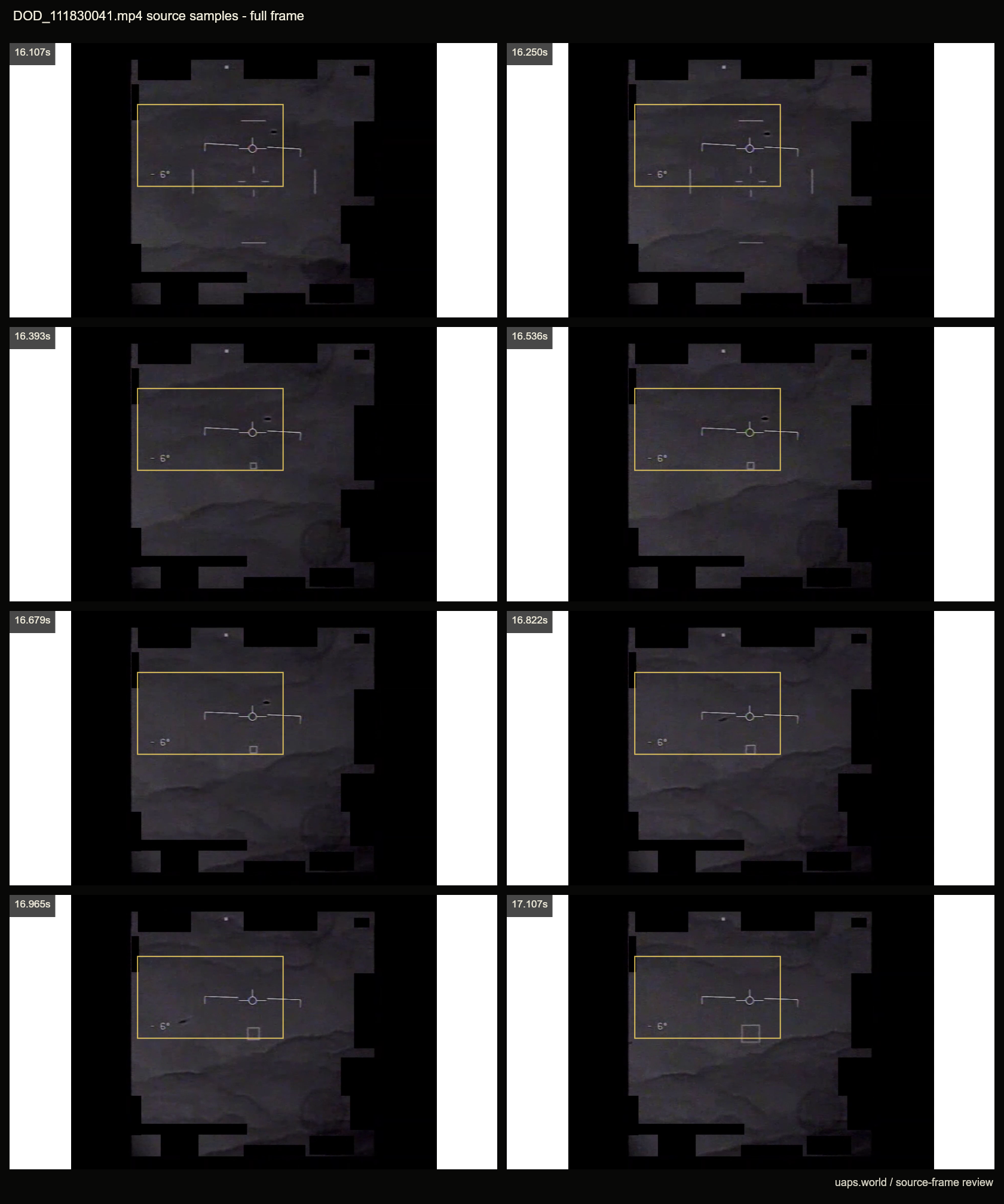
C92 PR107 Eastern US 2020 Reticle Crossing Contrast Sequence
A compact dark oval is source-visible above and right of the central reticle from 16.107 through 16.679 seconds. At 16.822 seconds, an elongated dark mark appears left of the reticle while the prior upper-right oval is no longer resolved. By 16.965 seconds, a dark mark is...
UAPs.world keeps this analysis report connected to its original source path, release context, and related analysis path so readers can inspect the evidence trail directly.
Analysis report summary
This analysis page exposes the report substance directly for readers and crawlers, while the research viewer remains the place for source inspection, frame review, and follow-up work.
Source Basis
The source is PR107 - Unresolved UAP Report, Eastern United States, 2020. The submitted Short/Lots controls were executed as exactly eight raw observations at 16.107s, 16.250s, 16.393s, 16.536s, 16.679s, 16.822s, 16.965s, and 17.107s. A later annotated source-focus lead retested the field-effect/camera-defect fork at 16.947s. Review bundle: raw source sheet, raw submitted-region sheet, and native Fiji enhanced inspection aid.
Observation
A compact dark oval is source-visible above and right of the central reticle from 16.107 through 16.679 seconds. At 16.822 seconds, an elongated dark mark appears left of the reticle while the prior upper-right oval is no longer resolved. By 16.965 seconds, a dark mark is lower-left; at 17.107 seconds no comparable mark is visible in the sampled region. The sequence therefore supports multiple source-visible contrast states and an apparent right-to-left/lower-left progression. The eight samples alone do not prove that every mark is one continuously tracked object: the jump between 16.679 and 16.822 seconds may mix rapid motion, dropped temporal information, display processing, or separate contrast events.
Disc/Bubble Frame Retest
The later frame capture asks whether 13.937s reads as a disc, black-hole-like void, or spacetime bubble. I executed the frame-control requirement by checking the previous frame, the submitted frame, and the next frame: 13.904s, 13.937s, and 13.970s.
The dark mark persists and shifts slightly down/right relative to the crop and nearby symbology.
Persistence across adjacent frames weakens a single-frame dirt/speck read.
It does not establish physical speed or a nonstandard propulsion mechanism.
The source-backed finding is that a compact dark, disc-like mark is real in the sampled frames and persists across the adjacent-frame check. The speculative "space-time bubble" lane remains only a visualization of possible field interaction. It would need calibrated optical distortion, target-locked edge behavior, native cadence, and platform geometry before it could become more than a model attached to the raw frame.
Explanation Lanes
Explanation Lanes
Lane
Fit to the sampled window
Upgrade or falsification test
Display/sensor contrast event
Compact dark marks coexist with heavy symbology and masked display regions; sampled continuity is incomplete.
Recover unaltered sensor frames, native cadence, and processing history.
Field-effect hypothesis
The 16.947s mark is real in raw frames and sits near display controls, but no calibrated optical distortion or target-locked edge response is measured.
Demonstrate a repeatable target-linked deformation that survives native frames, reticle/display overlays, and platform-motion correction.
Near-field or conventional crossing object
A compact object crossing the line of sight could create the apparent rapid image-plane traversal.
Establish focus behavior, range, platform velocity, and parallax.
Unusual controlled motion
A single object may have crossed the reticle region faster than the sparse samples resolve.
Track one stable centroid through every native frame and correct for sensor pointing and aircraft motion.
Field-coupled or nonstandard vehicle model
The disclosure-forward lane remains open if the discontinuous appearance reflects non-ballistic motion or sensor interaction.
Show repeatable target-linked effects that survive raw adjacent frames and cannot be reproduced by display or acquisition behavior.
Theoretical Scene Panels
Theoretical Scene Panels
Panel
Source-grounded read
Speculative model
Limit
A - Upper-right contact
A compact dark oval persists above-right of the reticle across five samples.
A tracked object is crossing the sensor line of sight.
Range and sensor pointing are absent.
B - Reticle crossing
The next sampled mark appears left of the reticle.
Rapid transverse motion or a nonstandard maneuver is possible.
Sparse sampling does not prove continuous identity.
C - Lower-left exit
A dark mark appears lower-left, then disappears from the sampled region.
The same object may continue out of frame.
A separate contrast event or display transition remains viable.
D - Evidence boundary
Source-preserving enhancement retains the oval under a small sensitivity change.
The contrast is not enhancement-only.
Persistence does not establish craft geometry or propulsion.
Working Assessment
PR107 contains a real source-visible compact contrast sequence and an apparent reticle-crossing progression. The 16.947s amendment strengthens the evidence that the dark mark is not merely an imagined single-frame feature, but it also strengthens the caution that display symbology and sparse cadence affect interpretation. It does not independently establish physical speed, acceleration, range, field effect, or a single continuous trajectory. The neutrality gate is satisfied by keeping display/sensor and conventional crossing-object controls active while preserving unusual controlled-motion and field-coupled models as testable, not proven, alternatives.
Crosswalk and analysis triage for the Release 4 DVIDS media files, including Yellow Sea, East China Sea, South China Sea, Eastern/Western United States, Gulf, Atlantic, Apollo debrief audio media, and repeated or digitally altered clips.
The contact is source-visible across the sampled window. It is a compact, high-contrast object that translates across the submitted crop while the background, reticle, and masked overlays shift with the sensor view. The target frame does not show a clean...
Source-anchored guide testing whether PR107's changing dark morphology is better treated as a field-coupled observable than as an isolated camera defect.
Classify this source for 2 points, mark useful or misleading records for 1 point, or submit observations for curator review. Public contribution points progress through Observer, Analyst I, Analyst II, Case Builder, and Archivist and can unlock field desk themes.