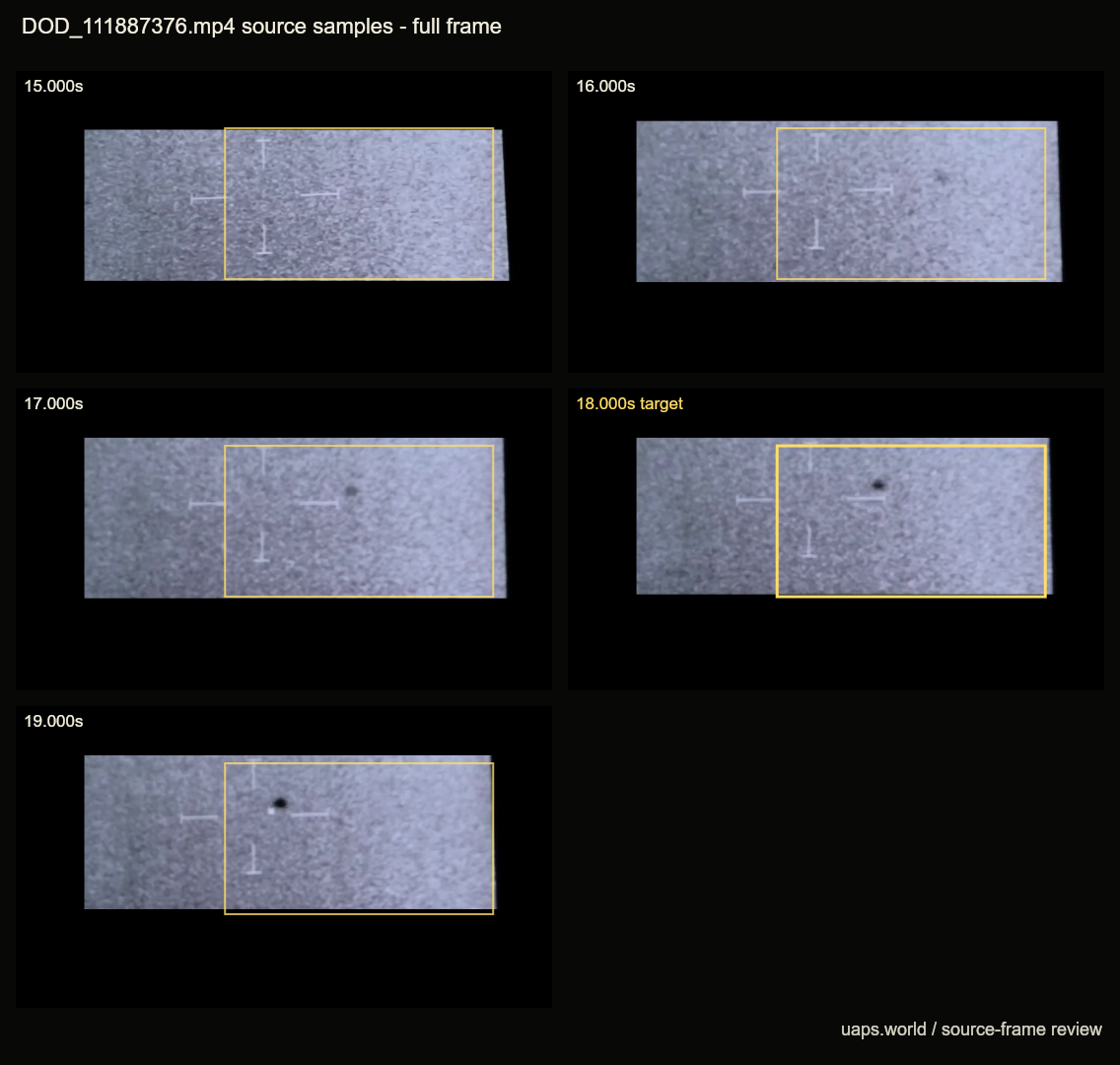
Secondary Release 5 representative sequence testing acquisition, gain, blur, and apparent target growth in PR125.
UAPs.world keeps this analysis report connected to its original source path, release context, and related analysis path so readers can inspect the evidence trail directly.
Analysis report summary
This analysis page exposes the report substance directly for readers and crawlers, while the research viewer remains the place for source inspection, frame review, and follow-up work.
Observation
The first two samples are dominated by a noisy low-contrast field. A compact dark return becomes separable near 17 seconds and is larger/darker at 18-19 seconds. This establishes detection continuity across the later samples and captures a transition in apparent image strength. It does not establish physical growth or approach. Pixel size can change through focus, gain, thresholding, interpolation, tracking, compression, field-of-view change, or slant-range change. The sparse background makes camera motion difficult to separate from object motion. The fixed geometry review preserves the acquisition sequence but does not recover a stable edge. The return remains a small unresolved thermal blob. No enhanced imag...
Working Assessment
Medium confidence: PR125 contains a real source-visible contrast return during 17-19 seconds. Its strongest value is as an acquisition and apparent-angular-size case. The clip does not independently resolve body geometry, range, velocity, or origin.
Related source visuals
These images are rendered directly for quick review, with clean image pages for crawlers and viewer links for inspection.
Classify this source for 2 points, mark useful or misleading records for 1 point, or submit observations for curator review. Public contribution points progress through Observer, Analyst I, Analyst II, Case Builder, and Archivist and can unlock field desk themes.