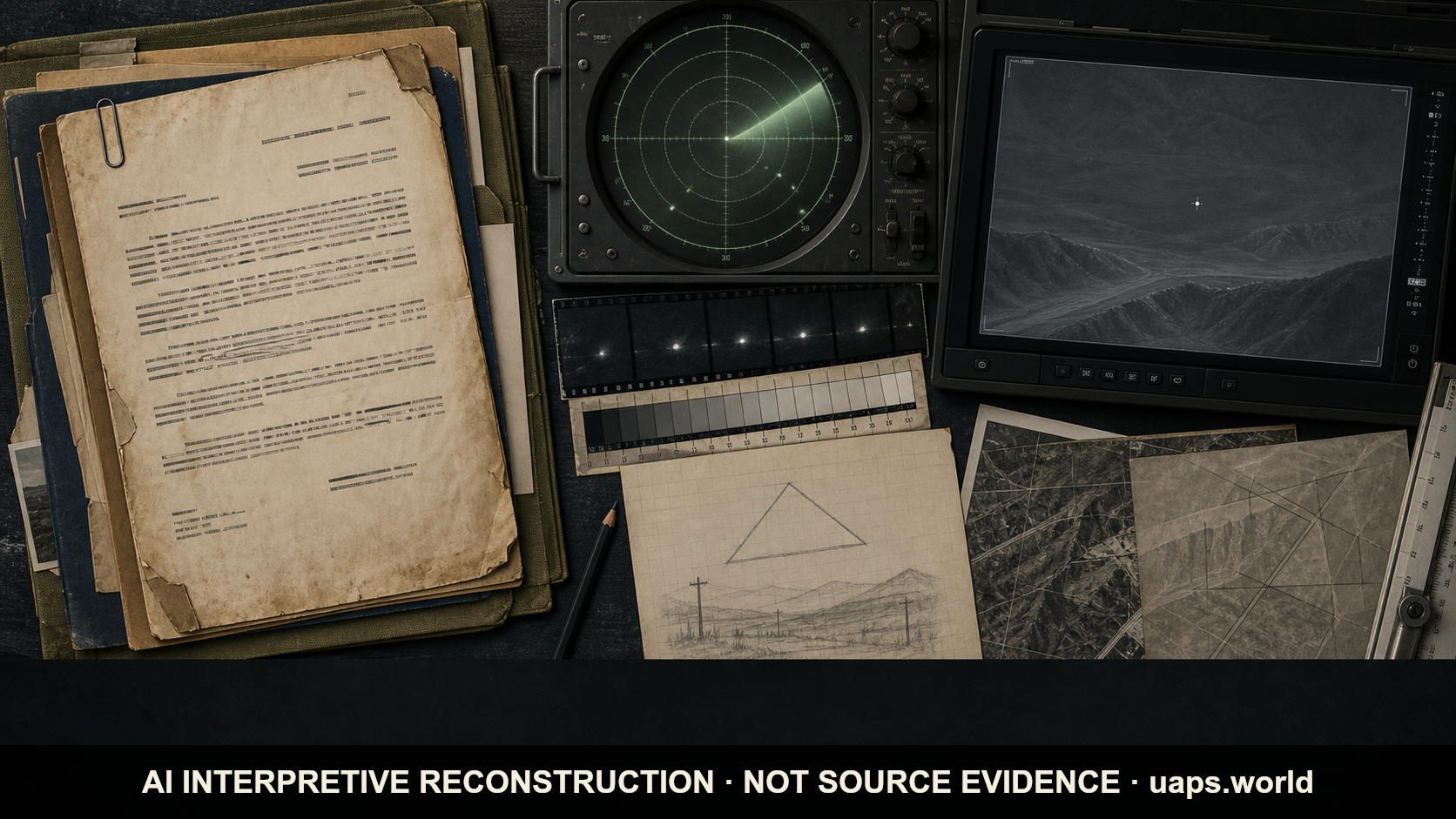
C109 Release 5 Cross Release Synthesis and Evidence Gaps
Integration of Release 5 historical analysis, witness/rendering packets, operational reports, and three representative video sequences with the existing Releases 1-4 evidence model.
Release 5 strengthens the archive in four ways: it adds early government analytical method, a well-bounded false-report correction, modern official witness-to-rendering packets, and sixteen operational/sensor videos. It does not collapse those layers into one phenomenon. The deepest continuity across Releases 1-5 is institutional and methodological. Government collectors repeatedly receive high-claim observations, separate some conventional cases, preserve an unresolved remainder, and release incomplete records whose missing range, calibration, or chain-of-custody fields prevent physical closure. The strongest recurring observable is not a specific craft. It is a compact or point-like contact whose apparent behavior becomes interpretation-dependent when distance and sensor state are unknown.
UAPs.world keeps this analysis report connected to its original source path, release context, and related analysis path so readers can inspect the evidence trail directly.
Analysis report summary
This analysis page exposes the report substance directly for readers and crawlers, while the research viewer remains the place for source inspection, frame review, and follow-up work.
Source Basis
The synthesis is anchored in D100 - Air Materiel Command Report, D022 - Puerto Rico report, D101 - Gulf of Oman report, FBI D024, and the representative raw videos PR136, PR125, and FBI PR007. Companion reports below provide the detailed claim trace.
Working Assessment
High confidence in the release-level synthesis, medium or lower confidence in most physical interpretations. Release 5 meaningfully enlarges the archive because it places strong claims beside methodological cautions and ordinary controls. Its historical documents show that unresolved does not mean unexamined; its modern packets show that examined does not mean physically solved. The durable conclusion is an evidence architecture: keep testimony, official rendering, intelligence narrative, raw video, enhancement, and interpretive reconstruction in separate lanes; promote only sequences that survive adjacent-frame review; and make every kinematic or morphology claim carry its missing calibration beside it.
Classify this source for 2 points, mark useful or misleading records for 1 point, or submit observations for curator review. Public contribution points progress through Observer, Analyst I, Analyst II, Case Builder, and Archivist and can unlock field desk themes.