C71 UAP Secrecy Handling and Disclosure Control Guide
A guide to secrecy, classification, public education, redaction, de-emphasis, report routing, and disclosure pressure across the UAP transcript corpus.
UAPs.world keeps this analysis report connected to its original source path, release context, and related analysis path so readers can inspect the evidence trail directly.
Analysis report summary
This analysis page exposes the report substance directly for readers and crawlers, while the research viewer remains the place for source inspection, frame review, and follow-up work.
Why It Matters
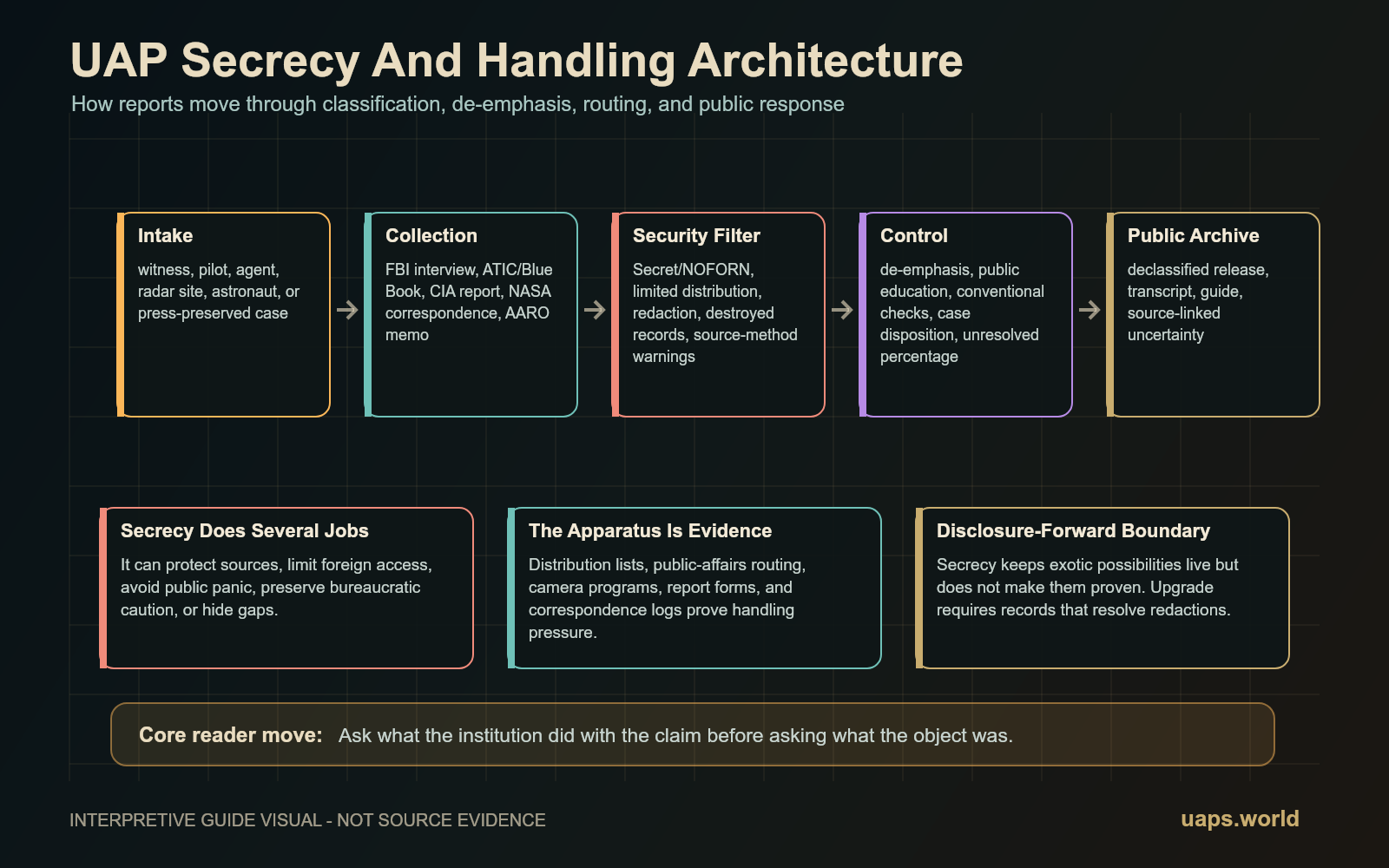
The UAP secrecy story is not simply "the government knows everything" or "the government knows nothing." The source record shows a more interesting machine. Officials collected reports, classified traffic, worried about public reaction, debated hostile-intent risk, created reporting forms, routed letters, hid or redacted some information, tried collection improvements, pushed conventional checks, and sometimes left a residue unresolved. That machine can hide exotic truth, ordinary intelligence, institutional embarrassment, weak evidence, or a mixture of all four. The guide's job is to keep those possibilities alive while stopping the reader from treating secrecy itself as a conclusion.
Working Assessment
The strongest source-backed claim is that the UAP topic has repeatedly been managed as an information-control problem. That does not settle the origin of any object. It does show why the archive feels contradictory: one file can de-emphasize mystery, another can preserve high-alert traffic, another can document evasive handling, and another can publish an unresolved percentage while admitting missing technical data. The Disclosure-Forward Neutrality Gate passes because this guide does not treat secrecy as proof of non-human technology. It treats secrecy as evidence of institutional handling pressure and then asks what records would upgrade, weaken, or falsify the exotic lane.
Classify this source for 2 points, mark useful or misleading records for 1 point, or submit observations for curator review. Public contribution points progress through Observer, Analyst I, Analyst II, Case Builder, and Archivist and can unlock field desk themes.