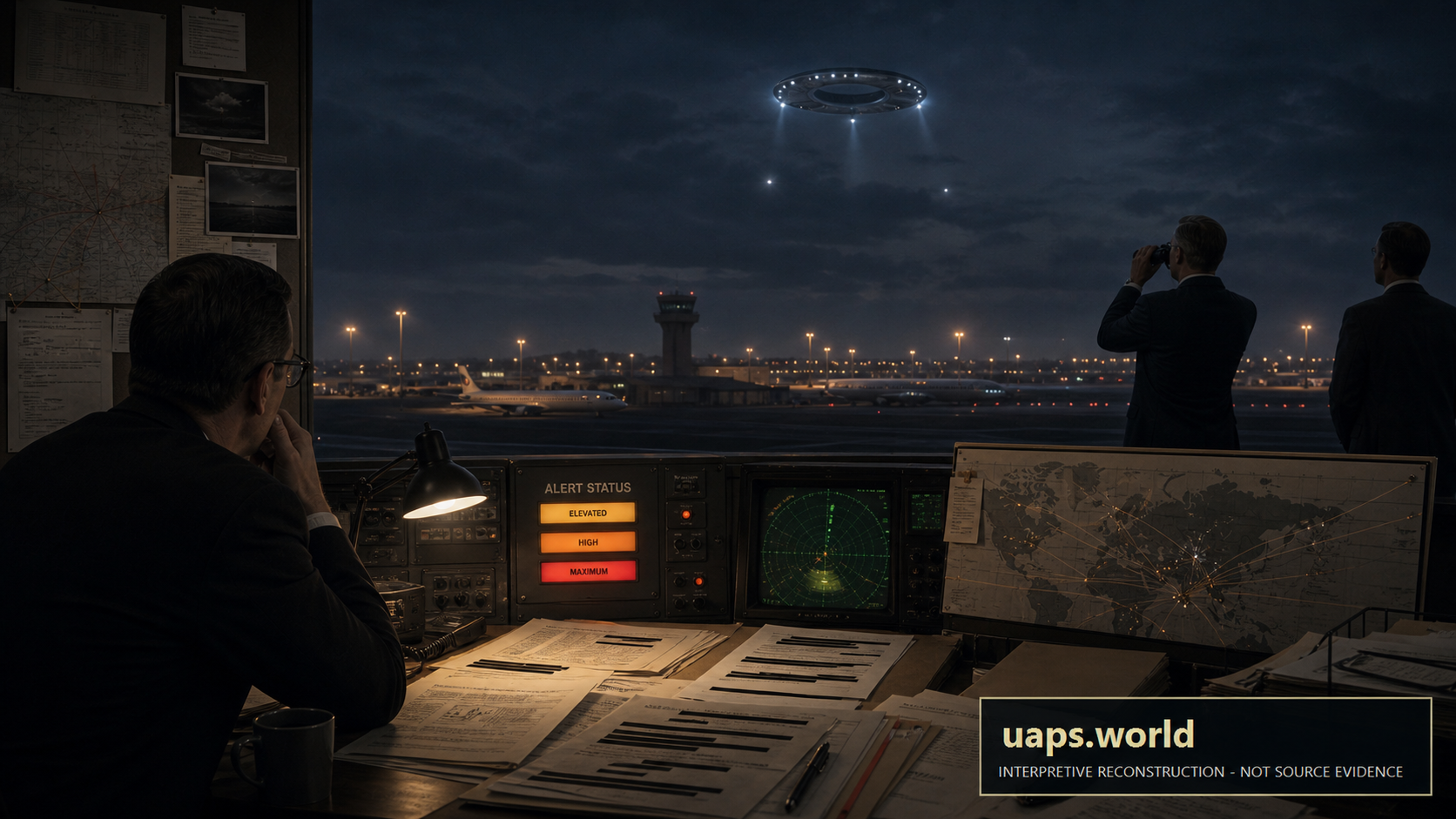
Source-render grounded guide to official and press-preserved UAP events that triggered police, civil defense, intelligence, aviation, scientific, or national-security response.
Analysis report summary
This analysis page exposes the report substance directly for readers and crawlers, while the research viewer remains the place for source inspection, frame review, and follow-up work.
Observation
The common pattern is not that every vivid report proves an extraordinary conclusion. It is that certain UAP events cross an institutional threshold. A light in the sky becomes a case when it touches airports, police witnesses, trace claims, FBI interviews, IC partner analysis, NASA correspondence, AARO-style review, civil-defense officials, aviation records, intelligence warnings, foreign-power suspicion, or alert posture. The Harare airport event remains the strongest national-security trigger in this guide. CIA-UAP-017 joins three layers in one record: source observation, security response, and origin debate. The source-observation layer is an object hovering at high altitude over or directly above...
Hypothesis To Test
Primary hypothesis: the most useful guide category is "apparatus-triggering events." These are cases where identity uncertainty mattered because the event forced some formal response: police investigation, scientific inspection, civil-defense concern, air-defense/aviation checks, CIA dissemination, or high-alert posture. Conventional/adversary-control hypothesis: the objects or reports in this guide could resolve to different ordinary lanes by case: foreign reconnaissance platform, balloon/aerostat, experimental aircraft, military flares, aircraft lights, ground vehicles, atmospheric/astronomical effect, snow/cloud backscatter, spacecraft debris, mission hardware, public-story amplification, or airport-area...
Why It Matters
High-profile UAP events matter because they reveal the tripwire. A case does not need to prove extraterrestrial origin to be important. It becomes historically important when it forces a system to act: police call scientists, FBI interviews are opened, IC partners write environmental assessments, AARO-style analysts compare reports against logs and radar, NASA responds through congressional correspondence, civil-defense officials report observations, Air Force records are checked, CIA sends warning traffic, aviation/security actors enter the loop, or a government moves to high alert. The guide is also a useful antidote to two opposite errors. The first error is overstatement: treating the words...
Working Assessment
The strongest source-backed claim is that the local corpus contains multiple apparatus-trigger lanes, but they are not all equal. CIA-UAP-017 is a medium-confidence document-analysis anchor and a high-value alert-threshold case: on 2 July 2008, an unidentified high-altitude object was reported over Harare International Airport; it was possibly observed by radar and optical means; it was described as beam-emitting, disc-like, hollow-centered, and fitted with rotating underside lights that shifted colors before rapid ascent; and the incident produced a high-alert decision for a redacted Zimbabwe-related entity. The Western U.S. packet is the best current modern official analysis-update lane: it preserves a...
Public Field Desk
Classify this source for 2 points, mark useful or misleading records for 1 point, or submit observations for curator review. Public contribution points progress through Observer, Analyst I, Analyst II, Case Builder, and Archivist and can unlock field desk themes.