The source is important because it is not just another UFO case catalog. It is a government-intelligence posture document. The minute paper says two attached documents were meant to focus on aspects of the UFO problem that had tended to remain hidden: one about the U.S....
UAPs.world keeps this analysis report connected to its original source path, release context, and related analysis path so readers can inspect the evidence trail directly.
Analysis report summary
This analysis page exposes the report substance directly for readers and crawlers, while the research viewer remains the place for source inspection, frame review, and follow-up work.
Source Basis
This note reviews CIA-UAP-019 - Australian Dept of Defense Scientific and Intel Aspects of the UFO Problem and the local OCR transcript CIA-UAP-019 transcript. The transcript identifies the source as a Department of Defence Joint Intelligence Organization minute paper dated 27 May 1971, with National Archives of Australia reference NAA:A13693,3092/2/000 visible in the OCR. The transcript is mechanically normalized and should be page-verified before tight quotation.
Observation
The source is important because it is not just another UFO case catalog. It is a government-intelligence posture document. The minute paper says two attached documents were meant to focus on aspects of the UFO problem that had tended to remain hidden: one about the U.S. official attitude and one about evidence for weapons systems allegedly used by UFOs. The weapons-system evidence is described as coming from computerized records collected by Dr. Jacques Vallee in collaboration with Dr. J. Allen Hynek, and the paper says Australia had its share of this kind of reporting. The summary makes a strong claim about the U.S. record: early USAF intelligence treated some reports as real phenomena with flight...
Robertson Panel, Blue Book, 4602nd AISS, JANAP, Special Report 14, anti-gravity funding, and Condon-report criticism are used to argue that public posture diverged from intelligence interest.
Needs page-level verification against the original PDF and cross-checking against CIA-002/CIA-007/D085.
The source claims a second document deals with UFO weapon-system evidence from Vallee/Hynek records.
OCR is thin in this region; capture and page review are required before promoting details.
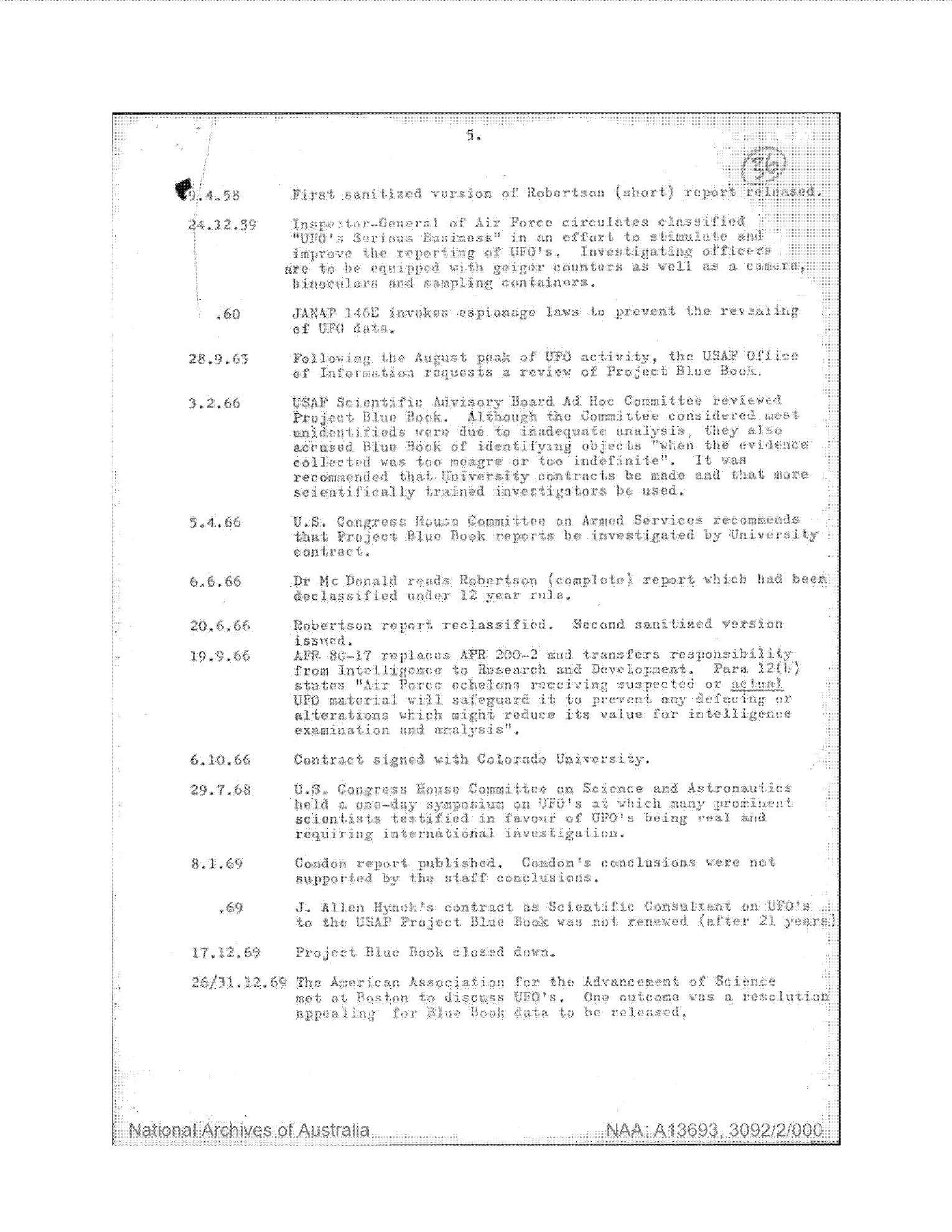
Capture-Lead Resolution - Page 19 Chronology
The July 1 capture lead asked to dissect the captured page 19, add it to the synopsis, and tie it into other reports. Page 19 is not a fresh object case; it is the last page of a chronology that sharpens the document's control-layer argument.
The page notes a first sanitized Robertson report release, an Inspector-General circular treating UFO reporting seriously enough to improve reporting channels and equipment, and JANAP 146E restricting release of UFO data.
This supports the report's information-control lane: UFO handling is framed as intelligence collection plus public/authorized-disclosure management.
After an August activity peak, USAF information channels requested Blue Book review; the Scientific Advisory Board criticized inadequate analysis and recommended university contracts and more scientifically trained investigators.
This strengthens the Australian paper's critique that public identifications and weak analysis were not enough; even inside the official chain, better scientific handling was being requested.
AFR 80-17 is described as moving responsibility from intelligence to research and development, while requiring Air Force echelons receiving suspected or actual UFO material to safeguard it against alteration or destruction.
Disclosure-forward possibility lane: the page leaves room for material-intelligence concern. Conservative lane: it may be procedural handling language rather than evidence that exotic material was recovered.
The page says the Condon conclusions were not supported by staff conclusions, Hynek's consultant contract was not renewed after 21 years, Blue Book closed, and AAAS discussion produced an appeal for Blue Book data release.
This is the strongest page-19 synopsis upgrade: the Australian document presents closure as contested, not as a clean scientific settlement.
Working update: page 19 upgrades the appendix from a vague "weapon-system evidence" pointer into a clearer administrative chronology. It supports a generous hypothesis that Australian intelligence readers saw a persistent mismatch between public closure and internal scientific/intelligence concern. It does not, by itself, prove U.S. possession of non-human technology, but it gives the archive a specific page citation for the claim that Blue Book/Condon closure remained disputed and that material-handling language existed in the official chain.
Hypothesis To Test
Conservative reading: CIA-UAP-019 is a 1971 Australian government/intelligence critique of UFO administration. It shows that at least one Australian defence-intelligence lane viewed the U.S. public posture skeptically and considered Australia underprepared. It does not independently prove U.S. anti-gravity success, extraterrestrial origin, or UFO weapon systems. Disclosure-forward reading: this is a very strong policy-shadow document. If the hidden-program model is true, the paper reads like an allied intelligence officer noticing the mismatch between public debunking and the deeper indicators: propulsion interest, gravity research, communications overload, public-relations control, and poor scientific...
Working Assessment
Promote CIA-UAP-019 as a high-value governance and intelligence-analysis source. The source-backed claim is that a 1971 Australian defence-intelligence paper argued Australia should not remain ignorant or rely on the U.S. public UFO posture, and that Australia lacked sufficient intelligence, scientific, and public-facing handling of UFO reports. The strongest caution is that the document is interpretive. It summarizes and argues from U.S. public records, Blue Book material, CIA/Robertson claims, Hynek/Vallee context, anti-gravity program claims, and RAAF shortcomings. Use it to map institutional concern and allied skepticism, not to declare that every assertion inside the paper has been independently verified.
The archive no longer reads as a set of isolated oddities. It has repeating families: luminous orbs, cigar or egg-like bodies, abrupt acceleration, apparent field occlusion, formation behavior, sensor ambiguity near clouds or water, and official paperwork...
The document layer repeatedly touches sensitive sites, scientific personnel, DOE-adjacent material, and narrative claims about close-range or anomalous objects. Some files are context rather than event evidence, but the clustering is meaningful.
A layman's guide to executive disclosure: what the archive shows, what the disclosure-forward model infers, how bureaucracy shapes the evidence trail, and what gaps still need source work.
A source-first guide to the Release 3 UAP records, including CIA historical control, Western U.S. records, FBI witness material, NASA/Gemini documents, and DVIDS media.
The key Release 3 historical finding is institutional, not photographic. The CIA/DOW set shows a repeated state problem: official channels tracked reports, assessed foreign-power risk, looked for instrumentation and reporting discipline, then also worried...
A source-first guide separating recovered-craft allegations from declassified CIA and allied intelligence leads, Soviet/PRC foreign-technology context, captured U.S. platforms, and China-adjacent UAP sightings.
Source-render grounded guide to official and press-preserved UAP events that triggered police, civil defense, intelligence, aviation, scientific, or national-security response.
A source-first guide to recurring UAP morphology and behavior claims across Release 3 transcripts, with controls for reading shape, light, motion, multiplicity, and secrecy-shaped evidence.
Classify this source for 2 points, mark useful or misleading records for 1 point, or submit observations for curator review. Public contribution points progress through Observer, Analyst I, Analyst II, Case Builder, and Archivist and can unlock field desk themes.