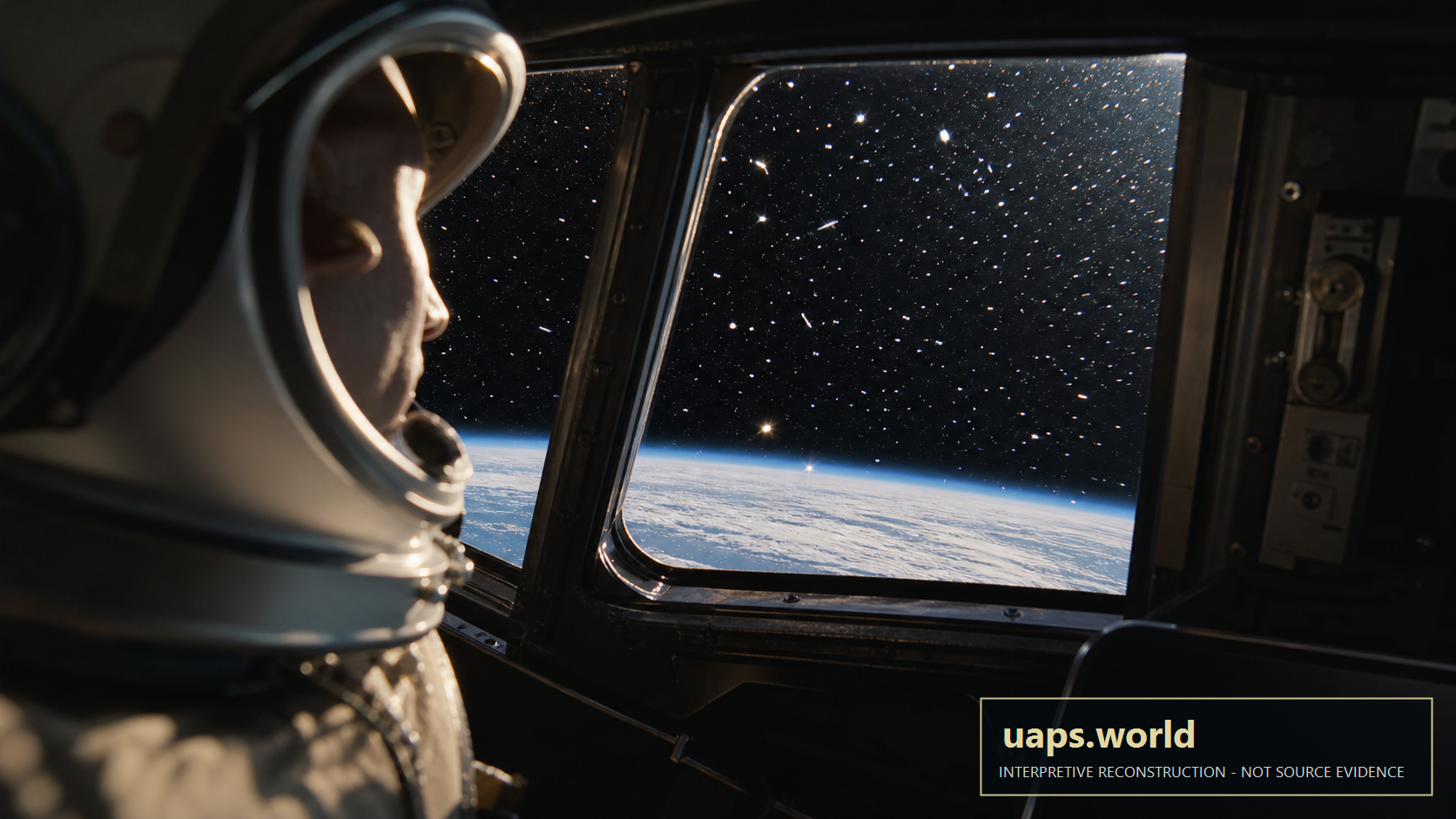
C52 NASA Gemini and Astronaut Phenomena Control Layer
Release 3 adds a Gemini-era control layer to the existing NASA/Apollo analysis. The official metadata points to luminous particles, sparkles, flashing lights, visual-sightings debrief sections, Gordon Cooper's public comments, and Apollo 16 scientific-audio anomalies. This is...
UAPs.world keeps this analysis report connected to its original source path, release context, and related analysis path so readers can inspect the evidence trail directly.
Analysis report summary
This analysis page exposes the report substance directly for readers and crawlers, while the research viewer remains the place for source inspection, frame review, and follow-up work.
Observation
Release 3 adds a Gemini-era control layer to the existing NASA/Apollo analysis. The official metadata points to luminous particles, sparkles, flashing lights, visual-sightings debrief sections, Gordon Cooper's public comments, and Apollo 16 scientific-audio anomalies. This is valuable because it narrows the question: NASA material should not be read as "anything in space is a craft." It should be read as a disciplined ambiguity set: particles, debris, flashes, instrument/experiment context, and trained-observer language.
Hypothesis To Test
Space-domain hypothesis: if the disclosure-forward frame is true, some NASA observations may be incidental glimpses of a monitoring or field-signature layer in cislunar/low-Earth space. The Gemini documents are useful because they preserve crew descriptions, not just still images. Control hypothesis: the same documents also preserve the strongest ordinary lanes: spacecraft debris, particles, vented material, illumination angle, visual adaptation, meteors, aurora, lightning, experiment flashes, and mission hardware. Release 3 should therefore reduce overstatement in C05 - NASA Apollo and Spaceflight, not inflate it.
Working Assessment
Release 3 should make the NASA lane sharper and more conservative. It supports the existence of recurring luminous/particle/flash reports in astronaut and scientific debrief contexts, while also supplying the reasons those reports are hard to upgrade. This is useful analysis material because it creates falsification pressure on speculative Apollo visual hypotheses.
Classify this source for 2 points, mark useful or misleading records for 1 point, or submit observations for curator review. Public contribution points progress through Observer, Analyst I, Analyst II, Case Builder, and Archivist and can unlock field desk themes.