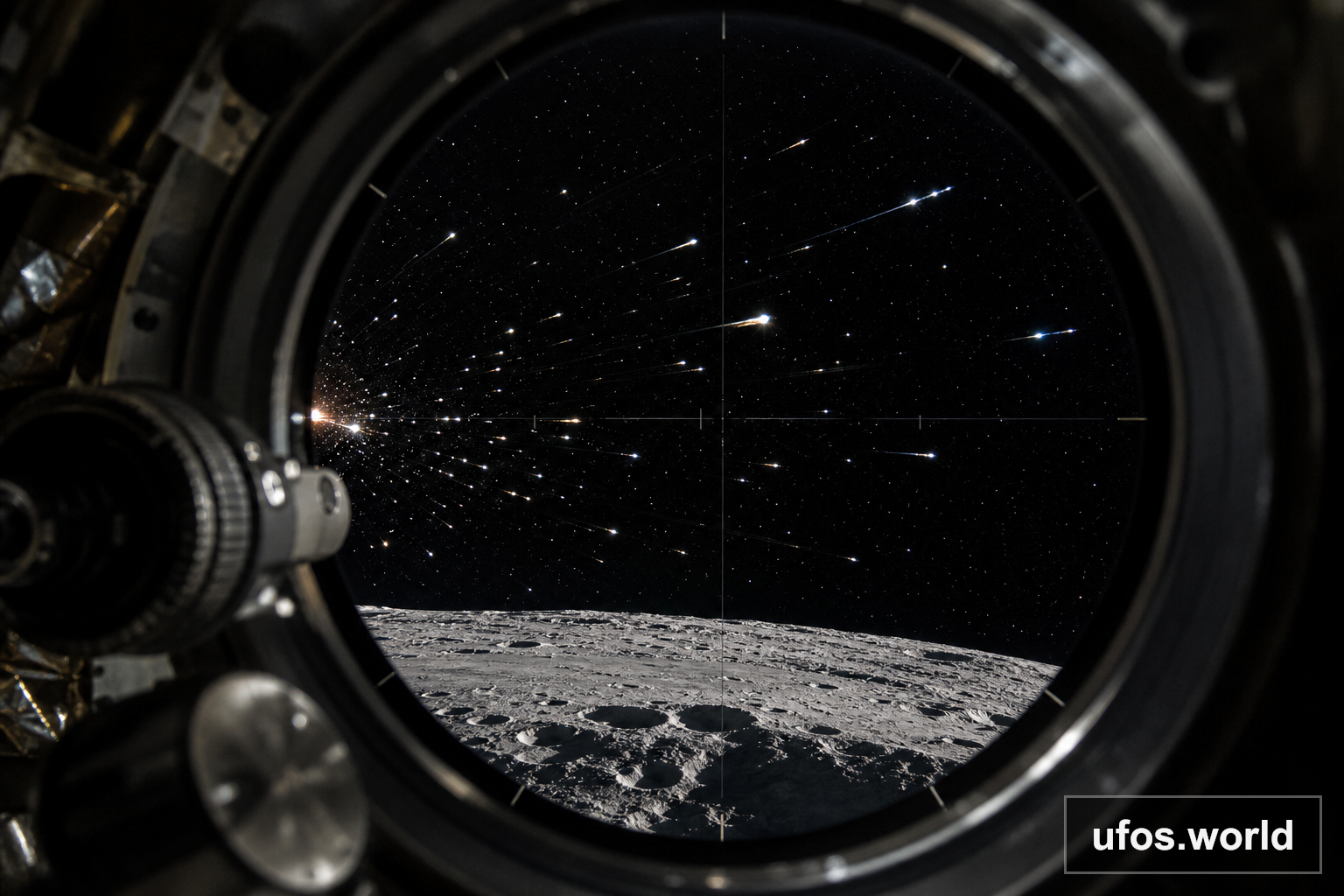
This speculative analysis consolidates NASA extracts, restored Apollo mission briefs, Apollo 12 visual capture analysis, and broader spaceflight context. It cites Apollo 12 Transcript, 1969, Apollo 11 Technical Crew Debriefing, 1969, Apollo 17 Transcript, 1972, Apollo 17 Crew...
UAPs.world keeps this analysis report connected to its original source path, release context, and related analysis path so readers can inspect the evidence trail directly.
Analysis report summary
This analysis page exposes the report substance directly for readers and crawlers, while the research viewer remains the place for source inspection, frame review, and follow-up work.
Source Basis
This speculative analysis consolidates NASA extracts, restored Apollo mission briefs, Apollo 12 visual capture analysis, and broader spaceflight context. It cites Apollo 12 Transcript, 1969, Apollo 11 Technical Crew Debriefing, 1969, Apollo 17 Transcript, 1972, Apollo 17 Crew Debriefing for Science, 1973, Apollo 17 Technical Crew Debriefing, 1973, Skylab Techincal Crew Debriefing 1973, Apollo 12, 1969, and the VM4 capture note image.
The following image is a non-evidentiary reconstruction of the viewing geometry described in the transcript. It illustrates the astronaut's reported AOT dark-quadrant view: the optical field, the behind-left apparent source direction, nearby debris-like lights that could fit the water-boiler explanation, and farther luminous points that seem to sail away from the Moon toward the star field.
The circular optical framing and faint quadrant feel represent the Alignment Optical Telescope context, not a camera photograph.
Based on the transcript's AOT/dark-quadrant language only.
Origin geometry
The particle paths are staged from behind and left of the observer into quadrant 1, matching the reported apparent direction.
Directional inference from the transcript; not independently measured.
Conventional control
The nearest specks remain close to the LM and are intentionally rendered as debris-like, preserving the water-boiler/spacecraft-source possibility.
This is the strongest ordinary explanation lane.
Anomalous motion prompt
The farther streaks lengthen outward into the star field to visualize "sailing off," "escaping the Moon," and pressing away from the local lunar scene.
Speculative visualization of the observer's wording, not proof of acceleration or propulsion.
The reconstruction is useful because it makes the ambiguity spatial. A purely local debris explanation predicts short-lived nearby particles illuminated by LM geometry. The more provocative reading begins only if some points show sustained outward motion inconsistent with simple venting, drifting fragments, or lighting angle. The transcript does not settle that fork; it simply records that the observer noticed the difference strongly enough to move from an onboard-source guess to escape-from-Moon language in the same report.
An approved anonymous follow-up asked that the Apollo 12 mothership hypothesis images be incorporated into this NASA synthesis, especially the hypothetical visualizations and a disclosure-forward summary of what the event family describes. The useful way to include them here is as a hypothesis family, not as upgraded source evidence. The source-backed anchors remain the Apollo 12 still-image states and their dedicated reports: C37 - Apollo 12 VM5 Mothership Hypothesis for the VM5 stacked-feature model, and C38 - Apollo 12 VM3 Frigate Capital Ship Hypothesis for the VM3 frigate/capital-ship variant. Both reports keep the source claim narrow: tiny color-separated stacked features in processed Apollo 12 image...
Evidence only: unresolved image features inside processed Apollo stills.
Geometry read
VM5 supports a larger carrier/frigate layout question; VM3 supports a smaller capital-ship profile question.
Observation plus inference; useful for asking sharper questions, not for raising confidence.
Mechanism model
Under a disclosure-forward model, the visible stack could be the optically available edge of a distant platform, field aperture, or illuminated structural boundary.
Speculative synthesis anchored to the cited still states.
Limits
The model fails if the features track scan blocks, annotation edges, color-channel separation, emulsion damage, dust, or compression behavior.
Provisional; confidence remains low until less-processed source versions preserve the geometry.
This amendment changes the synthesis value of the visuals, not the evidence grade. The reconstructions are best used as a field notebook layer: they let a reviewer picture what the mothership/frigate hypothesis is trying to test, while the Apollo source frames and conventional controls continue to decide whether the idea survives.
Working Assessment
Keep NASA and Apollo material as a separate speculative synthesis lane. It prevents the archive from becoming only a drone-or-balloon debate, while also preventing the disclosure-forward model from outrunning its evidence. Current assessment: NASA events are high-value pattern material, strongest as a disciplined speculative framework and weakest as standalone proof.
The broad 9.568s capture shows a compact source near the sensor center. The object is not a crisp aircraft silhouette. It appears as a soft thermal/contrast form with a brighter left-side region and a darker rightward extension.
The image contains a yellow annotation box and enlargement pointing to a small light-like speck above the lunar horizon. The speck is visible in the annotated crop and appears isolated against a darker sky region. The lunar surface, astronaut shadow, and...
This synthesis is a working model built from Release 1 and Release 2 source material plus prior UFO Viewer analysis. It assumes, for analytic purposes only, that some observed craft or contacts may use a surrounding field that obscures shape, alters sensor...
The still-image family divides into primary source stills, NASA mission images, FBI image plates, and secondary analysis products derived from video captures or reconstructions. The distinction matters because contact sheets are excellent for pattern...
The source-observable VM5 feature is tiny, vertically stacked, and heavily magnified inside the annotated source plate. It shows a bright lower region, cooler blue/white middle structure, and a warmer upper patch, but it is also embedded in a blocky,...
The VM3 capture shows a compact, vertically stacked bright feature against a dark, blocky photographic field. The strongest visible structure is a white lower lobe, a cooler blue fringe below or around it, and a small reddish upper patch. The full source...
A source-first guide to the Release 3 UAP records, including CIA historical control, Western U.S. records, FBI witness material, NASA/Gemini documents, and DVIDS media.
Release 3 adds a Gemini-era control layer to the existing NASA/Apollo analysis. The official metadata points to luminous particles, sparkles, flashing lights, visual-sightings debrief sections, Gordon Cooper's public comments, and Apollo 16...
A deeper pass through the active companion follow-up tasks, tying Release 3 document packets, orb videos, historical controls, and routing notes into a source-backed work map.
A source-first guide to the July 10, 2026 Release 4 records, including Los Alamos green fireball material, Project Sign and Blue Book files, Pantex, range-fouler debriefs, NASA spaceflight controls, and DVIDS sensor media.
Classify this source for 2 points, mark useful or misleading records for 1 point, or submit observations for curator review. Public contribution points progress through Observer, Analyst I, Analyst II, Case Builder, and Archivist and can unlock field desk themes.