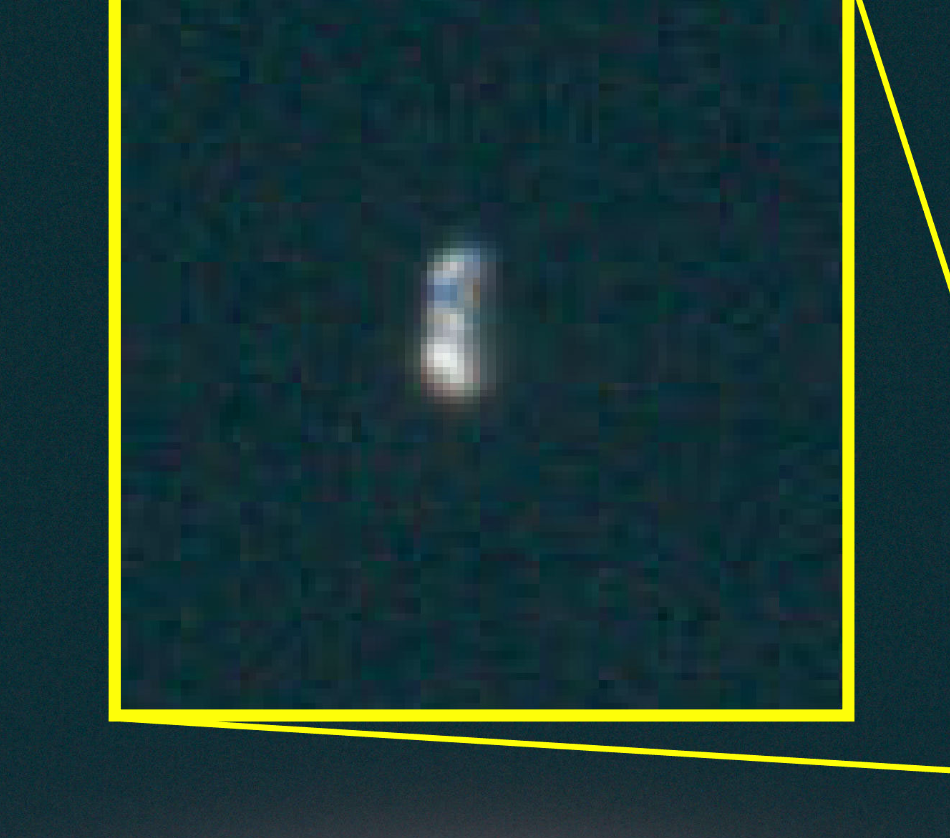
The source-observable VM5 feature is tiny, vertically stacked, and heavily magnified inside the annotated source plate. It shows a bright lower region, cooler blue/white middle structure, and a warmer upper patch, but it is also embedded in a blocky, processed-looking dark...
UAPs.world keeps this analysis report connected to its original source path, release context, and related analysis path so readers can inspect the evidence trail directly.
Analysis report summary
This analysis page exposes the report substance directly for readers and crawlers, while the research viewer remains the place for source inspection, frame review, and follow-up work.
Observation
The source-observable VM5 feature is tiny, vertically stacked, and heavily magnified inside the annotated source plate. It shows a bright lower region, cooler blue/white middle structure, and a warmer upper patch, but it is also embedded in a blocky, processed-looking dark field. The full VM5 source plate contains several annotated areas of interest; Area 5 is the richest for this particular vertical-stack reading. The 10.90x high-contrast capture strengthens the layout question but not the evidence grade. It shows a multi-lobed vertical feature near the yellow annotation boundary: a pale blue-white upper mass, a smaller green-blue left/lower protrusion, and a separated bright lower lobe. A sci-fi frigate...
Hypothesis To Test
Mothership hypothesis: if the VM5 vertical stack is a real object rather than scan noise, annotation artifact, or compression structure, its proportions could be interpreted as a larger carrier-like body seen nose-on or end-on above the lunar horizon. The bright lower mass could represent a luminous field aperture, propulsion envelope, or reflective lower hull. The darker upper cap could be interpreted as a body or superstructure. Under this reading, the object would be less like a small orb and more like a distant operational platform. Frigate variant: the newer high-contrast crop supports a more asymmetric model than the earlier mothership view. Instead of a single vertical carrier, the stacked pixels can...
Why It Matters
The analysis is valuable because it gives the speculative model a disciplined container. Without a separate note, the reconstruction can accidentally feel like evidence. Here it is explicitly a hypothesis illustration paired with the real VM5 capture, conventional controls, and validation links.
Working Assessment
Current assessment: unresolved Apollo 12 VM5 bright stacked feature with useful but highly speculative mothership/frigate/fleet hypotheses. The source does not yet support "mothership," "frigate," or "fleet" as a finding. It supports "structured-vehicle interpretive models to test against the VM image family." That is still worth preserving because it gives future review sharper questions: do the lobes persist across source states, and does the Apollo 12 above-horizon feature family behave like artifact, debris, annotation, or a repeated distant structured object?
Classify this source for 2 points, mark useful or misleading records for 1 point, or submit observations for curator review. Public contribution points progress through Observer, Analyst I, Analyst II, Case Builder, and Archivist and can unlock field desk themes.