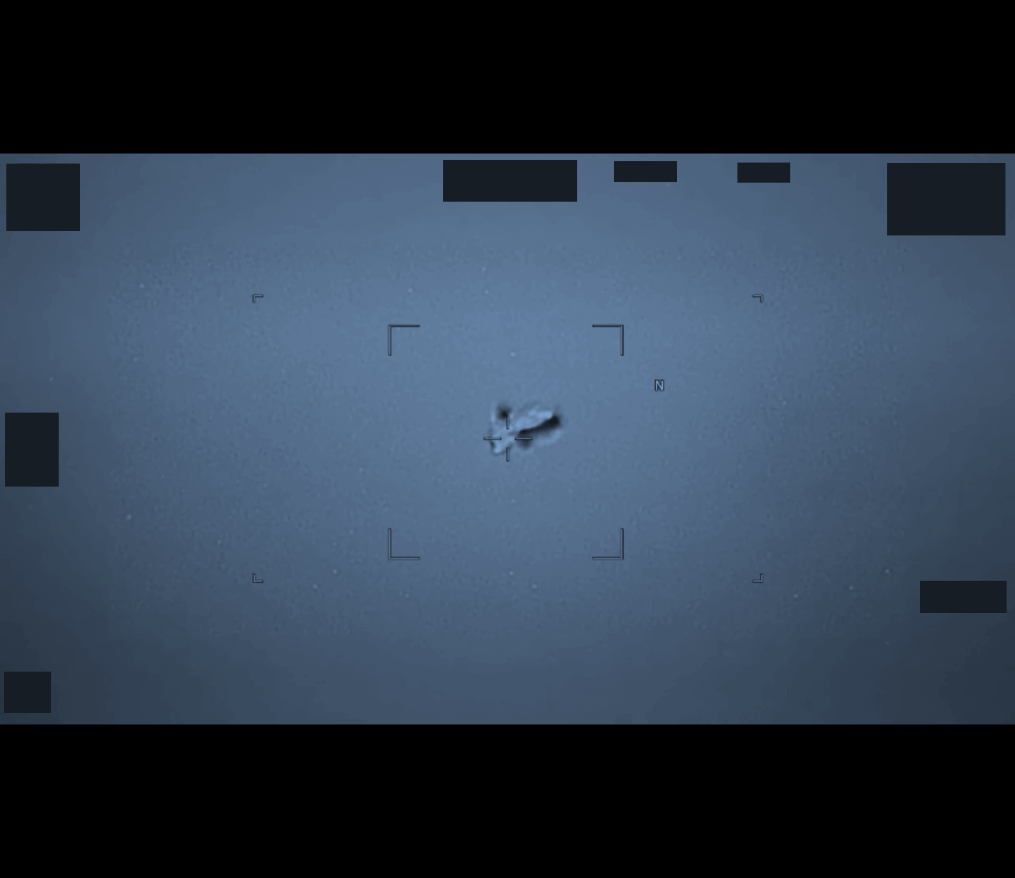
The broad 9.568s capture shows a compact source near the sensor center. The object is not a crisp aircraft silhouette. It appears as a soft thermal/contrast form with a brighter left-side region and a darker rightward extension.
UAPs.world keeps this analysis report connected to its original source path, release context, and related analysis path so readers can inspect the evidence trail directly.
Analysis report summary
This analysis page exposes the report substance directly for readers and crawlers, while the research viewer remains the place for source inspection, frame review, and follow-up work.
Observation
The broad 9.568s capture shows a compact source near the sensor center. The object is not a crisp aircraft silhouette. It appears as a soft thermal/contrast form with a brighter left-side region and a darker rightward extension. The close 9.367s capture makes the user-requested shape hypothesis understandable: one region can be read as a loop, oval, or field-envelope feature, while the opposite side can be read as a darker swept body or wake. However, the image is highly blurred, zoomed, and partially occluded by reticle marks. The visible shape is therefore source-observable only as a soft asymmetric contrast pattern, not as a confirmed hull geometry.
Hypothesis To Test
The approved lead asks whether this could be a visible craft hull, possibly a compact body with a toroidal field or reactor feature. The test is not whether the reconstruction looks plausible; the test is whether adjacent frames preserve the same internal geometry. Validation criteria: - any oval/loop-like structure should remain spatially attached to the target across adjacent frames, - any swept body or aft extension should maintain orientation relative to the object rather than the sensor frame, - reticle overlap and zoom processing should not create the apparent loop, - the halo/bloom should vary independently from any persistent core. If those conditions hold, the case strengthens as a hull/envelope...
Why It Matters
If the toroidal-field pattern survives adjacent-frame testing, DOD_111689133 becomes stronger than a generic unresolved dot. It becomes a morphology case with a proposed compact hull and aft field-reactor structure. If it fails, the archive should keep it as an instructive example of how sensor bloom and zoom can suggest a craft-like hull.
Working Assessment
Assessment: useful morphology lead, unresolved. The source captures support a visible asymmetric thermal form and justify a compact fieldcraft / toroidal-reactor hypothesis test. They do not yet prove a physical torus body or exotic hovering craft. Promote this to adjacent-frame morphology review, with the reconstruction treated as interpretive only.
Classify this source for 2 points, mark useful or misleading records for 1 point, or submit observations for curator review. Public contribution points progress through Observer, Analyst I, Analyst II, Case Builder, and Archivist and can unlock field desk themes.