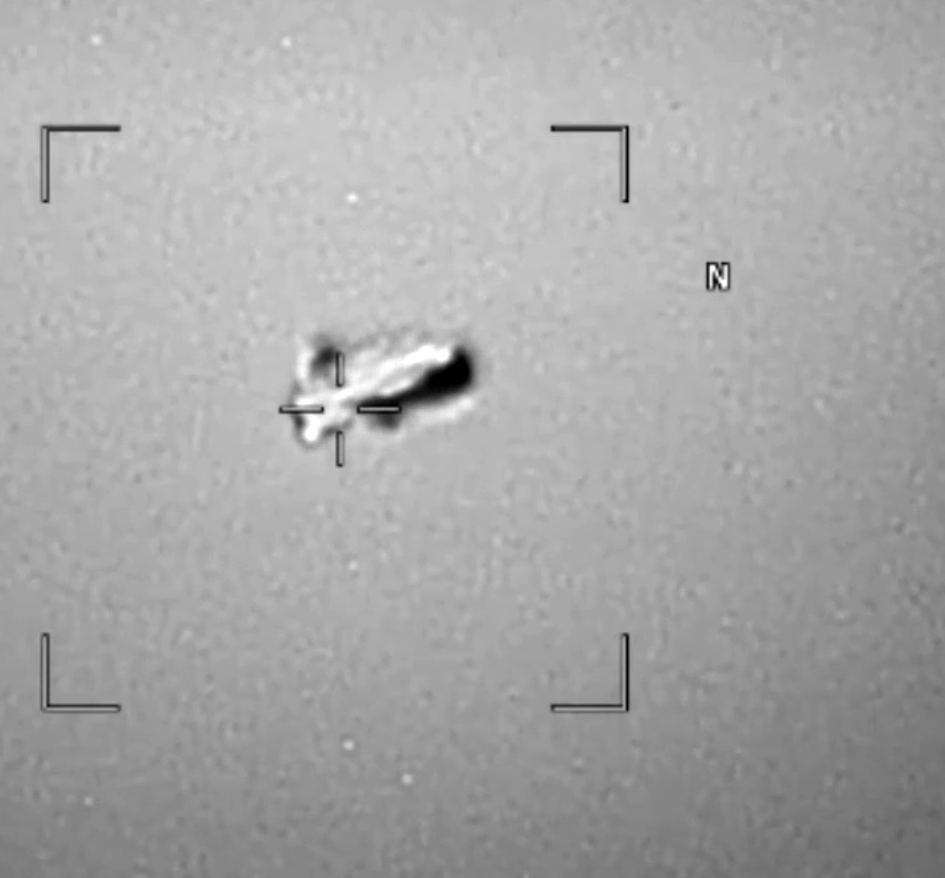
The captured frame shows a compact high-contrast object near the center-left of the sensor view. The strongest visible structure is not a clean outline but a bright leading or central region, a darker saturated lobe to the right, and a surrounding pale halo or smear. The...
UAPs.world keeps this analysis report connected to its original source path, release context, and related analysis path so readers can inspect the evidence trail directly.
Analysis report summary
This analysis page exposes the report substance directly for readers and crawlers, while the research viewer remains the place for source inspection, frame review, and follow-up work.
Observation
The captured frame shows a compact high-contrast object near the center-left of the sensor view. The strongest visible structure is not a clean outline but a bright leading or central region, a darker saturated lobe to the right, and a surrounding pale halo or smear. The contact is visibly more complex than a single point, but the frame does not show a stable, resolved hull boundary with enough detail to identify fins, wings, windows, seams, propulsion outlets, or a fixed fuselage geometry. The user request asks whether the hull might be visible. Source-backed answer: a possible body core is visible, but the capture more securely supports "compact object with bloom/halo and asymmetric contrast" than...
Hypothesis To Test
Hull-visible hypothesis: if the bright/dark central region stays consistent across adjacent frames while the surrounding bloom changes, the central region may be the physical body and the halo may be sensor or field interaction. If the entire shape stretches, collapses, or stays locked to image-axis artifacts, then the apparent hull is likely produced by motion blur, focus, sensor gain, compression, or contrast processing. This is therefore a good morphology lead, but not yet a feature-identification lead.
Why It Matters
This lead matters because a real hull/body boundary would move the case from "unresolved bright object" toward a morphology case. But a single zoomed frame can easily turn bloom, sharpening, compression, or motion smear into a perceived structure. The analysis value is in separating the persistent core from the transient envelope.
Working Assessment
Assessment: unresolved compact object with possible body core, not a resolved hull. The frame supports further testing for hull/envelope separation, but it does not establish distinct craft features. Treat the visible shape as provisional until adjacent-frame behavior confirms that the same central geometry persists independent of bloom and sensor processing.
Classify this source for 2 points, mark useful or misleading records for 1 point, or submit observations for curator review. Public contribution points progress through Observer, Analyst I, Analyst II, Case Builder, and Archivist and can unlock field desk themes.