Source Basis
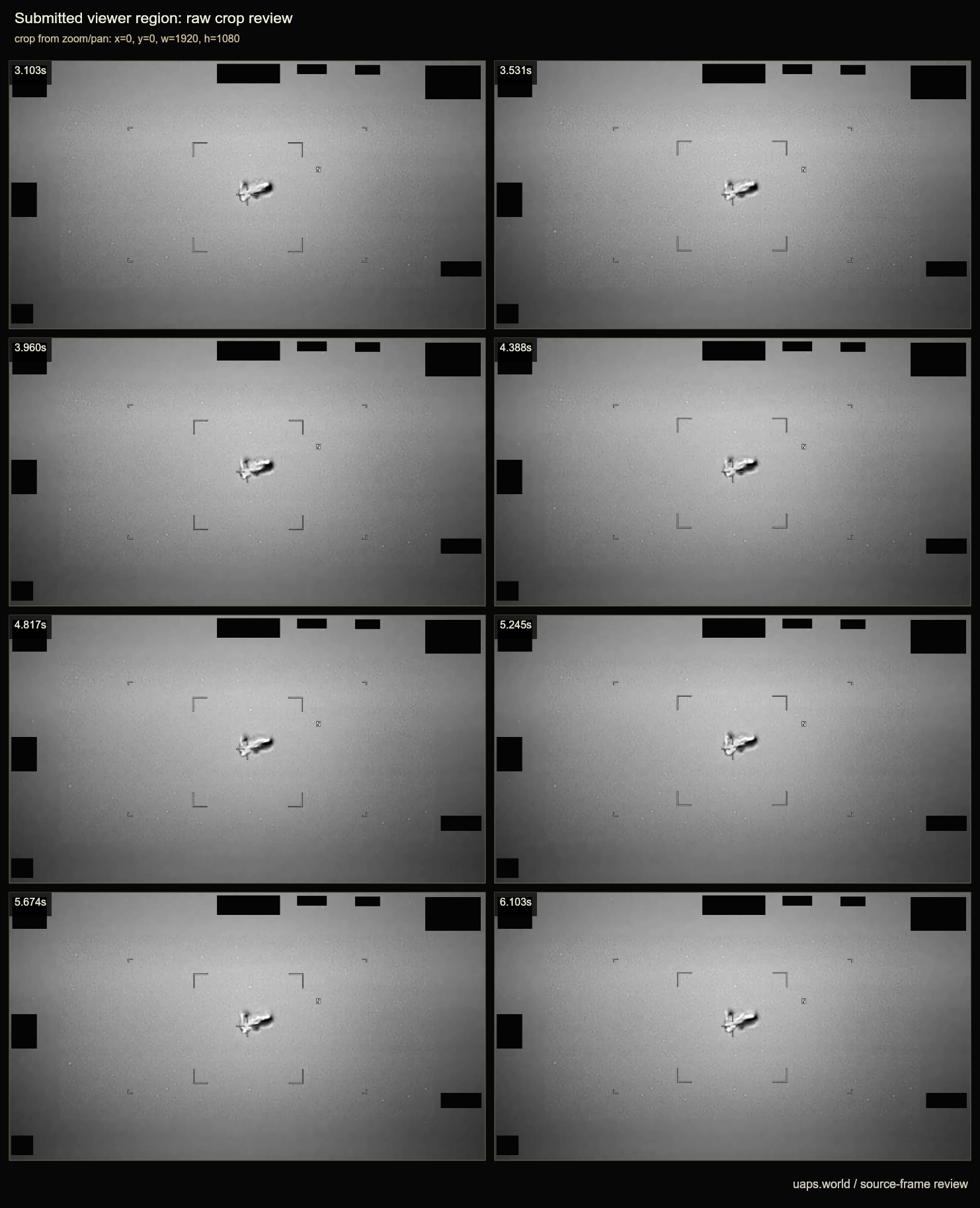
This note resolves two duplicate approved leads for DOD 111689133 at 4.603s. The submitted state uses the full frame, so the review sheet preserves the complete sensor image rather than a tight crop.
Across 3.103s through 6.103s, the object remains a bright compact body with a darker elongated lobe or tail-like region extending to the right. The contact stays in the same general image region while the sensor framing and background field remain stable enough for morphology...
UAPs.world keeps this analysis report connected to its original source path, release context, and related analysis path so readers can inspect the evidence trail directly.
This analysis page exposes the report substance directly for readers and crawlers, while the research viewer remains the place for source inspection, frame review, and follow-up work.
This note resolves two duplicate approved leads for DOD 111689133 at 4.603s. The submitted state uses the full frame, so the review sheet preserves the complete sensor image rather than a tight crop.
Across 3.103s through 6.103s, the object remains a bright compact body with a darker elongated lobe or tail-like region extending to the right. The contact stays in the same general image region while the sensor framing and background field remain stable enough for morphology comparison. The source-visible shape is not a clean sphere. It reads as an asymmetric bright body plus darker extension. That supports a hull/morphology review, but without range, optical mode details, or an independent background reference it does not establish physical dimensions or true three-dimensional motion.
The strongest testable hypothesis is not "what is it?" but "does the asymmetric body persist across adjacent frames?" In this pass, yes: the bright body and dark right-side extension persist across all eight sampled frames.
| Panel | Read | Boundary |
|---|---|---|
| Source frame | A bright asymmetric contact persists for roughly three seconds around 4.603s. | Evidence only. |
| Geometry read | The right-side dark lobe remains aligned with the body rather than appearing as a one-frame texture. | Observation plus low-level inference. |
| Mechanism model | Disclosure-forward reading: a field envelope or asymmetric vehicle boundary could be visible as the dark lobe. | Speculative; sensor/contrast explanations remain live. |
| Limits | No range, horizon, or parallax control is available in the submitted state. | Blocks speed and size claims. |
Promote this as a medium-confidence morphology persistence sample. It is useful for comparing asymmetric hull/field-boundary behavior across the archive. It does not prove exotic propulsion, biological form, or aircraft-relative performance by itself.
A new public lead asked for a filtered shape-analysis hypothesis at the end of DOD 111689133. The submitted state used invert mode, 4.10x zoom, and a long eight-second review window ending at the clip boundary. The deterministic review sheet below samples 1.867s, 3.010s, 4.153s, 5.296s, 6.439s, 7.582s, 8.725s, and 9.800s. The submitted frame was 9.867s, but the sheet uses 9.800s to avoid the exact end-of-file extraction boundary. Across all eight sampled frames, the contact remains an asymmetric bright form with a darker right-side lobe or shadowed extension. The shape is not stable enough to justify a precise hull outline, but it is stable enough to support a morphology-persistence claim: the bright body...
| Panel | Read | Boundary |
|---|---|---|
| Source frame | The invert-mode crop keeps a bright, irregular body near the reticle with a darker right-side extension through the sampled window. | Evidence only. |
| Geometry read | The contact repeatedly reads as a core-plus-lobe shape rather than a clean point light. | Observation plus low-level inference. |
| Field model | Disclosure-forward model: the right-side lobe could be a field boundary, shadowed envelope, wake, or sensor-visible asymmetric body. | Speculative; contrast and sensor bloom remain active controls. |
| Limits | Invert mode can exaggerate edge polarity and halos; no range, platform-motion, or raw-mode measurement is included here. | Blocks size, speed, and propulsion certainty. |
Working assessment: this amendment strengthens the morphology-persistence lane already in this report. It does not establish a torus, cigar hull, biological form, or propulsion system. The strongest safe claim is that the end-of-clip invert pass preserves a persistent asymmetric core-plus-lobe visual state worth comparing with other field-boundary candidates.
These UAPs.world reports cite this record. Read their findings and evidence limits, or inspect the cited material in the research viewer.
The captured frame shows a compact high-contrast object near the center-left of the sensor view. The strongest visible structure is not a clean outline but a bright leading or central region, a darker saturated lobe to the right, and a surrounding pale...
Open analysis in viewerThese images are rendered directly for quick review, with clean image pages for crawlers and viewer links for inspection.

analysis image
Release_1/Analysis/images/dod-111689133-04603-hull-motion-review-geometry-review.png · Updated 2026-07-02

analysis image
Release_1/Analysis/images/dod-111689133-9800-invert-shape-review-source-frame-contact-sheet.png · Updated 2026-07-06

analysis image
Release_1/Analysis/images/dod-111689133-9800-invert-shape-review-geometry-review.png · Updated 2026-07-06
Classify this source for 2 points, mark useful or misleading records for 1 point, or submit observations for curator review. Public contribution points progress through Observer, Analyst I, Analyst II, Case Builder, and Archivist and can unlock field desk themes.