UAPs.world keeps this analysis report connected to its original source path, release context, and related analysis path so readers can inspect the evidence trail directly.
Analysis report summary
This analysis page exposes the report substance directly for readers and crawlers, while the research viewer remains the place for source inspection, frame review, and follow-up work.
Observation
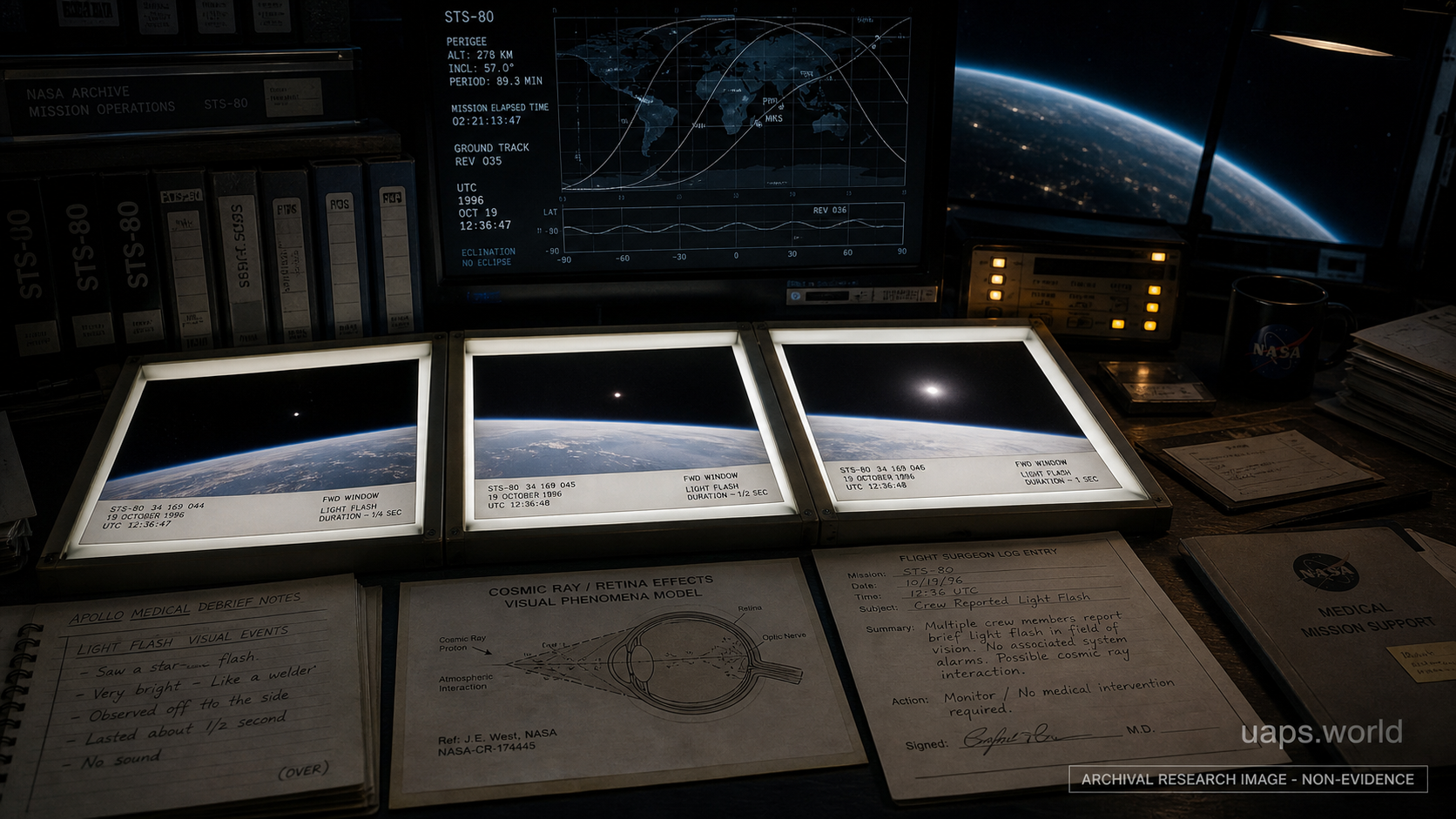
The STS-80 stills are external imagery: the official metadata describes an unidentified object near the Earth limb, then apparent rotation/tumble, then continued trajectory between Columbia and Earth. The Apollo 14 and Apollo 17 debriefing media are different evidence types: they discuss light-flash phenomena, a biological/physiological effect associated with high-energy cosmic rays passing through the eye and retina. Release 4 therefore gives the viewer a useful space-domain distinction:
Hypothesis To Test
The space-domain hypothesis is not that all NASA luminous phenomena are the same. It is that spaceflight records need a two-lane control: external object behavior versus observer/physiology/camera artifacts. STS-80 may be a legitimate unidentified object record in imagery; Apollo light flashes are a documented perceptual phenomenon and should discipline any attempt to convert every flash into a craft.
Why It Matters
Space records are easy to over-read because the setting is already extraordinary. Release 4 gives a better method: keep STS-80's external object sequence open for image/trajectory review, while using Apollo light-flash debriefings to remind readers that not every observed light in space is outside the observer or camera system.
Working Assessment
The strongest source-backed claim is that Release 4 adds a compact space-domain evidence-and-control pair. STS-80 belongs in the external object review queue; Apollo 14 and Apollo 17 light-flash debriefs belong in the physiological control lane. The new D030/D032 comparison keeps two submitted still-image states in the external-object lane while passing the Disclosure-Forward Neutrality Gate: ordinary debris, reflection, illumination, and scan explanations remain live, and the disclosure-forward model is only a provisional object/trajectory hypothesis until mission geometry or sequence timing upgrades it. Apollo light-flash physiology should not be used as craft evidence.
Classify this source for 2 points, mark useful or misleading records for 1 point, or submit observations for curator review. Public contribution points progress through Observer, Analyst I, Analyst II, Case Builder, and Archivist and can unlock field desk themes.