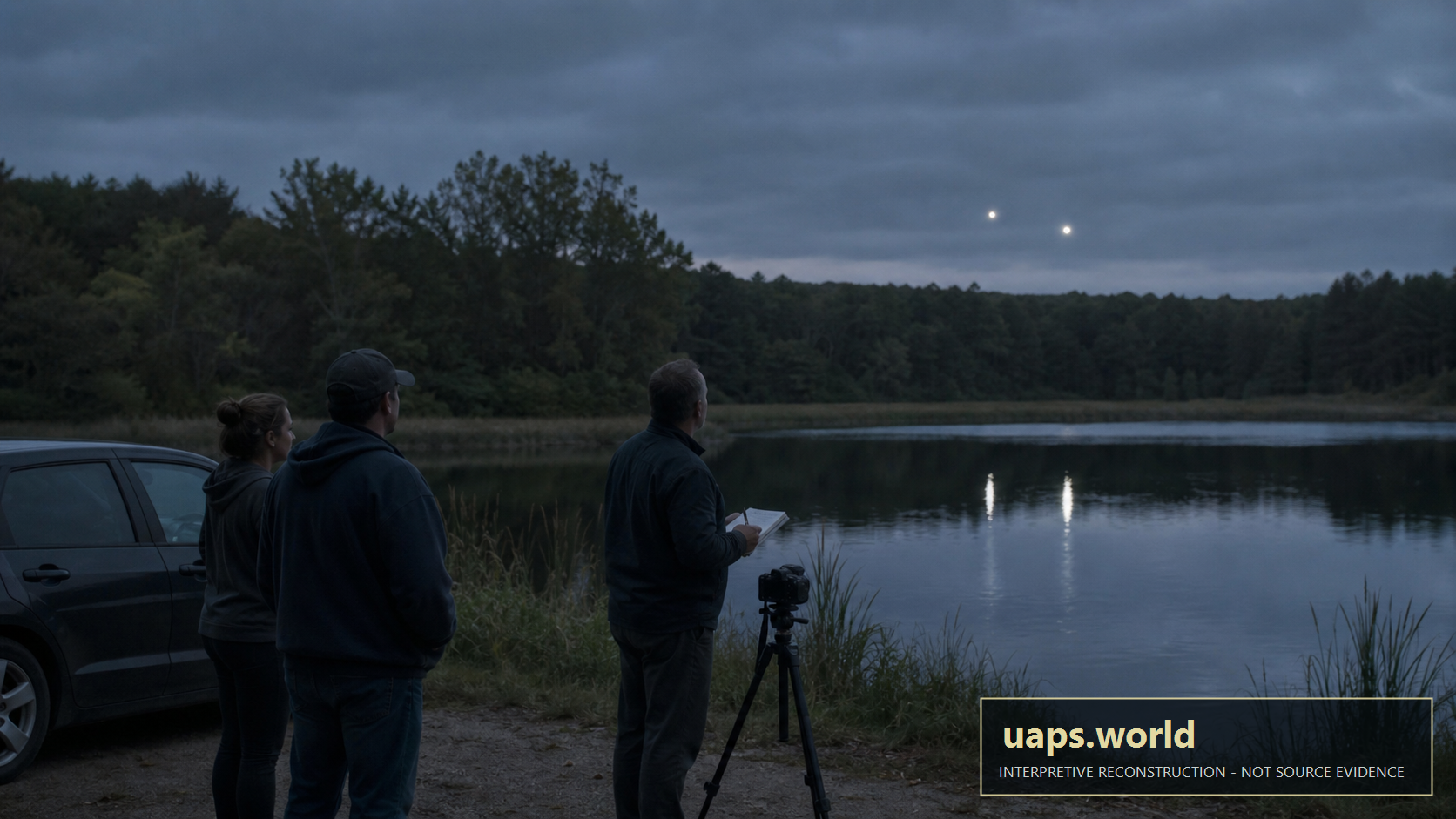
Release 3 adds a domestic witness-chain lane that the older military-heavy archive did not have in this form. The Northeastern set is organized around multiple FBI forms, repeated event labels, and four DVIDS-linked videos. The official metadata describes luminous sources,...
UAPs.world keeps this analysis report connected to its original source path, release context, and related analysis path so readers can inspect the evidence trail directly.
Analysis report summary
This analysis page exposes the report substance directly for readers and crawlers, while the research viewer remains the place for source inspection, frame review, and follow-up work.
Observation
Release 3 adds a domestic witness-chain lane that the older military-heavy archive did not have in this form. The Northeastern set is organized around multiple FBI forms, repeated event labels, and four DVIDS-linked videos. The official metadata describes luminous sources, red or plasma-like spheres, hovering near tree lines or water, separation into smaller luminous points, tandem/formation movement, merging, silence, and witness credibility language. The Colorado Springs set gives the same lane a useful control. The transcripted ICA Colorado Springs Analysis says five U.S. Army service members observed an angular, non-symmetrical, translucent/shimmering object over Cheyenne Mountain, while the IC partner...
Hypothesis To Test
Orb-pattern hypothesis: the Northeastern cases may represent a recurring domestic luminous-orb family with stationary hovering, red/white plasma-like structure, separation/merge behavior, and tandem motion. Under the disclosure-forward field model, the "orb" may not be a solid sphere; it could be a visible field boundary, plasma envelope, or sensor/phone-camera response to a compact source. Control hypothesis: the cases may still resolve to terrestrial lights, atmospheric effects, reflections over water, smartphone low-light artifacts, camera movement, distance/range misestimation, or memory-structured interviews. Colorado Springs demonstrates exactly why environmental reconstruction matters before the...
Working Assessment
The FBI/Northeastern materials are high-priority for visual review because they pair interviews with local videos. The Colorado Springs materials are high-priority for analytic discipline because they show a real unresolved case can also carry a plausible but low-confidence conventional explanation. Together, they make Release 3's domestic lane useful: not belief-first, not dismissal-first, but witness-chain plus environmental controls.
Classify this source for 2 points, mark useful or misleading records for 1 point, or submit observations for curator review. Public contribution points progress through Observer, Analyst I, Analyst II, Case Builder, and Archivist and can unlock field desk themes.