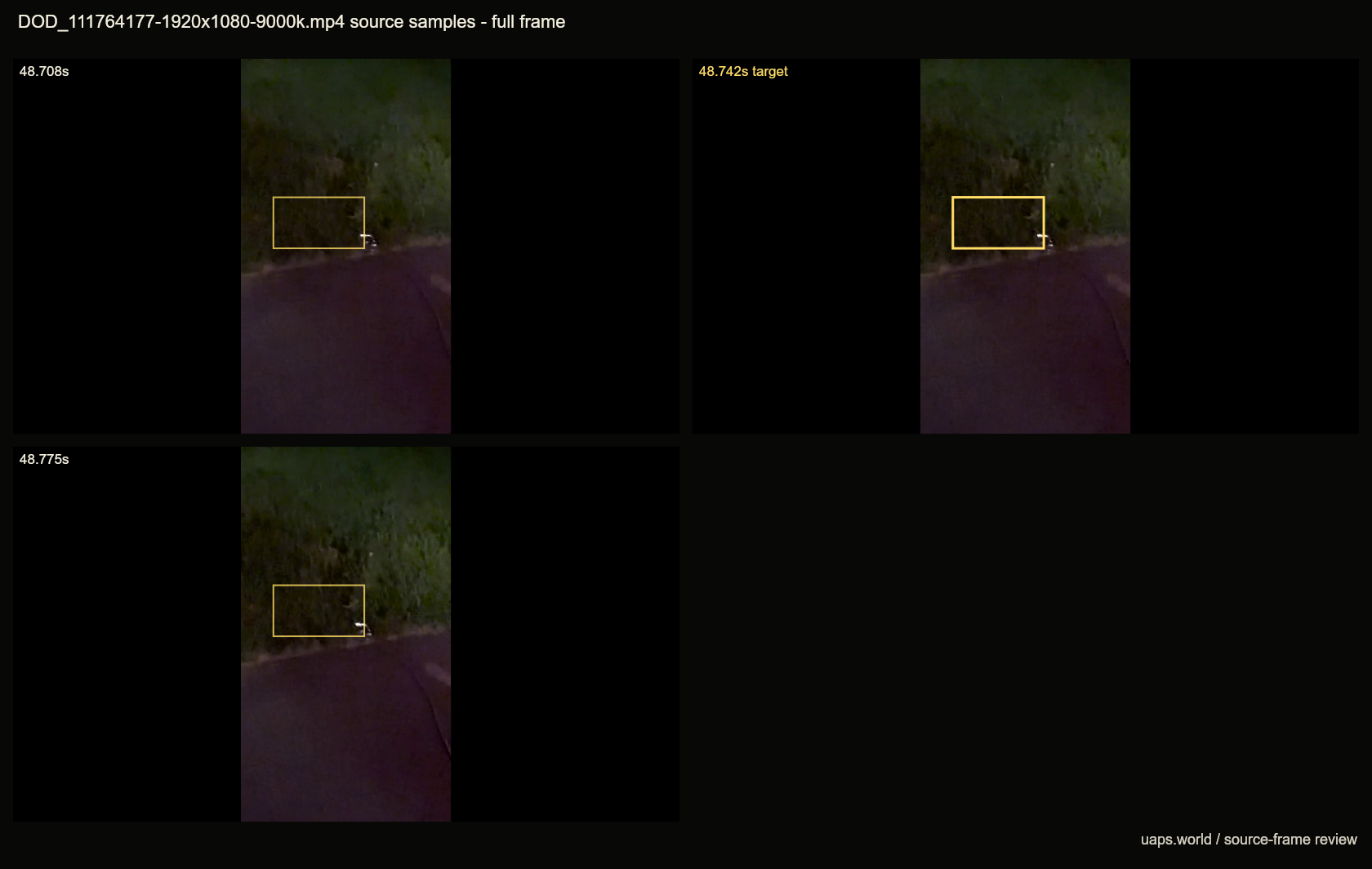
The submitted frame and neighboring samples at 48.708s, 48.742s, and 48.775s show a dark field with bright, saturated regions near the lower-right edge and a diffuse yellow-red structure toward the upper-right. The bright regions persist across the three samples, but the crop...
Analysis report summary
This analysis page exposes the report substance directly for readers and crawlers, while the research viewer remains the place for source inspection, frame review, and follow-up work.
Source Basis
This note resolves an approved anonymous capture lead for DVIDS 1010269 - Northeastern Orb Sighting. The submitted source state is 48.742s normal, 7.33x. Because the request asked "What is this - make a possible visualization," this note pairs a three-frame source review with a labeled non-evidentiary reconstruction. The final PNG is an interpretive visualization, not source evidence. The source evidence is the three-frame review and the linked video state.
Observation
The submitted frame and neighboring samples at 48.708s, 48.742s, and 48.775s show a dark field with bright, saturated regions near the lower-right edge and a diffuse yellow-red structure toward the upper-right. The bright regions persist across the three samples, but the crop does not isolate a resolved object body. This is a visualization-worthy frame because it gives the archive a concrete shape-language problem: does the reader picture a compact luminous source, a reflection/flare/smear, or a field envelope? The source does not decide that question by itself.
Hypothesis To Test
Conservative lane: the bright region may be a terrestrial light, camera movement, low-light phone artifact, reflection, flare, or compression behavior. The crop is highly zoomed and edge-adjacent, so sensor/display context remains important. Disclosure-forward lane: if the Northeastern orb family is a compact field-envelope phenomenon, this frame can be modeled as a luminous core inside a broader sensor-visible boundary. The visualization captures that possible geometry while keeping it falsifiable.
Theoretical Scene Panels
Working Assessment
Promote DOD 111764177 at 48.742s as a visualization lead with medium-low confidence. The source supports a possible luminous-envelope model, but only as a testable picture. It does not yet identify the object or defeat low-light terrestrial, reflection, lens, and camera-motion explanations.
Follow-Up Amendment - 9.965s Orb Characteristics And Movement
An additional anonymous capture lead asked to review the orb characteristics and movement "as described in the brief" at 9.965s normal, 3.15x. The submitted controls requested a three-second, four-observation pass with enhancement and event marking. The retest sampled 8.465s, 9.465s, 10.465s, and 11.465s. The window supports a stronger observation than the later 48.742s visualization frame: two red/orange luminous points are source-visible across multiple samples. Their apparent positions move substantially against tree silhouettes and the phone-frame crop, but the clip is handheld and low-light, so this movement cannot be converted directly into object speed or acceleration.
Working assessment: this amendment upgrades the early Northeastern orb lane. The source supports "two persistent warm luminous points in a handheld night-treeline video" and a useful tandem-movement question. It does not yet support a stronger claim about craft structure, non-human control, or extraordinary kinematics. The disclosure-forward field model remains live as a hypothesis only if a stabilized track shows coupled motion between the two lights that survives handheld camera motion, ordinary aircraft/lantern/drone checks, and exposure/bloom controls.
Follow-Up Amendment - Captured Lantern-Control Review
An approved capture lead asked for a one-second, four-observation review of DVIDS 1010269 - Northeastern Orb Sighting, including image enhancement and ordinary explanations such as lanterns. The submitted state was 12.570s, normal, 4.77x. The exact requested window runs from 12.070s through 13.070s, with four timestamped observations. The ImageJ plate below is an enhanced inspection aid, not source evidence. A restrained highlight-preservation recipe was applied to the same bounded upper-light ROI at three adjacent timestamps, with a small sharpening variation at the target time.
### Lantern And Conventional Controls A sky-lantern explanation remains plausible at the appearance level: warm emission, soft saturated bloom, low-light recording, and slow apparent movement are all compatible. Two independent lanterns would be expected to drift and change separation with local wind, while a single rigid carrier, aircraft-light geometry, or drone-light arrangement would better preserve paired spacing. The one-second window is too short to distinguish those options. A fixed terrestrial light seen through moving branches and handheld framing also remains live, although the broader clip should be used to test whether the sources clear or remain tied to the treeline. The ImageJ check does not...
### Working Assessment The strongest source-backed statement is: the selected interval contains two persistent saturated warm lights in a handheld night-treeline video. The pair is worth stabilized tracking, but the current window does not show extraordinary acceleration, a resolved craft, plasma behavior, or non-human control. The disclosure-forward neutrality gate is satisfied by keeping both the ordinary light/lantern/sensor lane and the paired-node field-system lane open, while requiring stabilized motion, longer-duration spacing behavior, and independent sensor or witness context to upgrade the latter.