
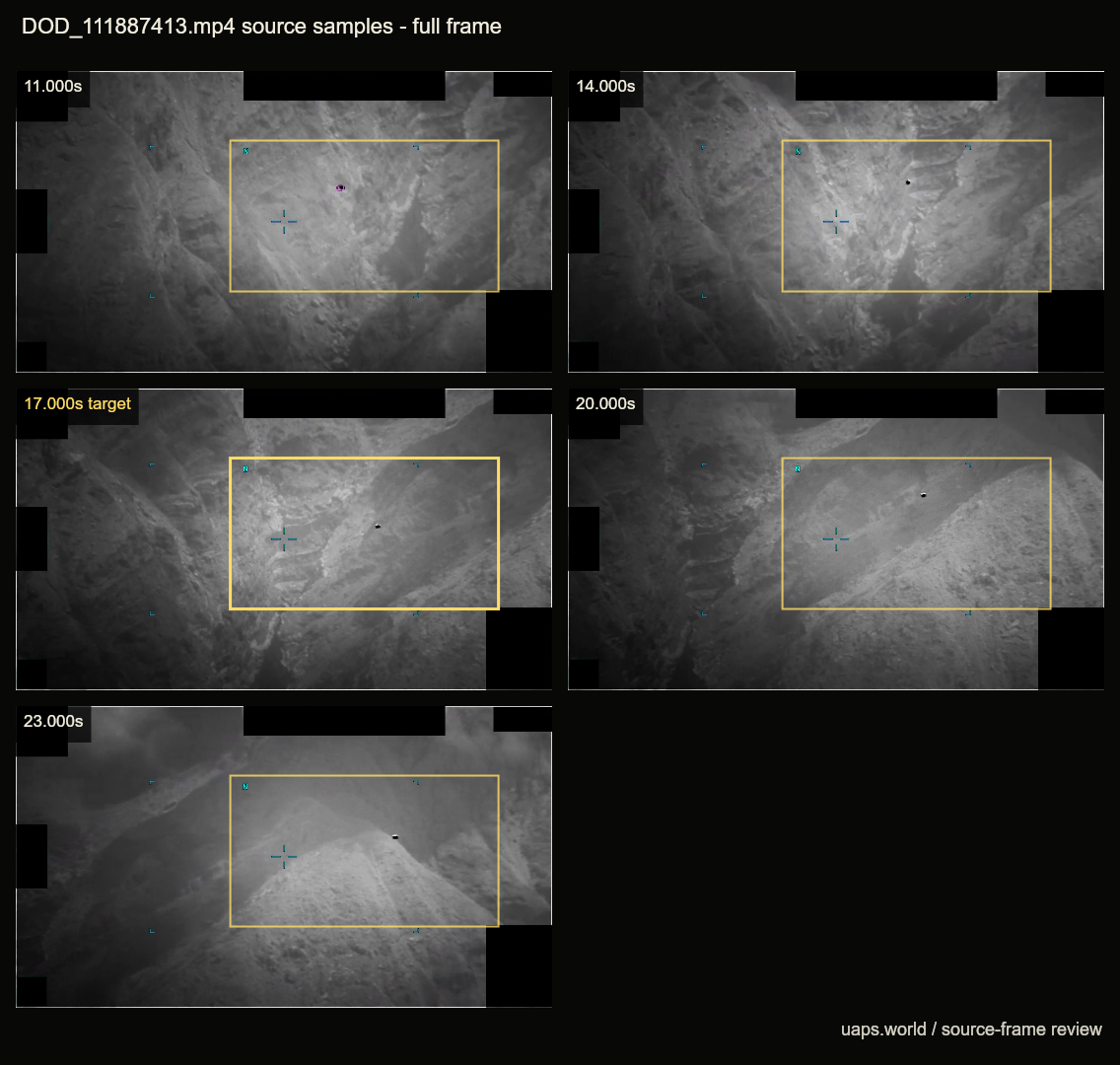
Observation
The compact dark return is independently visible in all five raw samples while ridges, slopes, and drainage features remain visible around it. Its image position changes as the sensor view changes. That establishes a persistent image-plane contact across the sampled twelve-second interval. The source does not establish a stable hull outline. The return occupies only a small pixel area, varies from compact dot to slightly elongated blob, and is sometimes accompanied by colored tracking/detection overlays. Terrain registration improves continuity analysis, but does not supply range: the contact can be in front of, over, or beyond the apparent surface. The fixed crop shows why absolute motion cannot be read direc...


