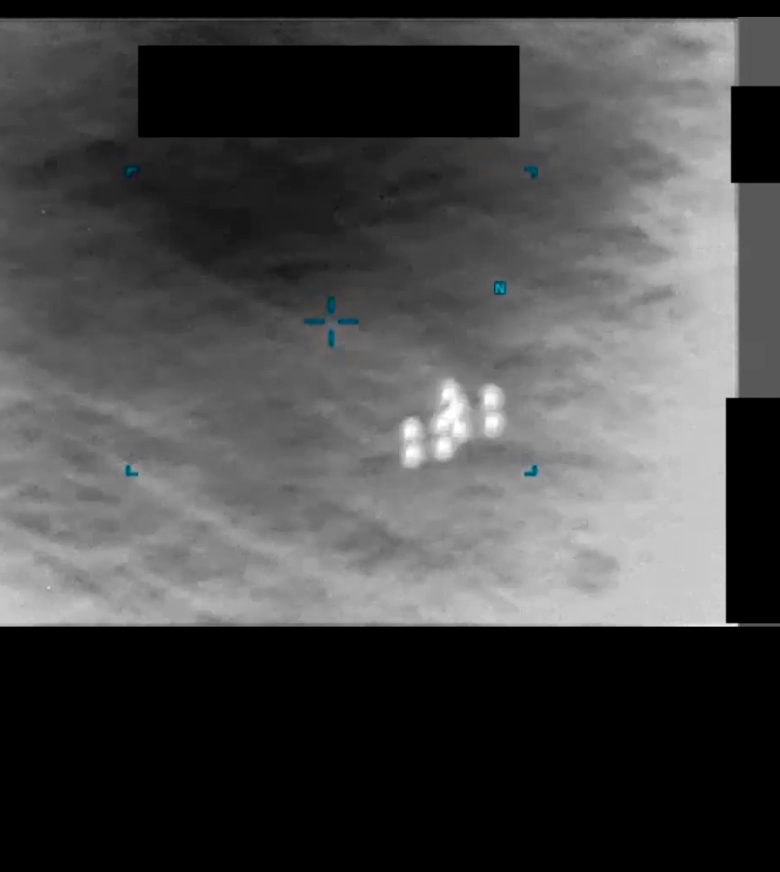
The captured frame shows a compact group of bright returns in the lower-right region of the sensor view. The grouping reads visually as several separate points or lobes packed together in a loose wedge or stacked formation. The user's "squadron" description is a fair visual...
UAPs.world keeps this analysis report connected to its original source path, release context, and related analysis path so readers can inspect the evidence trail directly.
Analysis report summary
This analysis page exposes the report substance directly for readers and crawlers, while the research viewer remains the place for source inspection, frame review, and follow-up work.
Observation
The captured frame shows a compact group of bright returns in the lower-right region of the sensor view. The grouping reads visually as several separate points or lobes packed together in a loose wedge or stacked formation. The user's "squadron" description is a fair visual label for the still frame, because it does not read like one clean point. The frame does not by itself prove independent craft. The grouped returns could be separate airborne objects, one object resolving into multiple saturated lobes, a flare or plume-like pattern, compression artifacts, or bright background features grouped by the eye.
Hypothesis To Test
Formation-travel hypothesis: if the bright elements maintain separable centroids and correlated spacing across adjacent frames, the source becomes a stronger multi-contact formation case. If the separations collapse, smear, or move with background texture, the "squadron" impression should be downgraded. The decisive evidence is centroid persistence through time, not the count in this single capture.
Why It Matters
Multi-contact behavior is one of the highest-value analysis categories because it can test coordination, formation discipline, distributed sensing, and field-node hypotheses. A single object can be ambiguous; multiple objects with stable spacing are harder to explain as simple image bloom.
Working Assessment
Assessment: approved formation lead, still provisional. The captured frame supports a squadron/cluster hypothesis, but it must be validated by adjacent-frame centroid tracking. If the same bright elements remain separable and move together, this should be promoted as a stronger C11 - Fleet Cluster and Multiple Contact Behavior multi-contact case.
Classify this source for 2 points, mark useful or misleading records for 1 point, or submit observations for curator review. Public contribution points progress through Observer, Analyst I, Analyst II, Case Builder, and Archivist and can unlock field desk themes.

![DOW-UAP-PR097, "Hi-Res: [CALLSIGN] Observes UAP on 25SEP19 at 2135Z"](/?open=Release_2%2FAnalysis%2Fimages%2Fvideo-2605-dod-111719813-dod-111719813-20260601t121101z-capture-lead.png)

![DOW-UAP-PR097, "Hi-Res: [CALLSIGN] Observes UAP on 25SEP19 at 2135Z"](/?open=Release_2%2FAnalysis%2Fimages%2Fvideo-2605-dod-111719813-dod-111719813-20260606t014701z-capture-lead.png)