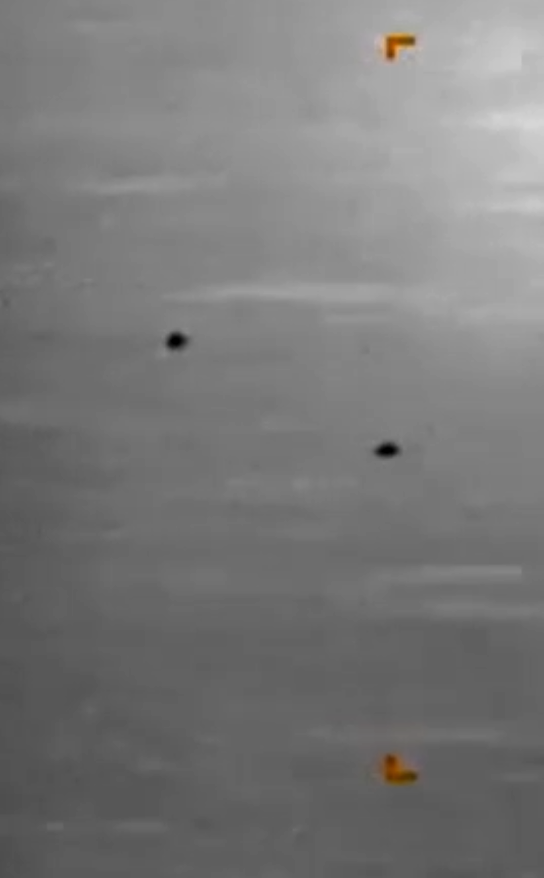
The captured frame shows two dark contacts separated diagonally across a gray sensor background. Both contacts are compact and darker than the surrounding field. Each appears as a small blob rather than a resolved aircraft or bird. The capture also includes orange/yellow...
UAPs.world keeps this analysis report connected to its original source path, release context, and related analysis path so readers can inspect the evidence trail directly.
Analysis report summary
This analysis page exposes the report substance directly for readers and crawlers, while the research viewer remains the place for source inspection, frame review, and follow-up work.
Observation
The captured frame shows two dark contacts separated diagonally across a gray sensor background. Both contacts are compact and darker than the surrounding field. Each appears as a small blob rather than a resolved aircraft or bird. The capture also includes orange/yellow interface marks near the top and bottom of the crop, which should not be confused with source contacts. The approved request describes "twin tin birds" and asks whether the behavior looks like coordinated flight. The still frame supports a twin-contact/formation lead. It does not prove coordination by itself.
Hypothesis To Test
The coordinated-flight hypothesis requires temporal persistence: - both contacts should remain present across adjacent frames, - their spacing should remain stable or change in a patterned way, - the pair should move together relative to the background, - sensor motion should not fully explain their relative placement, - the contacts should not resolve into birds, balloons, debris, or ordinary aircraft when the surrounding frames are reviewed. If both points persist with stable separation, this becomes a stronger formation case. If either point flickers, merges with background, or changes shape independently, the formation hypothesis weakens.
Why It Matters
Multiple-contact behavior is one of the cleaner ways to separate random visual artifacts from operational behavior. A stable pair moving together can support a stronger case than a single unresolved point, especially if the contacts maintain spacing while the camera or background changes.
Working Assessment
Assessment: useful twin-contact formation lead with a plausible twin-node or shared-field hypothesis. The original frame plus the 20-second source-window pass support two recurring source-visible contacts and a coordinated-flight test, but the hypothesis remains unresolved until denser tracking establishes persistence, relative motion, and stable inter-contact geometry.
Classify this source for 2 points, mark useful or misleading records for 1 point, or submit observations for curator review. Public contribution points progress through Observer, Analyst I, Analyst II, Case Builder, and Archivist and can unlock field desk themes.

![DOW-UAP-PR099, "Hi-Res: [CALLSIGN] Observes UAP on 25SEP19 at 1715Z"](/?open=Release_2%2FAnalysis%2Fimages%2Fvideo-2605-dod-111719835-dod-111719835-20260605t013317z-capture-lead.png)
![DOW-UAP-PR099, "Hi-Res: [CALLSIGN] Observes UAP on 25SEP19 at 1715Z"](/?open=Release_2%2FAnalysis%2Fimages%2Fvideo-2605-dod-111719835-201p380-221p380-twin-contact-10-frame-sheet.jpg)
![DOW-UAP-PR099, "Hi-Res: [CALLSIGN] Observes UAP on 25SEP19 at 1715Z"](/?open=Release_2%2FAnalysis%2Fimages%2Fvideo-2605-dod-111719835-201p380-221p380-twin-contact-10-frame-crop-sheet.jpg)
