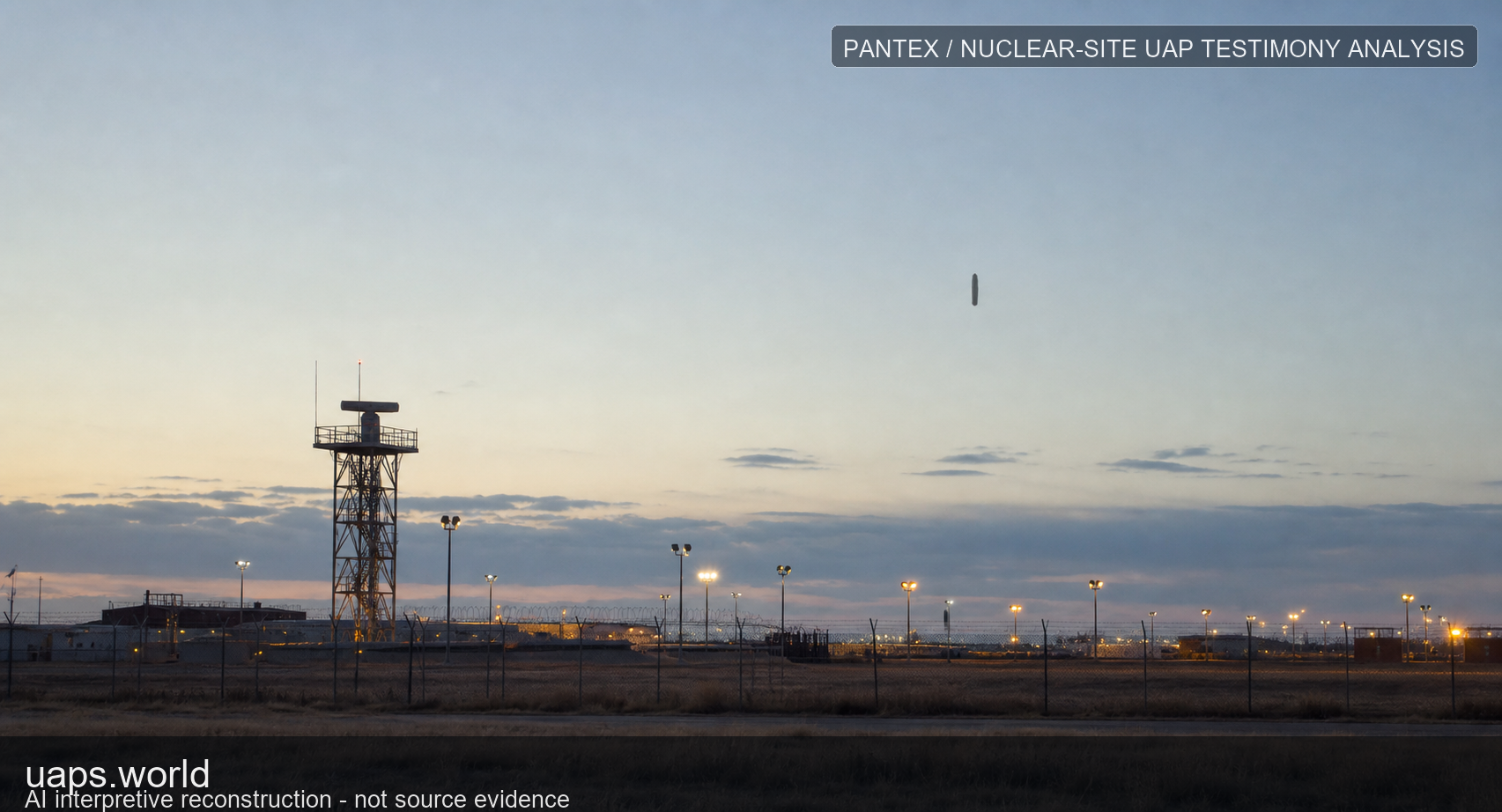
Trace the Pantex incident imagery from the surveillance tower to Sandia enhancement. The records establish an image-handling trail, not the object's identity or exceptional performance.
Analysis report summary
This analysis page exposes the report substance directly for readers and crawlers, while the research viewer remains the place for source inspection, frame review, and follow-up work.
Source Basis
This companion uses Enhanced PANTEX Imagery, the Pantex capture in C04 - Documents Sensitive Sites and Recovered Tech, UAP Reported at Sandia Base, 1948-1950, James Tuck Correspondence, Pajarito Astronomers Invitation, C34 - Sandia General Correspondence Page Map, C44 - Copper, Bismuth, and Magnesium Chemical Analysis, C50 - Western US Event Narrative and Rendering Packet, and C51 - FBI Domestic Orb and Witness Chain. The goal is not to prove one nuclear-site theory. It is to map the archive's strongest source-backed pattern: nuclear or strategic-site contexts repeatedly produce unusually serious handling of anomalous reports, but the evidence types vary sharply. Pantex is image provenance. Sandia is...
Pantex Anchor
The local Pantex transcript is sparse, but the visible source terms are important. It identifies a "Pantex Unidentified Object Incident Report," an "Image from Ground Surveillance Radar Tower," and "Sandia National Labs Enhanced Images of the Object." The C04 capture adds the page-level observation: the visible page is marked as a Pantex incident report, carries UCNI context, attributes the enhanced images to Sandia National Labs, and shows two enhanced crops of a dark, vertically elongated, soft-edged object-like form. That is a narrow but valuable signal. Pantex is not merely a rumor in this archive; it is a DOE-adjacent sensitive-site image-handling record. The source says an unidentified-object incident...
The working Pantex question is therefore procedural: why did this incident move through an image-enhancement path, what did the original tower image show, and what did the enhancement process add, sharpen, or distort?
Nuclear-Site Pattern Map
The archive's nuclear-site pattern is strongest when read as a handling pattern rather than a single merged event.
The pattern is not "UAP always target nuclear sites." The stronger, cleaner statement is this: When anomalous observations intersect nuclear, special-weapons, DOE, intelligence, or sensitive-site contexts, the archive often shows heavier institutional processing: security memos, OSI routing, scientific commentary, image enhancement, sampling attempts, witness matrices, renderings, or case-analysis packets. That processing is itself evidence of official concern. It is not automatic evidence of non-human technology.
Witness Testimony
Witness testimony is essential here because many sensitive-site cases begin as human observation. But testimony has to be handled by role.
For Pantex specifically, the best testimony question is missing from the current local transcript: who saw the object, what did the tower system record, and what did the incident report say before the enhanced-image page? Until that is recovered, Pantex should be analyzed as image-handling evidence rather than as a witness-performance case. For Sandia, testimony is embedded in OSI summaries and fireball reports. Those pages are valuable because they preserve time, location, direction, color, duration, disappearance, and apparent shape fields. They are also fragile because OCR quality is uneven and many events may be meteors, military activity, atmospheric phenomena, or reporting noise. C34 - Sandia General...
Theoretical Scene Panels
Working Assessment
Pantex should be promoted as a high-value sensitive-site image-provenance case, not as a solved UAP performance case. Its strongest evidentiary value is the chain: Pantex incident report, ground surveillance tower, Sandia enhancement, and preserved object imagery. That chain belongs beside Sandia's older scientific/security handling and modern witness packets because all three show institutions converting anomalous observations into durable records. The nuclear-site/UAP question should be framed as a source-handling problem before it is framed as an origin problem. Ask: what was observed, what system captured it, who enhanced or investigated it, what witness language survived, what controls were applied,...
Public Field Desk
Classify this source for 2 points, mark useful or misleading records for 1 point, or submit observations for curator review. Public contribution points progress through Observer, Analyst I, Analyst II, Case Builder, and Archivist and can unlock field desk themes.