C66 Red Orb Rotation Plasmoid Sentience Frame Review
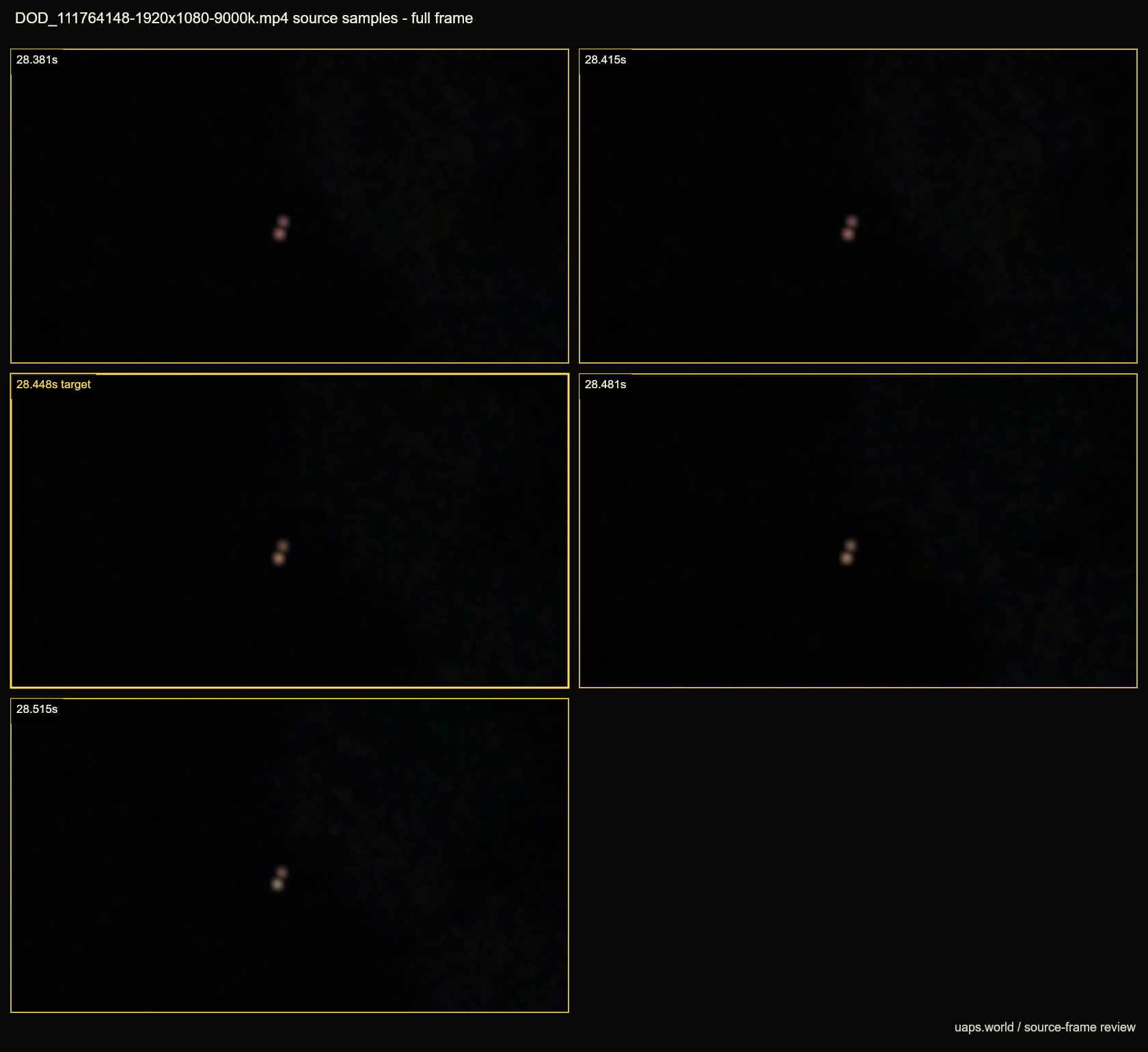
Across 28.381s, 28.415s, 28.448s, 28.481s, and 28.515s, the source frame preserves a compact two-lobed luminous target against a dark sky/terrain background. The upper lobe reads warmer and redder; the lower lobe reads brighter and more yellow-white. The pair remains close...
UAPs.world keeps this analysis report connected to its original source path, release context, and related analysis path so readers can inspect the evidence trail directly.
Analysis report summary
This analysis page exposes the report substance directly for readers and crawlers, while the research viewer remains the place for source inspection, frame review, and follow-up work.
Observation
Across 28.381s, 28.415s, 28.448s, 28.481s, and 28.515s, the source frame preserves a compact two-lobed luminous target against a dark sky/terrain background. The upper lobe reads warmer and redder; the lower lobe reads brighter and more yellow-white. The pair remains close and vertically stacked through the sampled window, with small image-plane drift. The source-backed finding is therefore narrow: this frame sequence shows a persistent two-lobed red/yellow luminous target in the Red Orb Rotation video. The sampled window does not resolve a hull, appendage, surface texture, face, limbs, or discrete organism-like anatomy.
Hypothesis To Test
Primary disclosure-forward hypothesis: the two-lobed target may be a plasma-like field system whose visible components are bright nodes, discharge regions, or an envelope/core pair. In that model, apparent rotation or lobe exchange elsewhere in the video could be an adaptive field behavior rather than a rigid craft surface. Control hypothesis: the two-lobed target may also be produced or exaggerated by low-light phone capture, exposure bloom, autofocus/exposure response, compression around saturated points, handheld movement, or two ordinary lights close together in the image plane. Sentience hypothesis: if the source later shows path correction, obstacle-aware motion, structured response to the...
Why It Matters
This pass upgrades the Red Orb Rotation review queue from a general high-priority item into a specific trackable question: compare the upper and lower lobes across a longer segment and decide whether their spacing, brightness phase, and apparent rotation are coupled to the source or mostly coupled to the camera. That question matters because it can bridge two evidence cultures without collapsing them. The ordinary lane can test bloom, smear, autofocus, and two-light geometry. The disclosure-forward lane can test a multi-node luminous field model. Both lanes use the same frame sequence, which keeps the theory attached to source evidence instead of letting it float away.
Working Assessment
The 28.448s lead is source-backed and worth promoting. It captures a persistent two-lobed luminous target in DVIDS 1010264 - Red Orb Rotation. The best current language is: a compact red/yellow two-lobed luminous source, unresolved between camera/sensor behavior, two close lights, and a speculative plasmoid-field system. The current source window does not support calling it a sentient being as a finding. It does support using plasmoid sentience as a hypothesis for longer behavioral tracking.
Classify this source for 2 points, mark useful or misleading records for 1 point, or submit observations for curator review. Public contribution points progress through Observer, Analyst I, Analyst II, Case Builder, and Archivist and can unlock field desk themes.