C78 DOD 111720827 Paired Ring Thermal Feature Review
This report resolves the approved capture lead for UAP from Dec 2019 (East Coast). The submitted source state is 13.145s, thermal preset, 3.46x view zoom, with the request to test whether the visible feature appears to be two rings moving together.
UAPs.world keeps this analysis report connected to its original source path, release context, and related analysis path so readers can inspect the evidence trail directly.
Analysis report summary
This analysis page exposes the report substance directly for readers and crawlers, while the research viewer remains the place for source inspection, frame review, and follow-up work.
Source Basis
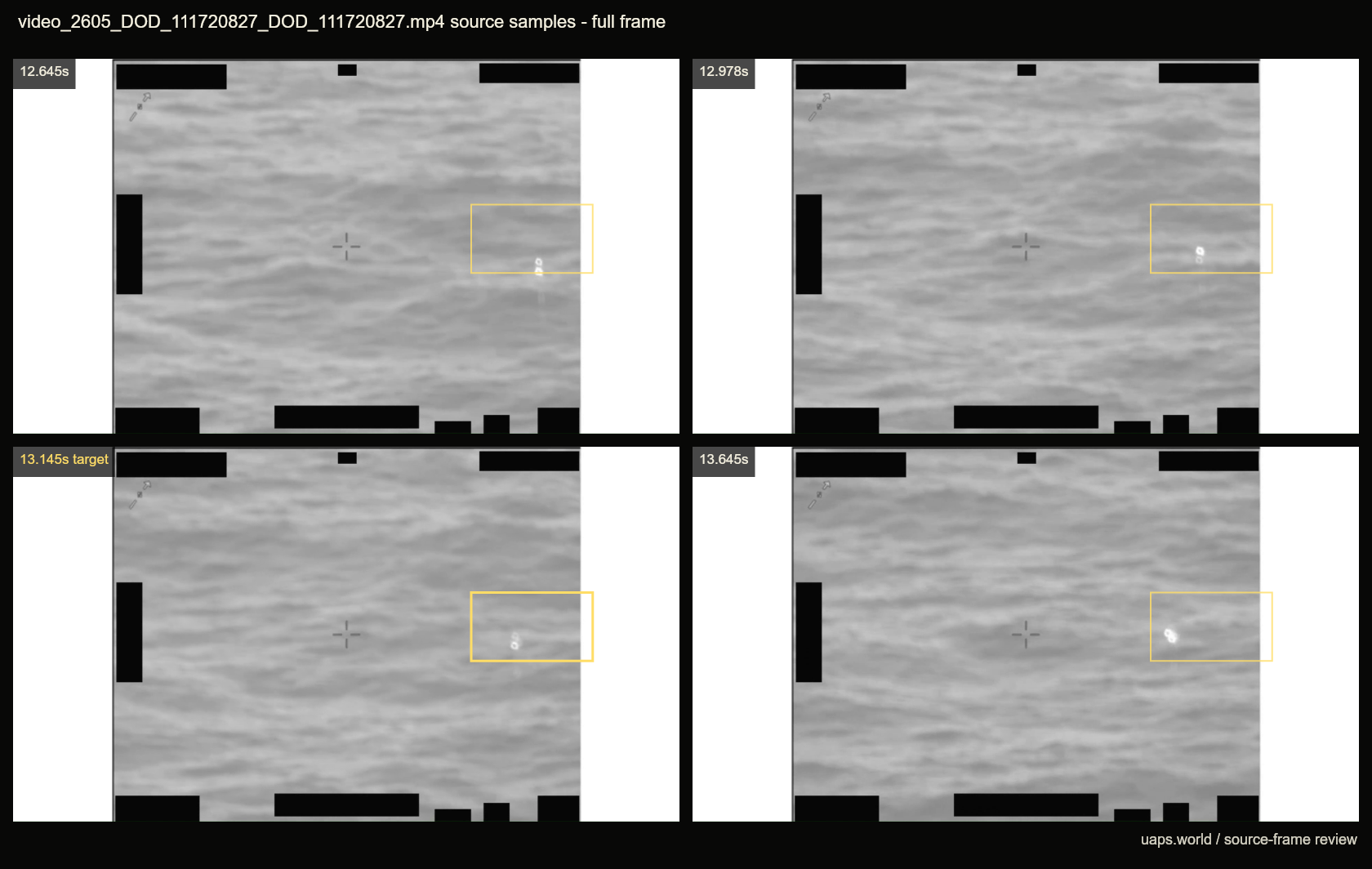
This report resolves the approved capture lead for UAP from Dec 2019 (East Coast). The submitted source state is 13.145s, thermal preset, 3.46x view zoom, with the request to test whether the visible feature appears to be two rings moving together. The submitted controls required a one-second review window and exactly four frame observations. I sampled 12.645s, 12.978s, 13.145s, and 13.645s.
A bright saturated paired feature sits near the right edge of the frame; the upper lobe has a hollow or ring-like center and a lower bright lobe is partly clipped by the lower edge of the crop.
Supports a two-lobed or two-ring image-plane feature, but the crop edge limits structure claims.
The paired feature remains compact and close-coupled. The upper bright region still reads as a ring or donut-like bloom, with a dimmer lower component beneath it.
Strengthens the "moving together" part of the lead because the paired relationship persists.
The target frame shows two vertically separated bright ring-like blooms. The upper and lower components are both visible, but saturation and blur prevent a clean hard-edge outline.
Best frame for the submitted claim: paired ring-like thermal signatures are source-visible.
The pair has shifted left/down in the centered crop and still appears as two bright coupled lobes or rings. The background texture changes smoothly behind it.
Supports continuity of a paired feature through the one-second window.
Hypothesis To Test
The submitted hypothesis is source-supported at the narrow image level: the one-second sample does show two bright ring-like or hollow-centered thermal blooms that remain close to each other and move together across the frame. The strongest phrasing is "paired ring-like thermal feature," not "two physical rings," because the visible shape is affected by saturation, compression, crop-edge clipping, and thermal/contrast bloom. This is a useful companion to C19 - Cloud Orb Color Prototype Comparison because it adds a paired-feature morphology check, and to C39 - Favorite Material Analysis Refinement because it preserves a concrete example of a hollow-centered luminous/thermal signature without converting it...
Theoretical Scene Panels
Theoretical Scene Panels
Panel
Read
Boundary
Source frame
A bright paired feature sits near the right side of the thermal frame during the sampled one-second window.
Evidence only: visible as a saturated image-plane feature.
Geometry read
Two close-coupled bright lobes keep their relationship across four samples; the upper and later lower lobes show ring-like hollow centers.
Observation plus low-level inference: "paired ring-like bloom" is safer than "two rings."
Field model
Under a disclosure-forward field-envelope model, the two lobes could be separate bright boundary zones of one object, a coupled pair, or a sensor-visible interaction layer rather than a hard hull.
Speculative only; requires better range, sensor metadata, and non-saturated imagery.
Limits
The feature is near frame/crop edges and is bright enough to bloom. A conventional or imaging explanation remains live.
Do not use this as standalone proof of physical ring craft.
Working Assessment
The lead is worth preserving because the paired feature survives the adjacent-frame test. The "two rings moving together" observation is not just a single-frame impression: within the required one-second window, the bright components remain close-coupled and shift together against the background texture. The result does not solve object identity. The thermal signature is too saturated and edge-adjacent to claim hard geometry, propulsion, scale, or physical linkage. The responsible conclusion is that DOD 111720827 contains a short, source-visible paired ring-like thermal feature that should be grouped with other field-envelope, bloom, and multi-lobed morphology leads rather than treated as a solved craft...
Classify this source for 2 points, mark useful or misleading records for 1 point, or submit observations for curator review. Public contribution points progress through Observer, Analyst I, Analyst II, Case Builder, and Archivist and can unlock field desk themes.