| 163 | The preceding page begins Arnold's biographical and flying-background statement: birth and family history, scouting and athletics, fire-control work, and the start of his flight training. | This context supports treating the following pages as a first-person competency statement, not an anonymous press retelling. |
|---|
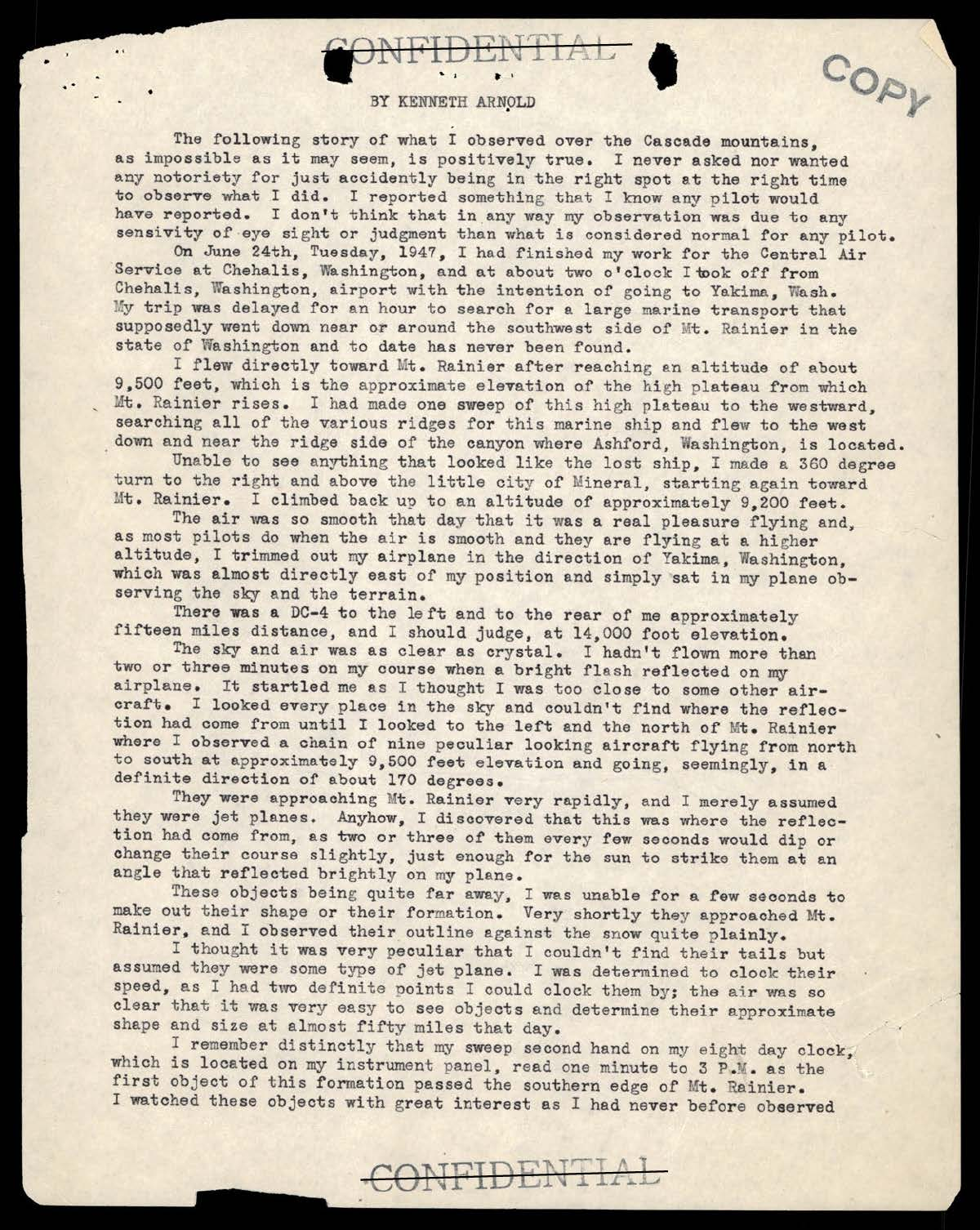
| 164 | The typed statement is headed by Kenneth Arnold and frames the account as "positively true." Arnold says he did not seek notoriety and that any pilot would have reported it. | This supports primary-witness attribution and a self-conscious attempt to separate observation from publicity. |
|---|
| 164 | Arnold dates the flight to Tuesday, June 24, 1947. He says he left Chehalis, Washington, at about 2:00 p.m. intending to go to Yakima, after being delayed to search near Mt. Rainier for a missing Marine transport. | This anchors the event to a route, date, mission context, and reason for being over the Cascade terrain. |
|---|
| 164 | He describes flying near Mt. Rainier, searching westward ridges, turning above Mineral, and climbing back to about 9,200 feet. A DC-4 was behind and left of him, roughly 15 miles away at an estimated 14,000 feet. | The page gives relative-position data and a comparison aircraft, which are more useful than the later saucer label alone. |
|---|
| 164 | After a reflected flash, Arnold says he saw a "chain of nine" peculiar aircraft north/left of Mt. Rainier, moving north to south at about 9,500 feet on an estimated 170-degree course. | The captured page supports a nine-object formation claim with altitude, direction, and first-acquisition trigger. |
|---|
| 165 | The next page says the objects flew close to mountain tops, held a generally definite direction while swerving around peaks, flashed in the sun, and appeared to have no visible tail. Arnold estimates his distance as about 20 to 25 miles. | Neighbor context strengthens the geometry: terrain masking, sun flashes, no-tail observation, and estimated range all belong to the same continuous statement. |
|---|
| 165 | Arnold compares apparent size with the DC-4 and estimates the formation length by using a five-mile ridge between Mt. Rainier and Mt. Adams. He times the formation crossing toward Mt. Adams at one minute and forty-two seconds. | The source gives the logic behind his speed/size inference, but it also shows that the inference depends on estimated distance, terrain alignment, and visual timing. |
|---|
| 166 | Arnold says the complete observation lasted about two and a half to three minutes. He reports that reflected sunlight made one or more units look round, but that in straight and level flight they appeared as a thin dark line. | This weakens a simple disk-only reading: the page distinguishes reflected appearance from observed profile. |
|---|
| 166 | He says the objects held nearly constant elevation, did not behave like rockets or artillery shells, and that he remained convinced they were some type of airplane, though unlike conventional aircraft known to him. | This supports an unresolved-aircraft interpretation, not a direct claim of non-human origin. |
|---|
| 167 | The closing page says Arnold had been asked to make "wild guesses" but grounded the article in positive facts. It gives pilot license 333487, a Callair airplane, national certificate 33355, and a Boise address signature. | This is useful provenance: the page ties the claim to an identified pilot, aircraft, license, and signed statement. |
|---|
| 167 | The sketch notes describe the objects as "longer than wide," about one-twentieth as thick as wide, mirror-bright, and not appearing to whirl or spin while traveling in fixed position. | This page is the strongest local morphology evidence because it combines text, sketch, surface quality, thickness ratio, and motion note. |
|---|