Source-first guide to Arnold's June 24, 1947 statement: route, Mt. Rainier search context, DC-4 comparison, nine-object chain, thin mirror-bright morphology, and why the file becomes a modern UFO origin case.
UAPs.world keeps this analysis report connected to its original source path, release context, and related analysis path so readers can inspect the evidence trail directly.
Analysis report summary
This analysis page exposes the report substance directly for readers and crawlers, while the research viewer remains the place for source inspection, frame review, and follow-up work.
Source Basis
Primary source: 65 HS1 834228961 62 HQ 83894 Section 2, especially page 164, page 165, page 166, and page 167. C81 - Kenneth Arnold Statement Page 164 Detail Extraction is the detail-extraction companion; this guide is the public-facing route map.
Event Spine
Event Spine
Step
Source detail
Why it matters
Witness platform
Arnold presents himself as a pilot and later gives pilot license 333487, a Callair airplane, and aircraft certificate 33355 on page 167.
The report is tied to a named, flight-qualified observer rather than an anonymous story.
Flight route
Page 164 places him after a Chehalis departure, intending Yakima, with a search detour near Mt. Rainier.
Route and mission context make the account testable against geography.
Air state
Page 164 describes clear air, smooth flying, and a DC-4 behind and left as a comparison aircraft.
Weather, altitude, and a reference aircraft are stronger than folklore labels.
Initial acquisition
Arnold reports a bright reflected flash before seeing nine peculiar objects north/left of Mt. Rainier on page 164.
The sighting begins as a visual-reflection problem, not as a preloaded belief claim.
Formation behavior
Page 165 describes chain-like movement, no visible tails, sun flashes, terrain-relative motion, and timing toward Mt. Adams.
The event belongs in the formation-and-performance lane, not just the shape lane.
Shape correction
Page 166 says reflection could make the units look round, while straight-and-level flight looked like a thin dark line.
This is the caution against reducing the event to "round saucers."
Sketch morphology
Page 167 adds longer-than-wide, very thin, mirror-bright, fixed-position movement notes.
The strongest local shape evidence is elongated/thin/mirror-bright, not a simple disk.
Speculation boundary
On page 167, Arnold says he had been asked for wild guesses but kept the account grounded in observed facts.
The witness himself creates a method boundary: observation first, identity later.
Method Stack
This case is a good training object for the viewer's analysis method because every tempting shortcut has a matching source control.
Method Stack
Method
Applied to Arnold
Connected analysis lane
Provenance check
Named witness, signature block, pilot license, aircraft certificate, and FBI file context.
Medium; relies on visual tracking and terrain estimates.
Timing
Formation crossing estimate of one minute and forty-two seconds, full observation about two and a half to three minutes.
Medium; useful but not instrumented telemetry.
Morphology
No visible tails, flashes in sun, thin-line profile in straight-and-level flight, longer-than-wide sketch, mirror-bright surface.
Strong for reported appearance; not a photograph.
Interpretation boundary
Arnold discusses airplanes, rockets, government tests, foreign government possibilities, and mystery, while resisting wild guessing.
Strong for witness caution and weak for origin certainty.
The Five Lanes
The Five Lanes
Lane
Source-first reading
What would upgrade it
Conventional aircraft
Arnold initially tries to interpret the objects as some type of airplane.
Matching aircraft test data, known formation route, or independent military operation records.
Reflection or mirage
The first cue is a bright reflection, and Arnold discusses visibility conditions.
A demonstrable optical/reflection geometry that recreates count, movement, timing, and no-tail appearance.
Misestimated speed/size
The speed/size inference depends on distance, terrain alignment, and timing.
Independent range, calibrated map geometry, or another observer with a matching track.
Unknown advanced craft
Nine no-tail, mirror-bright, high-speed objects near mountain ridges keep the unusual lane open.
Corroborating reports, radar, photos, technical recovery records, or documents tying the case to structured collection.
Cultural ignition
The witness statement entered an official file while press language helped create the public saucer era.
More file pages showing how agencies routed, compared, or managed Arnold-adjacent reports.
Why The "Saucer" Label Is Too Small
The statement does not give one clean object picture. It gives a changing visual problem:
Why The "Saucer" Label Is Too Small
Visual mode
Page support
Interpretation boundary
Flash
Page 164 begins with reflected light on Arnold's airplane.
The flash gets attention; it is not the whole object description.
Chain
Page 164 and page 165 describe a diagonal or chain-like formation.
The formation claim matters as much as any single-object shape.
Thin line
Page 166 says straight-and-level flight looked like a black thin line.
This weakens disk-only summaries.
Round under reflection
Page 166 says reflected sunlight made one, two, or three units look round.
Roundness may be a lighting state, not the whole morphology.
Sketch profile
Page 167 shows a longer-than-wide, very thin, mirror-bright form.
The sketch is witness reconstruction, not camera evidence.
Theoretical Scene Panels
Theoretical Scene Panels
Panel
Guide read
Boundary
Page 164 source frame
A named pilot starts a first-person account with date, route, altitude, missing-aircraft search context, DC-4 comparison, and first flash.
Evidence is the typed source page.
Cascade geometry
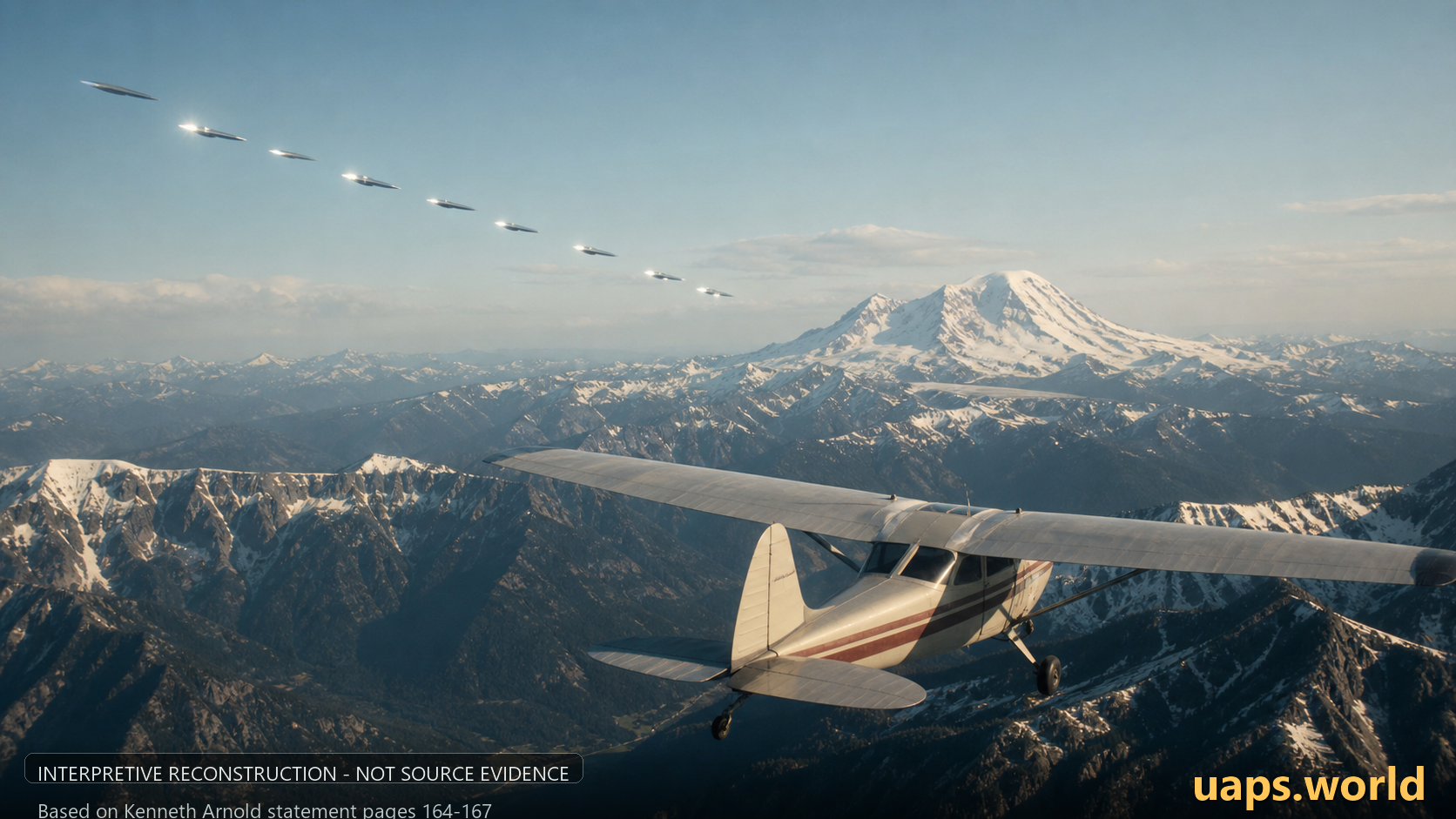
The realistic reconstruction visualizes the flight narrative: a small civilian aircraft near the Cascade mountains, Mt. Rainier, and a diagonal chain of thin reflective objects.
The image is interpretive, not a scale map or source photograph.
Formation system
The chain line suggests a coordinated formation or a set of linked visual contacts.
Coordination is a witness inference unless independently confirmed.
Morphology correction
Thin-line, mirror-bright, longer-than-wide notes challenge the familiar saucer shorthand.
The sketch clarifies witness impression but does not measure the object.
Historical ignition
The file becomes a case-study in how observation, official routing, press language, and public mythology can diverge.
Cultural importance does not prove object origin.
Working Assessment
Kenneth Arnold's statement is strongest when treated as a disciplined witness packet rather than a saucer myth. The guide reading is: page 164 starts the modern UFO problem as a structured observation puzzle, pages 165-167 prevent the reader from flattening it, and the later analysis corpus gives us the tools to hold geometry, morphology, formation behavior, and cultural ignition in separate hands. The Disclosure-Forward Neutrality Gate passes. The ordinary lane remains live because the observation is visual and range/speed are estimated. The unusual lane remains live because the reported formation, no-tail appearance, reflective behavior, speed impression, and thin mirror-bright morphology are not resolved...
Companion routing for Los Alamos green fireballs, Project Sign, Air Intelligence flying-object studies, Blue Book review, CIA unconventional-aircraft analysis, and Project Y context.
Classify this source for 2 points, mark useful or misleading records for 1 point, or submit observations for curator review. Public contribution points progress through Observer, Analyst I, Analyst II, Case Builder, and Archivist and can unlock field desk themes.