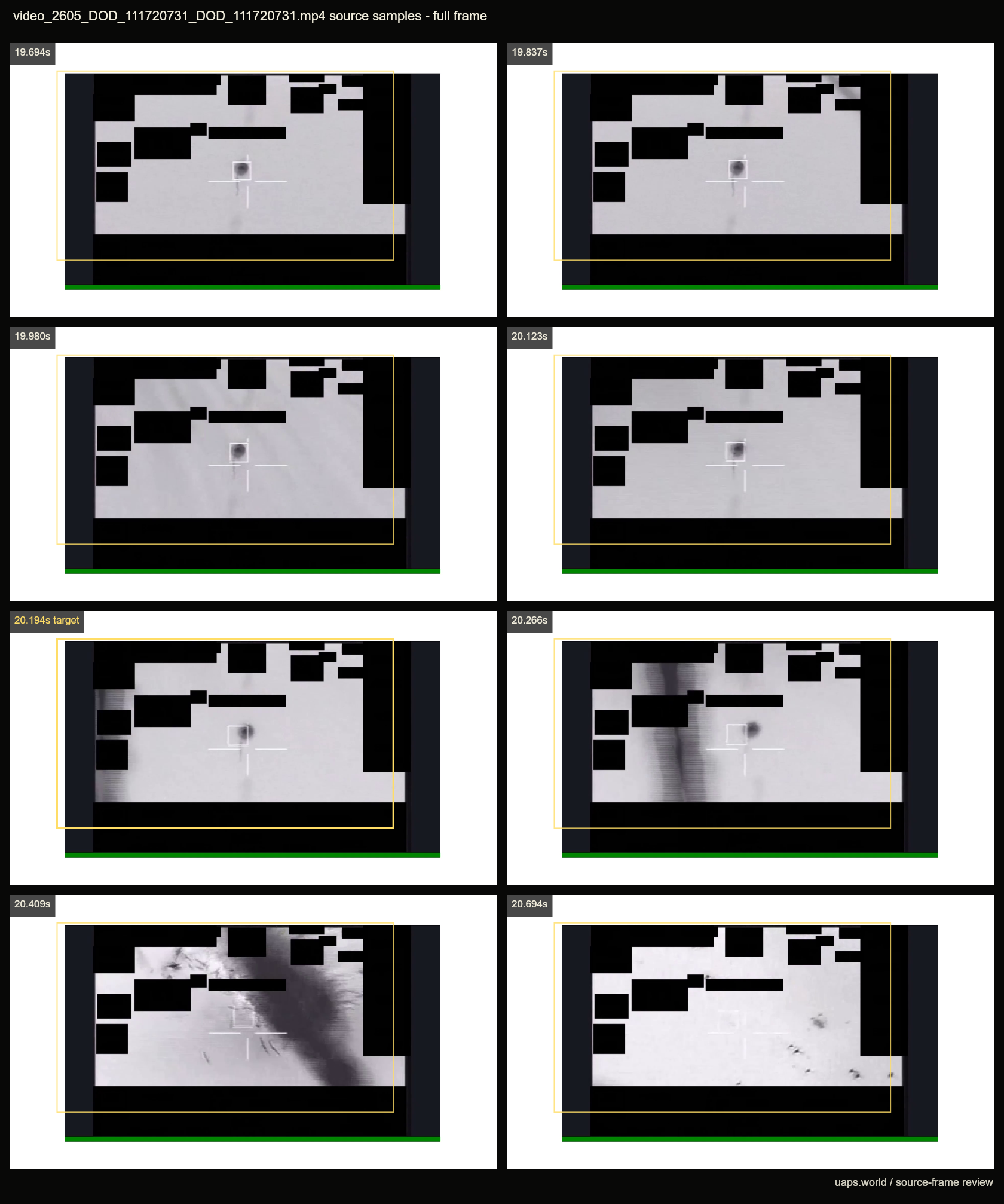
C79 DOD 111720731 Lake Huron Kinetic Interaction Check
This note resolves the approved capture lead for USAF ANG F-16C Lake Huron UAP engagement at 20.194s. The submitted requirement asked to "catalog the kinetic interaction" using the captured normal-preset viewer state, 1.45x zoom, pan -271,-160, contrast 1.15, brightness 1,...
UAPs.world keeps this analysis report connected to its original source path, release context, and related analysis path so readers can inspect the evidence trail directly.
Analysis report summary
This analysis page exposes the report substance directly for readers and crawlers, while the research viewer remains the place for source inspection, frame review, and follow-up work.
Hypothesis To Test
The lead asks whether the frame supports a kinetic-interaction interpretation. The source-backed version is narrow: the tracked contrast spot passes into a region where background contrast and tracker overlay make it difficult to keep the object separated. That can be cataloged as a contrast-loss or occlusion-like interaction in the image plane. The stronger claim, that the source shows a physical impact, breakup, weapon effect, anomalous acceleration, or object transformation, is not supported by this one-second pass. The frame sequence does not show a discrete flash, expanding debris, plume, thermal bloom, split body, or measurable sudden displacement independent of the changing background.
Working Assessment
The requested kinetic interaction is real as a viewer event: around 20.194s, the compact contrast target crosses into a region where background structure and the tracker overlay reduce separability. It should be cataloged as a contrast-loss/background-transition moment. Disclosure-forward neutrality gate: the report starts from the source pixels, keeps the Lake Huron engagement context open as operationally significant, and does not convert that context into visual proof of exotic behavior. Ordinary/object and sensor-background explanations remain stronger for this one-second window. The disclosure-forward lane would strengthen only if external timing data tied this visual transition to a weapon effect,...
Classify this source for 2 points, mark useful or misleading records for 1 point, or submit observations for curator review. Public contribution points progress through Observer, Analyst I, Analyst II, Case Builder, and Archivist and can unlock field desk themes.