Evidence trail: analysis report

C81 Skywatcher Nine UAP Classes Evidence and Archive Crosswalk

A field guide, methodology audit, and archive crosswalk for Skywatcher's preliminary UAP taxonomy.

Open this source in the research viewer Open source file
Rendered source preview Open in viewer
C81 Skywatcher Nine UAP Classes Evidence and Archive Crosswalk

Source details

Media type
analysis report
Archive path
Release_2/Analysis/C81-Skywatcher-Nine-UAP-Classes-Evidence-and-Archive-Crosswalk.md
Last updated
2026-08-14
Source file
Open source file

Source Summary

UAPs.world keeps this analysis report connected to its original source path, release context, and related analysis path so readers can inspect the evidence trail directly.

Analysis report summary

This analysis page exposes the report substance directly for readers and crawlers, while the research viewer remains the place for source inspection, frame review, and follow-up work.

How To Read The Nine Classes

These are not pure shape categories. Each class mixes several dimensions:

How To Read The Nine Classes
DimensionExamples inside the taxonomyWhy it matters
MorphologyTetrahedron, cylinder, orb, manta, tendrils, eggShape can be useful, but viewpoint, blur, focus, bloom, compression, and silhouette can change it.
KinematicsTumble, hover, oscillate, jump, descend, arrestMotion can separate classes only when camera/platform motion and tracking behavior are controlled.
SpectrumEO-visible, IR-only, strong heat, radar, RFA class defined partly by sensor channel requires calibrated, synchronized sensors and known detection thresholds.
GroupingSingleton, pair, group of 1–3, formation of 3–20+Group size may describe one event family rather than a stable object type.
InteractionLaser response, jamming response, electronic or physiological effectsCorrelation, timing, controls, and independent instrumentation are essential before inferring response or intent.
InterpretationCraft, light phenomenon, plume, active camouflage, awarenessInterpretation must remain downstream of observation and measurement.

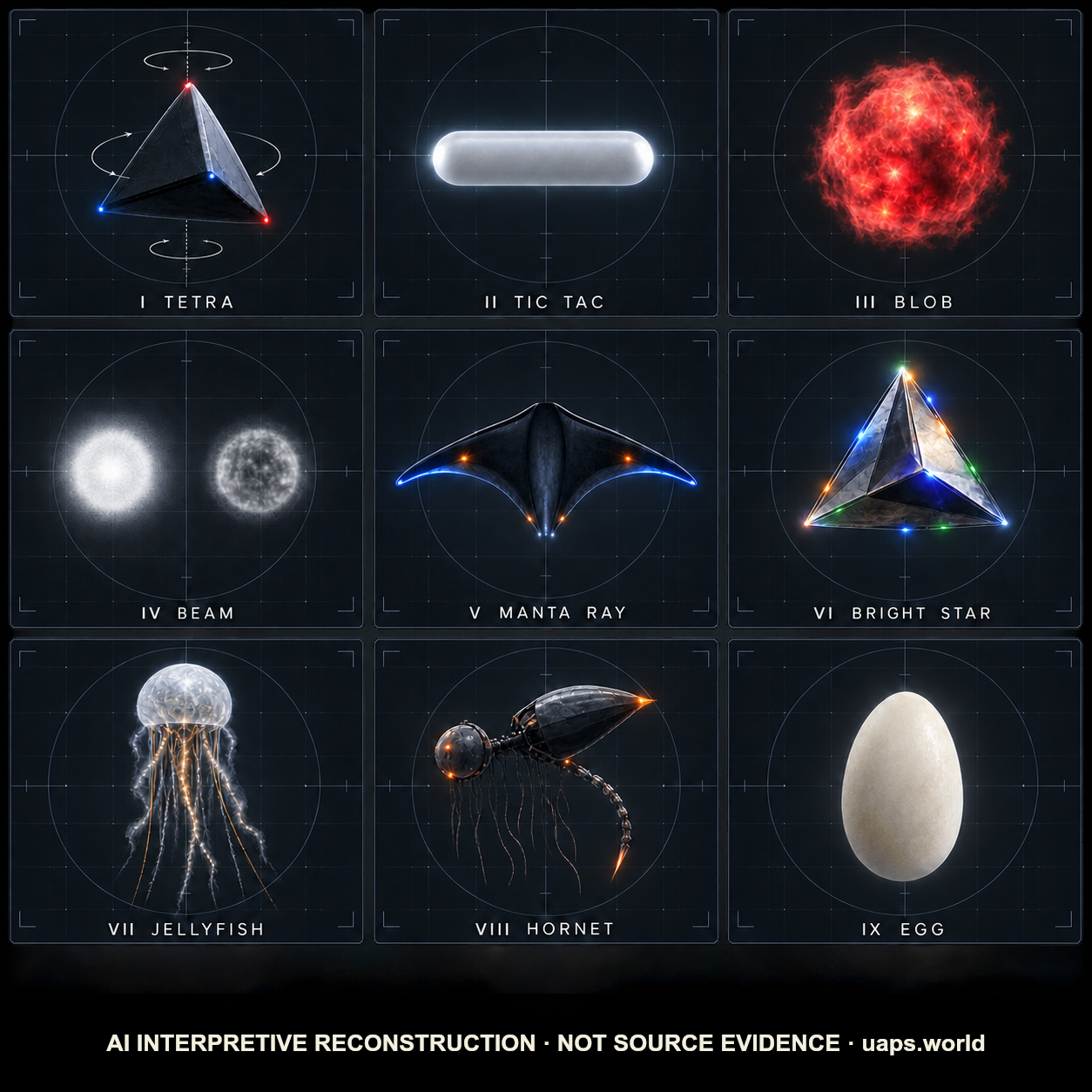
The result is best called a hybrid phenotype/signature taxonomy: a field shorthand for how an event reportedly looks and behaves across instruments. That can be more useful than shape alone, but it also creates circularity risk. If “Tic Tac” means a cylinder that hovers, elongates, descends, arrests, affects electronics, and appears near a Manta Ray, a new event can appear to confirm the class simply because only matching details were selected for comparison.

Source Basis

Skywatcher currently describes itself as an independent private initiative focused on aerial intelligence, advanced sensing, and unconventional aerospace research. Its About page presents a team drawn from special operations, aviation, intelligence, aerospace, and research backgrounds. Those backgrounds establish organizational context; they do not independently validate the taxonomy. The Skywatcher research index calls the system a living taxonomy and says its class hypotheses are exploratory rather than conclusive scientific fact. Skywatcher Part II introduced the nine labels publicly alongside the group's electromechanical-signaling and neuromeditative-interaction work. The April 2025 Skywatcher...

Source Basis
LevelFramework purposePublic status relevant to this guide
1 — Preliminary ObservationDocument and triage a report; remove obvious known objects and hoaxes.Compatible with a descriptive class label.
2 — Structured Data CollectionUse instruments, timestamps, geolocation, metadata, and known-object checks.Necessary before a class can carry more than descriptive weight.
3 — Analysis and Hypothesis TestingMeasure properties, test conventional explanations, and advance only if anomalous traits remain.The framework self-assessed electromechanical signaling at this level in April 2025.
4 — Independent Verification and Peer ReviewShare data and methods for external reanalysis and corroboration.No official closing report or inspectable independent-validation dataset was located on Skywatcher's official public pages during this review.
5 — Public Disclosure and ReviewPublish validated data and rigorous papers for broad scrutiny.Class descriptions are public; the underlying class packages reviewed here are not yet publicly inspectable.
6 — Full Discovery and IntegrationMove a conclusively supported phenomenon into accepted knowledge and policy.Not publicly established for any of the nine classes.

The framework assessed Electromechanical Signaling at Level 3 and Neuromeditative Interaction at Level 2, with a stated goal of reaching a decisive result by the end of 2025. As of the access date, no official public result located by this review closes that milestone. This is a source-bounded finding about the public record, not a claim about what Skywatcher may have completed privately.

Nine-Class Matrix

Nine-Class Matrix
ClassMorphology / claimed sizeMotionClaimed sensor channelsGrouping / interactionPublic maturityStrongest control
I — TetraDark tetrahedron; 1.5–2 mMulti-axis tumble on stable path; descent; alleged evasive jinkingEO strobe, strong IR, claimed radar/RF contextGroups of 3–20+; alleged laser-response behavior1Balloons or debris with apparent rotation; camera tracking loss; shape instability across frames
II — Tic TacBright cylinder; 9–12 m; apparent elongation/color changeHover, oscillation, rapid descent and arrestEO/IR; claimed electronics/aircraft effectsGroups of 1–3; Manta Ray proximity; reported physiological effects1Range/parallax, autofocus/bloom, aircraft or balloon, projected/plasma signature, track reassignment
III — BlobRed cloud-orb; 3–5 m; flare expansionLateral oscillation; point-to-point jumpsEO and strong IR claimSingleton; no direct interaction reported1Defocus, saturation, atmospheric scintillation, compression, camera motion, hot conventional target
IV — BeamIR-only orb; unknown sizeHours-long hover; slow motion; lateral vibrationIR present, EO absentPairs; claimed laser/jamming response1Celestial body, hot pixel, sensor registration, stabilization, distant stationary source
V — Manta RayDark manta silhouette; 2–3 m; colored emissionTumble, hover, altitude shiftsEO/IR and some radar claimsRare; Tic Tac proximity; claimed concealment1Bird, kite, aircraft aspect, balloon, perspective, compression, wind drift
VI — Bright StarReflective tetrahedral/angular form; 1.5–3 mRapid horizontal oscillationEO/IR; alleged radar artifact and directed-energy effectClaimed team sensor disruption1Star/planet, diffraction, autofocus, saturation, rolling shutter, atmospheric scintillation
VII — JellyfishPale head with tendrils; head ~2 m, extensions 3–5 mSerpentine path; “seeking” headEO/IR/radar claimsAlleged localized electromagnetic disruption1Balloon/payload train, debris, parallax, stabilization, enhancement or segmentation artifact
VIII — HornetDual-body form; tendrils and folding tail; 2–4 mIrregular asynchronous rotationIR and radar claims; brief optical visibilityAlleged diversion and descent toward team1Multipart balloon/payload, dangling debris, viewpoint change, segmentation, rolling shutter
IX — EggOff-white ovoid; unknown sizeUndocumentedOne low-quality EO recording; no IR/radar validationNo direct interaction; no confirmed repeat1, weakestBalloon, blur, bloom, distant aircraft, compression, featureless object under poor resolution

Methodology Audit

The Discovery Framework's staged logic is sensible: collect, analyze, verify independently, then disclose. The public taxonomy does not yet show that those gates have been cleared at class level.

Methodology Audit
Audit questionWhat is public nowWhat a validation package needs
How many events support each class?No per-class event count is published on the reviewed pages.Event ledger with unique IDs, dates, sites, sensors, duplicates, exclusions, and class votes.
How were events selected?“Most consistently observed patterns” is stated, but sampling and rejection rules are not shown.Inclusion/exclusion criteria defined before class fitting; rejected and conventional cases retained.
Are dimensions explicit?Shape, size, behavior, sensor and interaction prose are present.Machine-readable variables, units, required versus optional features, uncertainty, and missing-data rules.
Are class boundaries mutually exclusive?Several pages acknowledge overlap; Tic Tac/Manta proximity is part of the descriptions.Decision rules, hierarchical or multilabel policy, reviewer confusion matrix, and merge/split thresholds.
Can reviewers reproduce assignments?No public inter-rater result was located.Blinded independent classification, Cohen's kappa or equivalent, disagreement adjudication, and held-out events.
Are measurements calibrated?Sensor types are named, but event calibration and metadata are not public on the class pages.Sensor model, mode, time sync, field of view, point-spread function, radiometric/geometric calibration, platform state, weather and celestial context.
Is processing traceable?No class-level raw-to-published processing chain is public.Raw files, hashes or chain-of-custody record, processing steps, software settings, and unprocessed controls.
Are interaction claims causal?Laser, jamming, electronic, physiological, or directed-energy effects are reported in prose.Randomized/blinded stimulus trials, synchronized command and sensor-health logs, baseline/control periods, effect-size and false-positive analysis.
Has the taxonomy replicated independently?No public independent replication package was located.External team, independent equipment/site, preregistered criteria, comparable hit/false-alarm rates, and open event-level results.

### The circularity problem Classes should be discovered on one dataset and tested on another. If the same observations generate the labels, tune the boundaries, and demonstrate the categories, the result can overfit a small or selected sample. A future release should separate: 1. A development set used to propose dimensions and class boundaries. 2. A locked rule set specifying required, optional, and exclusionary features. 3. A blind validation set assigned by reviewers who do not know the desired result. 4. An external replication set gathered by an independent team. ### A cleaner data model The most durable part of Skywatcher's work may be the dimensions rather than the names. Record each event as a...

Archive Crosswalk

The local archive is not a Skywatcher training set. These links give a case officer nearby shapes, behaviors, and controls to inspect.

Archive Crosswalk
Skywatcher questionExact local sourceAnalysis routeShared dimensionMissing or contrary dimensionsBoundary
Can an elongated IR silhouette stay stable across adjacent frames?USCG C-144 Tyndall UAP 1 TIC TAC IR hotC12 — Shape, Size, and Plane-Backdrop AssessmentsElongated/ovoid appearance; IR visibilityNo Skywatcher size, color shift, descent/arrest, grouping, or electronic effectTic Tac comparison, not classification
Does a pulse/flare represent physical expansion or sensor bloom?Spherical UAP pulsing over waterC08 — Formation, Cloud, and Atmospheric Interaction and C07 — Field, Propulsion, and Morphology ModelPulsing bright contact and flare/burst questionDigitally altered upload; no red-cloud boundary, range, or confirmed positional jumpBlob comparison, not classification
Can group behavior be separated from shape identity?UFOs in formation over Persian Gulf?C11 — Fleet, Cluster, and Multiple-Contact BehaviorMultiple contacts / formation questionNo Tetra geometry, tumble, size, or stimulus responseGroup-behavior comparison only
How fragile is an egg/teardrop reading?DOD 111719799 videoC12 — Shape, Size, and Plane-Backdrop AssessmentsOvoid/teardrop appearanceBloom, smear, compression, range and motion unresolvedEgg comparison, not classification
Can witness silhouette language carry a Manta Ray comparison?Western US EventC12 — Shape, Size, and Plane-Backdrop AssessmentsLarge translucent-kite descriptionNo direct technical data; no size, tumble, colored emission, Tic Tac proximity or radar/IR packageManta Ray comparison, not classification
What ordinary controls fit irregular silhouettes and tendrils?Mission Report, Arabian Gulf, 2020 and DOD 111720731C14 — Conventional, Misleading, and Balloon FlagsBalloon-like appearance, wind travel, soft edge, payload/tether controlsNo articulated body, serpentine powered motion, or corroborated EM/radar packageJellyfish/Hornet controls, not positive matches
How should extreme motion claims be bounded?Syrian UAP instant accelerationC09 — Instant Acceleration, Displacement, and VanishingsImage-plane displacement and disappearance testingNot evidence of any Skywatcher shape class; range and track state control physical claimsKinematic method comparison only

The sparse result is intentional. Beam, Bright Star, Jellyfish, and Hornet have no adequate local positive parallel for their full observable packages. Tetra has only an incomplete grouping question. Filling every class with a look-alike would convert this guide into the classification lane it was designed to avoid.

Working Assessment

Skywatcher's taxonomy is strongest as a research interface. It reminds analysts that UAP reports have multiple dimensions and that the right question is not only “what shape was it?” but “what did calibrated sensors record, how did it move, what else was present, what controls were run, and can another team reproduce the assignment?” Its present weakness is not that the names are imaginative. Scientific taxonomies often begin with useful descriptive names. The weakness is the gap between public specificity of claim and public inspectability of evidence. A 9–12-meter size, a Mach-plus descent, a radar artifact, or a directed-energy effect needs a measurement chain proportionate to the claim. The correct...

Cited public sources

Analysis of this record

These UAPs.world reports cite this record. Read their findings and evidence limits, or inspect the cited material in the research viewer.

Public Field Desk

Classify this source for 2 points, mark useful or misleading records for 1 point, or submit observations for curator review. Public contribution points progress through Observer, Analyst I, Analyst II, Case Builder, and Archivist and can unlock field desk themes.

Open this source in the research viewer Browse related analysis report items Open analysis desk