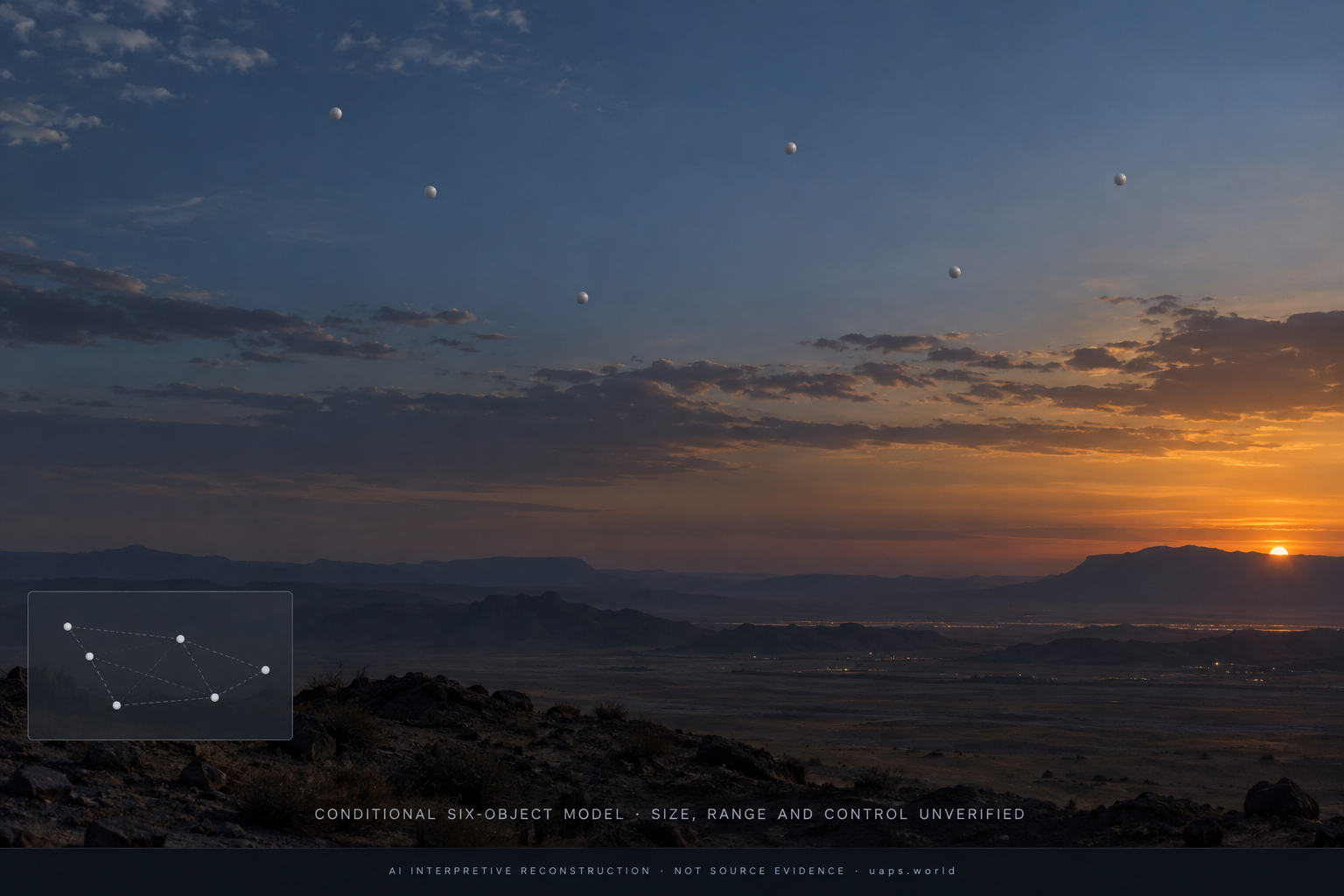
C125 Middle East Six Object Group Disclosure Companion
The most useful disclosure-forward encounter question in this Release 6 review is whether PR135 records a controlled group maneuver, and what the paired report adds to that question. This is a selection for deeper investigation, not a ranking of probability of non-human...
The most useful disclosure-forward encounter question in this Release 6 review is whether PR135 records a controlled group maneuver, and what the paired report adds to that question. This is a selection for deeper investigation, not a ranking of probability of non-human origin. The release's strongest evidence of an actual funded research program remains the AAWSAP contracting record; that is a different kind of disclosure. The case combines a released infrared recording with an explicitly paired mission report. The report describes six small spherical objects, apparent agility and rapid simultaneous direction changes. A second raw-image pass finds six separable bright components in several selected states, while other states merge them into fewer connected patches. That improves the visual basis for multiplicity beyond the initial short-window review. It does not independently establish spherical hulls, the reported speed or intelligent control. Under a disclosure-forward model, the important possibility is several independently mobile objects responding as a coordinated system. That could make the case more informative than a solitary unresolved light. The evidentiary challenge is to establish real individual trajectories and correlated maneuvers, then distinguish ordinary group behavior, human technology and non-human technology. The supplied public subset does not complete that chain.
UAPs.world keeps this analysis report connected to its original source path, release context, and related analysis path so readers can inspect the evidence trail directly.
Analysis report summary
This analysis page exposes the report substance directly for readers and crawlers, while the research viewer remains the place for source inspection, frame review, and follow-up work.
Source Basis
PR135 — released infrared video is paired to D108 by the official Release 6 catalog. Their association is documentary, not a guess from a shared location label. - D108 — PDF page 1 supplies the July 29, 2025 mission narrative. D108 — PDF page 6 records initial contact at 20:22:32 UTC and apparent agility; D108 — PDF page 7 supplies the six-object description, estimated performance and explicit unknown/negative fields. - C121 Middle East PR133 and PR135 Raw Sequence Tests preserves the first raw-window pass. This companion adds a thirteen-state whole-clip survey and six states at half-second spacing in a later window. It does not claim continuous review of every encoded frame. - D110 — PDF page 1 and D151 —...
Observation
### Whole-Clip Context The source file is about one minute long. The thirteen reviewed states are 1.000s, 6.000s, 11.000s, 16.000s, 21.000s, 26.000s, 31.000s, 36.000s, 41.000s, 46.000s, 51.000s, 56.000s and 59.000s. Raw source inspection aid. Early states retain a tall ground structure; the view subsequently follows a bright group. Later states change framing/magnification and do not provide a comparably clear group view in this sampling. This is not proof that the targets vanished, accelerated away or crossed a medium. The official catalog likewise describes a late magnification change; its “no content” wording is not a claim that the frames contain no scene imagery. The reticle, direction marker,...
Working Assessment
Confirmed: the catalog pairs a specific report and video; the report contains both a consequential maneuver claim and explicit limitations; the sampled raw sequence contains persistent multiple returns, with six separable bright cores in selected later states. Narrowed: an exact six-object count is state- and segmentation-dependent, spherical morphology remains a reported description, and changing image spacing is not a complete physical trajectory. The late display change does not establish disappearance. Open: whether the group executed a coordinated physical turn; whether the estimated performance is correct; what the objects were; and whether any advanced or non-human mechanism is required. Confidence...
A cross-release disclosure guide connecting information control, unresolved encounters, historical assessment disputes, AAWSAP research and the evidence still needed.
This family connects human interfaces, health claims, cognition, computing and the search for intelligence. Those are different evidence types. A medical narrative, a statistical civilization model and a cockpit scenario cannot collectively establish an...
The operational packets are stronger than uncontextualized clips because the catalog supplies exact document/media pairings. Their quantitative claims still depend on unavailable geometry and explicitly estimated fields. The written estimate and the public...
All 16 MP4 files received a six-state raw survey. Fifteen contain visual encounter or historical film material; one carries Ruppelt's audio presentation. The survey supports a release-wide allocation of attention, not a claim that every frame or audio...
PR133 contains a compact bright return that persists through five sampled states while its screen position changes. PR135 contains a persistent cluster of several bright returns. These findings support the existence of visible source features; they do not...
An official unresolved finding is a substantive disclosure of analytical uncertainty. It is not a demonstrated extraordinary capability. The most useful cases let a reader inspect both the consequential claim and the limits of the evidence behind it.
Classify this source for 2 points, mark useful or misleading records for 1 point, or submit observations for curator review. Public contribution points progress through Observer, Analyst I, Analyst II, Case Builder, and Archivist and can unlock field desk themes.