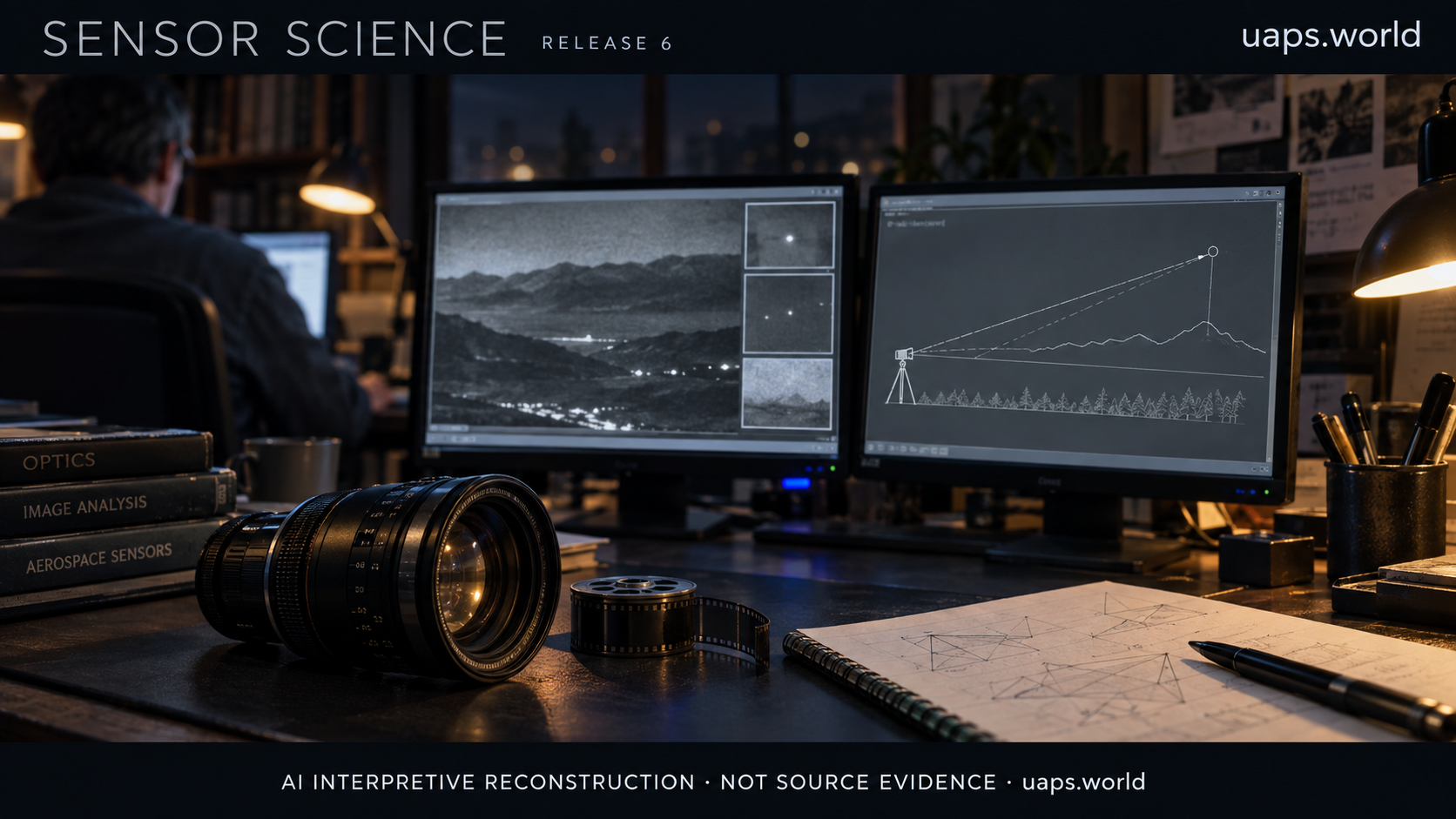
Release 6 becomes most scientifically useful when we connect what the instrument recorded, what the crew estimated, and what the released data let us calculate. The transcripts now make those distinctions much easier to find. Start with the operational fields, use the tracking paper to understand the missing measurements, then return to the imagery with a testable question.
UAPs.world keeps this analysis report connected to its original source path, release context, and related analysis path so readers can inspect the evidence trail directly.
Analysis report summary
This analysis page exposes the report substance directly for readers and crawlers, while the research viewer remains the place for source inspection, frame review, and follow-up work.
Source Basis
This is a focused guide to the operational reports D106/D108/D109, the D148 tracking paper, D102's camera record and the Release 5 D101 comparison, each linked at the relevant passage below. The transcripts are comprehension aids; their review flags remain. Important fields were checked against the original PDFs. Existing video findings are cited as prior work, not presented as a new frame review.
Working Assessment
The companion C127 - Advanced Aerospace Science and Corpus Guide takes the next step: using those measurements to test materials, energy and propulsion hypotheses. The enrichment improves access to real sensor context, especially the Iraq range field and the difference between aircraft and target estimates. It does not recover native telemetry. The disclosure-forward neutrality gate is satisfied by specifying both ordinary explanations and observations that could strengthen or weaken an unusual interpretation. Read C119 → D148 → C125 → C113, using the source links above, then continue to C116 - Materials Signatures and Sensor Engineering for spectral and material-response tests. The NASA study's calibration...
An official unresolved finding is a substantive disclosure of analytical uncertainty. It is not a demonstrated extraordinary capability. The most useful cases let a reader inspect both the consequential claim and the limits of the evidence behind it.
Classify this source for 2 points, mark useful or misleading records for 1 point, or submit observations for curator review. Public contribution points progress through Observer, Analyst I, Analyst II, Case Builder, and Archivist and can unlock field desk themes.