Evidence trail: analysis report

C50 Release 2 Companion Map and Disclosure Bridge

A guide to Release 2 UAP source material, including DOD videos, sensitive-site records, ODNI narrative material, formation behavior, water interaction, and conventional controls.

Open this source in the research viewer Open source file
Rendered source preview Open in viewer
C50 Release 2 Companion Map and Disclosure Bridge

Source details

Media type
analysis report
Archive path
Release_2/Analysis/C50-Release-2-Companion-Map-and-Disclosure-Bridge.md
Last updated
2026-11-22
Source file
Open source file

Source Summary

UAPs.world keeps this analysis report connected to its original source path, release context, and related analysis path so readers can inspect the evidence trail directly.

Analysis report summary

This analysis page exposes the report substance directly for readers and crawlers, while the research viewer remains the place for source inspection, frame review, and follow-up work.

Source Basis

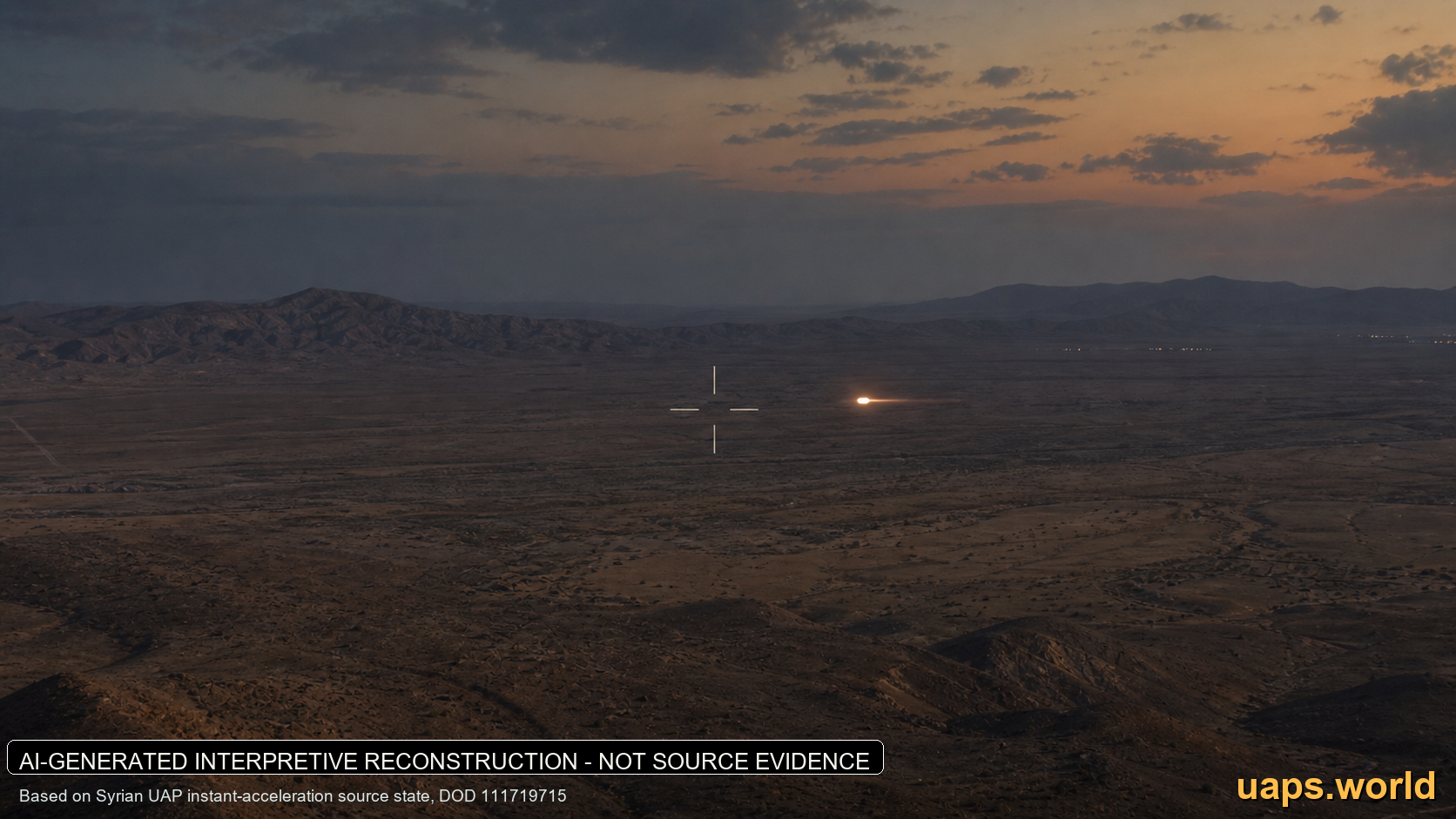
Release 2 is the archive's behavior library. It adds the ODNI USPER narrative, DOE/PANTEX and Sandia-sensitive-site material, a CIA foreign-intelligence report, and the densest set of DOD video clips in the local release stack. This guide cites ODNI USPER Narrative, Senior USIC Official, DOE PANTEX Image, DOE James Tuck Correspondence, DOE Pajarito Astronomers, DOW Sandia General Correspondence, CIA USSR Intelligence Information Report 1973, and the C00-C14 analysis layer led by C00 - Executive Disclosure Synthesis. The cover image is an AI-generated interpretive reconstruction of the Syrian instant-acceleration lane, chosen as the guide thumbnail because it keeps the Release 2 entry point tied to a...

Observation

Release 2 is where the viewer stops asking only "what documents exist?" and starts asking "what behaviors repeat?" The release has enough video, document, and analysis density to support source-family reading:

Observation
Release 2 laneWhat it gives the readerBest local starting pointsBoundary
Sensitive-site and USPER documentsNarrative, facility, scientific, and correspondence context around official concern.ODNI USPER Narrative, C04 - Documents Sensitive Sites and Recovered TechDocument salience does not solve object identity.
Video behavior familiesFormation, pulse, cloud, water, occlusion, disappearance, and multi-contact patterns.C08 - Formation Cloud and Atmospheric Interaction, C09 - Instant Acceleration Displacement and Vanishings, C10 - Occlusion Water and Medium Interaction, C11 - Fleet Cluster and Multiple Contact BehaviorBehaviors are grouped for analysis; each claim still needs frame-specific support.
Field and craft modelsHypothesis vocabulary for field envelopes, propulsion, inertia, negative-energy boundaries, morphology, and quantum-state analogies.C07 - Field Propulsion and Morphology Model, C17 - Flying Saucer Field Envelope Prototype Illustration, C20 - Frictionless Propulsion Field Coherence Theory, C23 - Inertia and Boundary Field Interaction Model, C52 - Quantum Tunneling Physics and Science GuideModels are analysis scaffolds, not proof chains.
Conventional controlsBalloon, glare, sensor, missile, distance, and misleading-UAP cautions.C14 - Conventional Misleading and Balloon Flags, C12 - Shape Size and Plane Backdrop Assessments, C47 - DOD 111688775 Syria Three-Frame Missile Field Object TestControls belong inside the guide path, not after the fun parts.

Guide Route

Use Release 2 as the bridge between Release 1's broad foundation and Release 3's policy/witness-chain layer. It is the release to open when a reader asks how a visual pattern turns into a working model.

Guide Route
Reader questionRelease 2 routeWhat to compare next
"What is the strongest behavior library?"Start with the DOD video clips and the C08-C11 behavior-family reports.Compare with Release 3 phone-video cases in C55 - Release 3 Public Topic Evidence Routing.
"Why do field-envelope models appear so often?"C07, C17, C20, C22, C23, C35, and C52 provide the vocabulary for field, inertia, morphology, quantum-state hypotheses, and tunneling guardrails.Compare with exact source-frame notes such as C46 - Syrian 188795 Half-Second Contact Sequence.
"Where do documents change the story?"ODNI, PANTEX, Sandia, Pajarito, and James Tuck files keep the visual behavior layer attached to sensitive-site and technical context.Compare with C59 - Roswell, New Mexico, and the Official Record Contradiction Guide.
"How do we avoid overclaiming?"Keep C14 and C12 in the reading path before accepting any morphology, speed, or distance conclusion.Compare with Release 1 missile/frame-registration notes in Release 1 Companion Map and Disclosure Bridge.

Theoretical Scene Panels

Theoretical Scene Panels
PanelSource frameInterpretive readBoundary
A - Sensitive-site stackODNI USPER Narrative, DOE PANTEX Image, DOW Sandia General CorrespondenceThe document lane gives Release 2 institutional gravity: science sites, correspondence, and modern narrative routing.Contextual gravity is not object identification.
B - Behavior atlasC08 - Formation Cloud and Atmospheric Interaction, C10 - Occlusion Water and Medium Interaction, C11 - Fleet Cluster and Multiple Contact BehaviorThe release lets a case officer compare repeated visual behaviors without forcing one answer too early.Similarity across clips is a prompt for testing, not a conclusion.
C - Field-model workbenchC07 - Field Propulsion and Morphology Model, C20 - Frictionless Propulsion Field Coherence Theory, C35 - Macroscopic Quantum States and Long-Duration Travel Hypothesis, C52 - Quantum Tunneling Physics and Science GuideThe speculative layer is useful because it names what to measure: envelope edge, field response, occlusion, acceleration, coherence, tunneling analogies, and control.A model becomes stronger only when it predicts or explains source-specific features better than controls.
D - Control laneC14 - Conventional Misleading and Balloon Flags, C12 - Shape Size and Plane Backdrop AssessmentsThe archive stays credible when explainable cases and caution flags sit in the same rack as disclosure-forward synthesis.Skepticism is a routing discipline, not a dismissal shortcut.

Working Assessment

Release 2 is the right home for behavior-first guide work. It has enough DOD video material to compare recurring visual families, enough document material to keep those families source-anchored, and enough local analysis to let speculative models become testable prompts. Its strongest use is not "look at this one clip." Its strongest use is "walk the pattern library, then return to exact frames."

Follow-Up Resolution - Release 2 Guide Pass

The guide-routing work is complete. This file remains the Release 2 behavior-library entry point, while C49 - All Releases Companion Map and Disclosure Bridge handles cross-release narrative and C00 - Executive Disclosure Synthesis handles the broad claim map.

Follow-Up Resolution - Release 2 Guide Pass
Release 2 guide update typeExact citation routeBoundary
Pulse/energy-contraction behaviorC40 - PR056 Pulsing Over Water Energy Contraction Lead and Spherical UAP pulsing over water (CALLSIGN)Treat energy language as a source-state hypothesis unless frame tracking and sensor controls support it.
Instant acceleration and reticle transitC46 - Syrian 188795 Half-Second Contact Sequence and Syrian UAP instant accelerationDo not claim measured acceleration without range, platform, and source-frame controls.
Early-sequence morphologyC45 - PR063 Early Sequence Shape Field AnalysisShape and field-envelope language remains provisional unless it survives filter and adjacent-frame comparison.
Twin/contact formationC33 - Columbus Twin Contact Formation AssessmentTreat formation as an image-plane observation before physical grouping.
Sensitive-site documentsC04 - Documents Sensitive Sites and Recovered Tech, C34 - Sandia General Correspondence Page MapDocument salience, page routing, and site context do not solve object identity.

Cited public sources

Analysis of this record

These UAPs.world reports cite this record. Read their findings and evidence limits, or inspect the cited material in the research viewer.

Public Field Desk

Classify this source for 2 points, mark useful or misleading records for 1 point, or submit observations for curator review. Public contribution points progress through Observer, Analyst I, Analyst II, Case Builder, and Archivist and can unlock field desk themes.
Open this source in the research viewer Browse related analysis report items Open analysis desk